
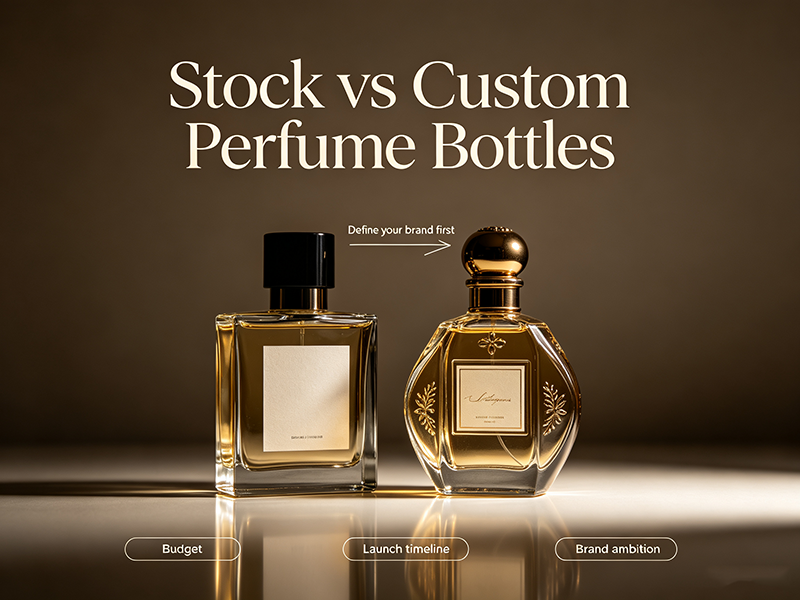
どちらを選ぶか 市販の香水瓶と特注の香水瓶 これは、新しいフレグランスブランドにとって、最も初期の段階で行われる、かつ最も重要なパッケージングに関する決定の一つです。この選択は、外観以上に多大な影響を及ぼします。具体的には、最小注文数量、金型への投資、発売時期、在庫に拘束される資金、部品の互換性、品質管理の複雑さ、輸送コスト、そして市場の反応を受けてブランドが方向転換できるかどうかにまで影響を及ぼします。.
この判断については、しばしば「既製のボトルは安価で迅速に調達できる一方、特注のボトルはより個性的である」というように、単純化しすぎて説明されることがよくあります。この要約は概ね正しいものの、実際の製品発売を導くには不十分です。既製のボトルであっても、装飾や調和のとれたキャップ、印象的なパッケージによって、高い認知度を獲得することは可能です。一方、特注のボトルは独自のシルエットを実現できるものの、その数量、コスト、あるいは納期がブランドが対応できる範囲を超えている場合、商業的に失敗に終わる可能性があります。.
新しいブランドには、クリエイティブなコンセプトとビジネスモデルの両方に合致した判断が求められます。本ガイドでは、実務上重要な基準に基づいて、既製のガラス製香水ボトルと特注のガラス製香水ボトルを比較しています。また、見過ごされがちな第3の選択肢についても解説しています。それは、既存のボトル金型を使用して製品を発売し、厳選した特注部品によって差別化を図り、需要が確認されてから初めて独自のガラス金型に移行するという方法です。.
なぜなら 新ブランド向けの香水瓶 アイデンティティと資本規律のバランスをとらなければならないため、この比較では、ボトルの外観だけでなく、パッケージングシステム全体およびそれが発売計画に与える影響についても評価する。.
まず、「ストック」と「カスタム」が実際に何を意味するのかを明確にしましょう
カスタマイズレベルが異なるにもかかわらず、同じ用語が使われると、パッケージングに関する話し合いが混乱を招くことになります。見積もりを比較する前に、ブランド側とサプライヤー側が同じ定義を用いていることを確認してください。.
既製金型は必ずしも在庫として用意されているとは限りません
A 市販の香水瓶 通常、これはガラス金型がすでに存在していることを意味します。このボトルであれば、ブランド側が新しいガラス金型の費用を負担したり、新しいボトルデザインがゼロから設計されるのを待ったりする必要はありません。.
ただし、金型が存在するからといって、必ずしも完成したボトルがすぐに発送できる状態にあるとは限りません。サプライヤーには、次のような状況が考えられます:
- 倉庫在庫の完成品ボトル
- 装飾のないボトルはありますが、それに合う部品はありません
- 実績のある金型で、新たな生産ロットが必要となっている
- 特定の容量またはネック仕様の製品は数量限定です
- 希望するキャップやポンプは在庫がないものの、ボトル本体は在庫がある場合
したがって、ブランドは次の2つの異なる問いを自問すべきです:
- 既存の金型はありますか?
- 必要なボトルや互換性のある部品は、現在実際に手に入る状態ですか?
この区別は、サンプルの入手可能性、生産計画、および提案された発売日の確実性に影響を及ぼします。.
ストックボトルでもカスタマイズが可能です
市販のガラス瓶を使用しても、決して画一的なパッケージに妥協することにはなりません。既存の瓶は、以下の方法でカスタマイズすることができます:
- スプレー塗装
- スクリーン印刷
- ホットスタンピング
- フロスティング
- UV印刷
- デカール
- メタライゼーション
- 厳選された、または特注仕上げのキャップ
- ポンプとカラーの組み合わせ
- 特注の折りたたみ式段ボール箱または硬質箱
このルートは、より正確に言えば ストックボトルのカスタマイズ. ガラスのシルエットは既存の金型に基づいていますが、ブランドイメージの表現は、色、装飾、付属品、および外装を通じて作り出されています。.
オーダーメイドの装飾は、オーダーメイドのガラス金型とは異なります
独自のカラーやロゴがプリントされたボトルは、視覚的にはそのブランド特有のものかもしれませんが、そのベースとなっているガラスの形状は、他の購入者も利用可能な場合があります。真の オーダーメイドの香水瓶 通常、独自のガラス設計と、そのプロジェクトのために新たに製作された金型が用いられます。.
カスタムガラスの開発では、以下の点を制御できる場合があります:
- ボトルのシルエット
- 高さ、幅、奥行き
- ショルダープロファイル
- ベースの厚さ
- ガラスの重量と分布
- 設置面積と安定性
- 容量と充填レベル
- ロゴのエンボス加工またはデボス加工
- 特殊な表面形状
- ネックの位置と適合する留め具のコンセプト
これにより差別化がさらに進む一方で、技術面や営業面での責任も増大することになります。.
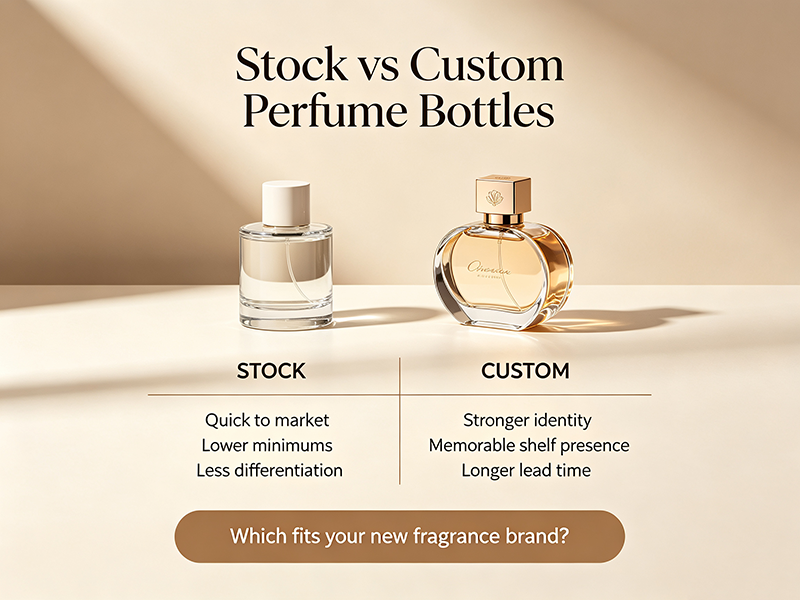
簡単な答え:ほとんどの新規ブランドは、強力なストックボトル戦略から始めるべきです
多くの新規フレグランス発売において、厳選された既製のボトルを採用することは、商業的により堅実な出発点となります。これにより、金型開発のリスクを軽減し、初期のガラス製品の最小発注数量(MOQ)を抑え、検証プロセスを簡素化できるほか、製品、ポジショニング、あるいは販売予測に変更が生じた場合でも、ブランドはより柔軟に対応できるようになります。.
とはいえ、すべての新ブランドが専用金型の使用を避けるべきだというわけではありません。ビジネスコンセプトにおいてボトルのシルエットが不可欠であり、見込まれる販売数量が現実的であり、十分な資金があり、かつ発売計画において開発期間の長期化に対応できるのであれば、独自のボトルを採用することは妥当であると言えます。.
「どちらの選択肢がより高級感があるか?」という問いよりも、むしろ重要なのは次の点です。
どのパッケージング手法であれば、数量、資金リスク、タイミング、技術的リスクを事業が許容できる範囲内に抑えつつ、ブランドを支えるのに十分な差別化を図ることができるでしょうか?
ブランドによっては、既製のガラスに独自の装飾を施すという方法があります。また、新しいガラス金型を採用するブランドもあります。多くのブランドにとって、この2つの間を段階的に進めていくことが最善の解決策となります。.
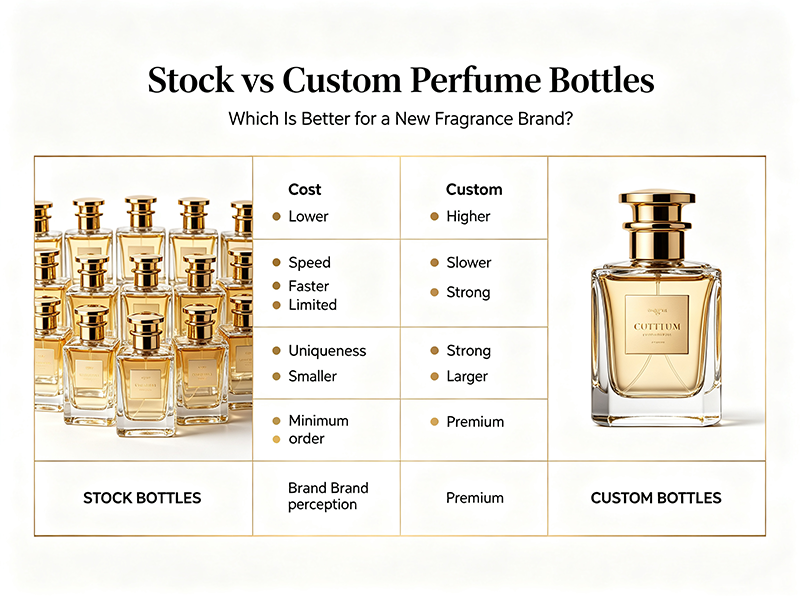
既製品とオーダーメイドの香水ボトルの比較一覧
| 決定要因 | ストック用香水ボトル | オーダーメイドの香水瓶 |
|---|---|---|
| ガラス型 | 既存の金型 | 新規プロジェクト専用の金型 |
| DAXINにおけるガラスの最小注文数量(MOQ)の目安 | 3,000個 | 10,000個 |
| 金型への投資 | 新しいガラス型は必要ありません | 新しい金型の導入および開発への投資が必要 |
| 開発の道筋 | たいていはもっと単純です | 図面、設計、金型試作、および検証が必要となります |
| ブランドの差別化 | 主に装飾、キャップ、箱を通じて制作された | 独自のガラスのシルエットと寸法が含まれています |
| リリース前の柔軟性 | より高い | 金型製作および試作開始後に価格を下げる |
| 技術的リスク | ボトルが確認されたら下げる | 製造および組立の検証が完了するまで、さらに高くなる |
| 在庫リスク | ガラス使用量の削減 | ガラス調達量の拡大と、プロジェクトごとの在庫の増加 |
| サンプルを採取する時間 | サンプルがあれば、多くの場合、処理が速くなります | 試作サンプルを作成する必要があるため、時間がかかる |
| 独占権 | ガラスの形状レベルに限定される | 金型および商業契約の条件に従い、より高度な制御が可能 |
| 最適なサイズ | テスト、初回立ち上げ、リスクの低い成長 | コンセプトの有効性が実証済み、販売数量の増加、特徴的な形状への強いニーズ |
この表はあくまで参考であり、最終的な答えではありません。キャップ、ポンプ、装飾品、箱などは、ガラス瓶とは最低注文数量(MOQ)が異なる場合があり、その結果、商業的な成果に影響を与える可能性があります。.
1. パッケージ全体における最小注文数量を比較する
MOQは、ブランドが販売実績を確立する前に購入しなければならない包装資材の量を決定するものであるため、最初の実用的なフィルターとなります。.
DAXINにおけるプロジェクト計画の最低注文数量(MOQ)の目安は以下の通りです:
| コンポーネントまたはプロセス | 最小注文数量(MOQ)の参考情報 |
|---|---|
| 一般的なガラス瓶 | 3,000個 |
| 特注のガラス瓶 | 10,000個 |
| キャップ | 10,000個 |
| ポンプ | 10,000個 |
| 紙箱 | 3,000個 |
| 散布 | 1色あたり3,000個 |
| シルクスクリーン印刷 | 1,000個 |
| 電気めっき | 10,000個 |
これらは計画上の参考情報です。選択した部品、色、素材、加工方法、およびアートワークについては、最終的な最小発注数量(MOQ)を確認する必要があります。.
ボトルの最小発注数量(MOQ)は、プロジェクトの最小発注数量(MOQ)とは異なります
新ブランドの場合、ストックボトルの最小注文数量(MOQ)を3,000本と想定し、パッケージ一式を3,000セット生産できると考えてしまうことがあります。しかし、選定したポンプとキャップがそれぞれ10,000個必要となる場合、その想定は誤りとなる可能性があります。.
その場合、ブランドは以下の4つの選択肢に直面することになる:
- 少ない初回発注数量に対応可能なコンポーネントを選択してください
- 今後の生産に備えて、予備のキャップとポンプを購入する
- 予測とキャッシュフローが許す限り、最初の注文量を増やす
- 互換性の高いMOQ体系に合わせてパッケージを再設計する
だからこそ、あらゆる調達プロジェクトにはMOQマトリックスが必要なのです。ボトル、ポンプ、カラー、キャップ、各装飾工程、箱、インサートをリストアップします。各行の最低注文数量を記録し、最初の充填工程後にどの部品が残るかを特定します。評価を行う際には、 香水ボトルの最小発注数量(MOQ), 、その数字が実際にプロジェクトのどの部分を指しているのか、またそれによってどのような追加の在庫確保の義務が生じるのかを、常に明確にしておくこと。.
複数の香りを組み合わせると、実際の最低値が倍増する可能性がある
あるブランドが、スプレーボトルの色が3種類ある3つのフレグランスを発売する場合、スプレーの最小注文数量(MOQ)は、注文の合計ではなく、各色ごとに適用される場合があります。また、アートワークが異なる場合、印刷の設定もそれぞれ別になることがあります。.
コレクション全体をまとめたスプレッドシート上では効率的に見えるものでも、数量をサイズ、香り、色、構成バージョンごとに細分化すると、在庫が膨れ上がってしまうことがあります。新規ブランドは、コレクション単位だけでなく、SKU単位やプロセス単位でもMOQを算出する必要があります。.
2. 単価だけでなく、初期の現金負担額を比較する
既製のガラスは、新しいガラス金型が不要であるため、通常、開発投資が少なくて済みます。一方、特注ガラスでは、金型製作、試作、修正に加え、より大きな最低発注数量が求められます。.
しかし、単価だけでは実際の財務リスクを正確に把握することはできません。.
在庫ボトルによるキャッシュ・エクスポージャー
ストックルートでは、次のような用途に現金が必要になる場合があります:
- ガラス瓶(在庫品)
- ポンプとカラー
- キャップ
- 装飾の配置とユニット
- 箱とインサート
- サンプル
- 梱包と輸送
ガラスの使用量は少なくても、特注のキャップや電気めっき部品については、依然としてより多くの購入数量が必要となる場合があります。ブランド側は、ボトル単価に予定充填量を乗じるのではなく、余剰部品も含めた総資金需要を算出する必要があります。.
カスタムボトルによるキャッシュエクスポージャー
カスタム成形ルートには、以下が追加される場合があります:
- 設計工学
- ガラス金型のコスト
- 試作金型またはサンプル金型の要件
- 金型の変更
- 試作ボトルの製造
- 大型ガラスの最小注文数量(MOQ)
- カスタム梱包の開発
- 梱包までの期間が長ければ、売上につながる可能性がある
また、このブランドは沈没コストのリスクも負っています。金型が開発された後に、消費者テストの結果、小売業者からのフィードバック、配合の方向性、あるいはポジショニングに変更が生じた場合、投資額の一部が回収できなくなる可能性があります。.
販売可能単位あたりの現金を算出する
最も参考になる比較は、単に「既製品はX、特注品はY」というものではありません。次のように計算してみてください:
包装に必要な現金総額 ÷ 初回生産で実際に充填・販売可能な単位数
あるブランドがキャップを10,000個購入したものの、実際に充填したボトルが3,000本にとどまった場合、未使用のキャップは在庫として資産に残りますが、それでも現金を消費することになります。意思決定にあたっては、保管、破損、設計変更、および陳腐化のリスクも考慮に入れる必要があります。.
3. Compare Total Development Time, Not Only Production Time
A supplier may quote a normal mass-production period of 30–35 days after order confirmation and approval of details, with high-season production around 40 days. That production period is only one part of the launch schedule.
Typical Stock-Bottle Development Stages
A stock-bottle project may still require:
- Bottle and component selection
- Plain sample review
- Pump and cap compatibility testing
- Color sampling
- Artwork preparation
- Decorated sample approval
- Box structure development
- Complete assembly approval
- 量産
- Inspection and shipping
An existing bottle mold removes one major development stage, but it does not eliminate the need to approve the full package.
Additional Custom-Mold Stages
A custom bottle can add:
- Concept feasibility review
- Technical bottle drawings
- Capacity and glass-distribution engineering
- Mold design and manufacture
- 試作ボトルの製造
- Dimensional inspection
- Stability and neck evaluation
- Mold correction where required
- Decoration trials on the approved glass
- Custom packing validation
Each approval can generate a new revision loop. The brand should not schedule a custom bottle as if it were simply a stock bottle with a longer factory production period.
Consider the Cost of a Late Launch
Custom glass may be worth the additional time when it creates a durable brand asset. But if a missed retailer window, seasonal launch, or funding milestone carries significant commercial cost, schedule risk may outweigh the value of the proprietary shape.
The brand should decide which date is fixed and which specification can move. If both the design and the launch date are treated as non-negotiable, risk will often reappear as air freight, rushed approvals, or compromised quality.
4. Compare Brand Differentiation Honestly
The strongest argument for a custom bottle is differentiation. A proprietary silhouette can improve recognition in product photography, on a retail shelf, and in the customer’s hand. It may become a long-term brand asset that carries across multiple fragrances.
However, new brands often overestimate how much differentiation comes from glass shape alone.
A Stock Bottle Can Still Build a Recognizable Identity
Consumers experience the complete system. A stock bottle can become distinctive through:
- A proprietary color palette
- A disciplined print layout
- A recognizable cap proportion
- A consistent collar finish
- A signature label or plaque
- A strong box-opening sequence
- Repeated visual codes across a fragrance collection
If the brand has not yet established its name, typography, color, or product architecture, a custom glass silhouette cannot solve the underlying identity problem.
A Custom Bottle Should Have a Strategic Reason
A new mold is more justified when the bottle shape performs a specific brand job, such as:
- Expressing a recognizable symbol or architectural idea
- Creating a distinctive grip or ritual
- Supporting a refill or special closure system
- Establishing a family shape for future fragrances
- Delivering proportions unavailable in the stock market
- Integrating logo relief into the glass
“We want something unique” is a starting desire, not a complete design brief. The brand should be able to explain what customers should recognize and why that recognition matters commercially.
5. Compare Design Flexibility and the Cost of Changing Direction
New brands learn during development. Retailers may prefer another capacity. Testing may show that the cap feels too heavy. The filling partner may require a different neck specification. The price structure may need to change.
Stock Bottles Preserve More Optionality
With an existing mold, the brand can often change color, artwork, cap selection, or box structure without abandoning the underlying bottle. This flexibility is valuable before demand and positioning are fully proven.
The bottle may also support future fragrances through new decoration. Sharing the same glass across several SKUs can simplify purchasing, filling, quality control, and inventory.
Custom Molds Increase Commitment
Once a custom mold is made and trials begin, changing height, width, base geometry, neck position, or major relief details may require mold modification or new tooling. Changes can affect the cap, box, insert, carton count, and filling setup.
This does not make custom development a bad choice. It means the brand should enter it with a more stable concept and a formal change-control process.
6. Compare Technical and Manufacturing Risk
An existing bottle that has already been produced offers useful manufacturing knowledge. The supplier may have established expectations for glass formation, decoration areas, packing, and compatible components.
A new bottle has no mass-production history until it is developed and validated.
Custom Shapes Create New Questions
Features that require careful engineering include:
- Very thick or uneven bases
- Sharp transitions in glass distribution
- Narrow feet or small contact areas
- Highly asymmetric shapes
- Deep recesses
- Thin projecting features
- Broad flat panels sensitive to deformation
- Unusual shoulder geometry
- Off-center neck positions
A concept may look compelling in a rendering but create instability, decoration difficulty, glass stress, or inefficient packing.
Stock Does Not Mean Risk-Free
A stock bottle still needs inspection and assembly testing. A bottle from an existing mold may have:
- A neck finish that does not match the preferred pump
- Limited cap options
- A decoration area smaller than expected
- Variable availability
- A weight that conflicts with freight targets
- A shape shared too widely within the market
The difference is that stock-bottle risk is usually easier to evaluate using samples before the brand commits to glass tooling.
7. Compare Pump, Collar, and Cap Compatibility
The glass bottle cannot be evaluated independently from the closure system.
Stock Bottle Compatibility
A stock bottle with a standard, proven neck may offer a wider choice of pumps and available caps. This can shorten compatibility testing and reduce the need for custom internal structures.
However, “compatible” should still be demonstrated with an assembled sample. Check:
- ポンプと首周りのフィット感
- Crimp or assembly quality
- ディップチューブの長さ
- Spray pattern
- 漏れ抵抗
- Collar coverage
- キャップの保持
- キャップの位置合わせ
- Clearance around the actuator
Custom Bottle Compatibility
A custom bottle gives more control over the relationship between the glass and closure, but it also requires more coordination. If the bottle neck or shoulders are modified late, the pump, collar, cap, and box may all need to be rechecked.
The supplier should freeze key interface dimensions before related tooling is approved. The glass mold, pump specification, collar drawing, cap internal structure, and assembled height should be managed as connected documents.
Custom Caps Can Remove the MOQ Advantage of Stock Glass
A brand may choose stock glass to launch 3,000 units, then design a proprietary cap with a 10,000-piece MOQ. The cap—not the bottle—becomes the controlling commitment.
For a first launch, it may be more efficient to select an available cap structure and customize the visible finish. A fully custom cap can be introduced later when volume supports it.
8. Compare Decoration Potential
Decoration is the main tool for turning stock glass into brand-specific packaging, but bottle geometry determines what can be executed reliably.
Decoration on Stock Bottles
Before choosing a stock model, examine:
- Size and flatness of the print area
- Shoulder and base transitions
- Ability to rotate the bottle during decoration
- Areas that may collect excess coating
- Visibility of seams or mold marks
- How liquid color changes the visual result
Spray coating can dramatically change the character of existing glass. Screen printing and hot stamping can establish the logo hierarchy. Frosting can soften the surface, while UV printing and decals can support more complex artwork.
At DAXIN, spraying uses a 3,000-piece-per-color MOQ reference, silk printing uses a 1,000-piece reference, and electroplating uses a 10,000-piece reference.
Decoration on Custom Bottles
A custom bottle allows the decoration area to be considered during glass design. The brand can create a dedicated logo panel, relief detail, label recess, or geometry designed around a gradient.
But a custom shape can also make decoration harder. Deep curves, tight corners, and irregular surfaces may reduce color consistency or print accuracy. Decoration feasibility should be reviewed before the mold is finalized, not after the glass shape has already been approved.
9. Compare Quality-Control Complexity
Quality control should be defined before mass production regardless of the bottle route.
Stock Bottle Quality Control
For an existing bottle, the brand can often inspect representative samples and define expectations using known production characteristics. Relevant checks include:
- Capacity and dimensions
- Bottle stability
- Neck quality
- ガラスの配分
- Bubbles, stones, cracks, and deformation
- Surface cleanliness
- Decoration adhesion and position
- Pump and cap fit
Custom Bottle Quality Control
A custom project needs additional validation between concept and mass-production standard. Trial samples may be used to confirm:
- Whether the drawing can be manufactured consistently
- Whether capacity and dimensions match the specification
- Whether the bottle stands securely
- Whether the glass distribution is acceptable
- Whether the neck works with the intended pump
- Whether decoration can be applied consistently
- Whether the bottle survives the planned packing and transport method
The approved trial sample should not remain an informal visual reference. Create a controlled approval set including drawings, color standards, artwork position, closure components, box structure, and agreed inspection criteria.
10. Compare Inventory and Obsolescence Risk
Inventory risk is particularly important for new fragrance brands because demand is still uncertain.
Stock Components May Be More Reusable
Undecorated stock glass, standard pumps, and common caps may be usable across more than one fragrance if the design architecture is planned carefully. The brand can create differentiation later through decoration and boxes.
This does not guarantee that every component can be reused, but a modular package can reduce the financial impact of changing a fragrance name, color, or launch plan.
Custom Components Are More Brand-Specific
A bottle with a molded logo, unique capacity, or proprietary silhouette may have little alternative use. If the brand changes its identity or discontinues the product, remaining glass and matching components may become obsolete.
Before committing to a custom mold, calculate:
- Expected first-year sell-through
- Reorder probability
- Storage cost
- Risk of artwork or formula changes
- Whether the bottle will support future fragrances
- Whether the cap and pump can be shared
- What happens to unused packaging if the launch underperforms
A custom bottle becomes more financially defensible when it is designed as a long-term platform, not a single short-lived novelty.
11. Compare Shipping and E-Commerce Performance
Bottle shape and weight affect logistics whether the glass is stock or custom.
Efficient Stock Shapes
Rectangular and compact stock bottles may support efficient dividers, cartons, and shelf arrangements. The brand can compare several proven shapes and choose one that balances presence with pack density.
Custom Shape Opportunities and Tradeoffs
A custom bottle can be engineered for efficient packing, but creative concepts sometimes prioritize width, projection, or weight without calculating the logistics impact.
確認:
- Assembled bottle dimensions
- Net and gross unit weight
- Units per inner and master carton
- 段ボールの寸法および総重量
- Protection between decorated surfaces
- Pallet configuration where applicable
- E-commerce parcel requirements
A heavy or irregular package may look impressive but increase freight and breakage exposure. The cost should be evaluated per delivered sellable unit, not only at the factory gate.
12. Compare Exclusivity and Brand Ownership
Stock glass generally offers limited exclusivity because the underlying mold may be used for other customers. Brands should not assume a catalog bottle becomes exclusive simply because they customize it.
Differentiation can still be protected through proprietary artwork, brand elements, a unique color system, custom box design, or a cap developed under a clear commercial agreement.
For a custom mold, clarify:
- Who pays for the mold
- Who owns or controls its use
- Whether the shape is exclusive
- Which regions, products, or time periods are covered
- Who stores and maintains the tooling
- What happens if the relationship ends
- Whether replacement or repair costs are defined
- How technical drawings and revisions are recorded
Intellectual-property protection depends on jurisdiction, originality, agreements, and registration strategy. A packaging supplier can clarify manufacturing and tooling arrangements, but the brand should obtain appropriate legal advice for design rights, trademarks, and contractual protection.
13. Compare Scalability Across Future Fragrances
The first bottle decision should consider what happens after a successful launch.
Stock-Bottle Family Strategy
A stock bottle can become the base of a collection. Different fragrances may share the same glass, pump, cap structure, and box dimensions while using separate colors and artwork.
Benefits can include:
- Consolidated glass purchasing
- Shared closure inventory
- Simpler filling-line setup
- Easier quality standards
- More efficient box engineering
- Faster introduction of new fragrances
The risk is that the collection may rely too heavily on decoration for differentiation. Strong art direction and consistent brand codes become essential.
Custom-Bottle Platform Strategy
A proprietary bottle can create a powerful family asset if the brand plans to use it across several fragrances and years. Tooling investment and development effort are spread over a larger commercial base.
Before developing it, ask:
- Can the bottle support several fragrance identities?
- Will one cap system work across the range?
- Can future sizes use related proportions?
- Is the silhouette connected to the brand rather than a short-term trend?
- Can the package be produced profitably at forecast reorder volumes?
The custom route is strongest when it supports a repeatable platform rather than a one-time object.
When a Stock Perfume Bottle Is the Better Choice
A stock bottle is usually the better option when several of the following conditions are true:
- The brand is preparing its first launch
- Demand has not yet been validated
- The first order needs to remain near 3,000 glass bottles
- The launch date is commercially important
- Funding should be preserved for formula, marketing, filling, or distribution
- The brand identity can be expressed through color, print, cap, and box
- The team expects to learn from the first production run
- Multiple fragrances need to share components
- A suitable existing shape and neck specification are available
- The business prefers lower sunk-cost exposure
The stock route is not a lack of ambition. It can be a deliberate way to protect capital and learn faster.
When a Custom Perfume Bottle Is the Better Choice
A custom glass mold becomes more suitable when:
- The bottle silhouette is central to the brand proposition
- No existing bottle can deliver the required proportions or function
- The brand can support at least the custom-glass MOQ reference
- Projected demand is supported by credible sales channels or prior performance
- The business can fund tooling without weakening other launch activities
- The development schedule allows trials and revisions
- The design direction is stable
- The bottle will support several reorders or future fragrances
- The team can manage technical approvals and change control
- The commercial value of exclusivity exceeds the additional risk
Custom glass should be an investment in durable brand equity, not an attempt to compensate for an unclear product strategy.
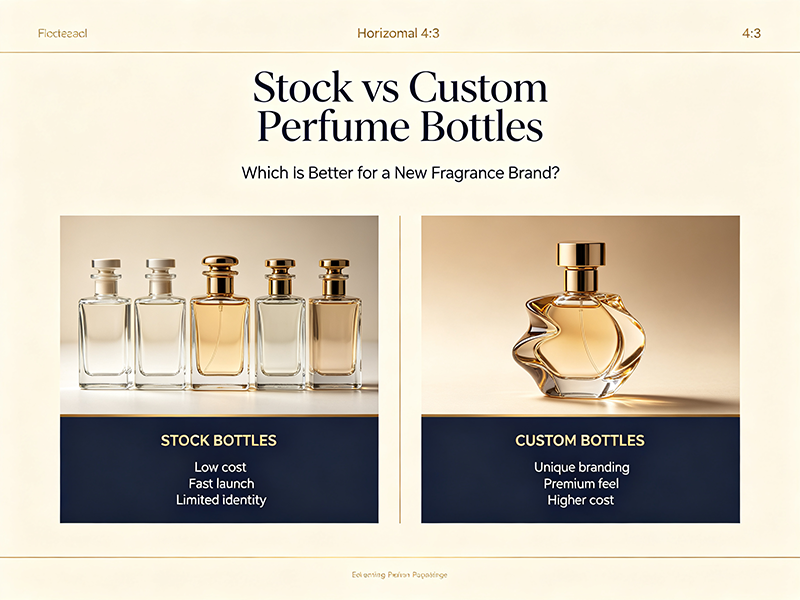
The Hybrid Route: Often the Best Answer for a New Brand
The most practical choice is not always fully stock or fully custom. A hybrid strategy uses proven elements where they reduce risk and selected custom details where they create the most brand value.
Examples include:
- Stock glass with a custom sprayed color
- Stock bottle and pump with a custom-finished cap
- Existing cap structure with a proprietary outer shell
- Stock bottle with a unique plaque or label system
- Shared bottle and cap across several fragrances with distinct decoration
- Stock glass for the first launch, followed by a custom mold after demand is validated
Why the Hybrid Model Works
It lets the brand concentrate investment on the touchpoints customers notice most. It also preserves proven bottle and pump geometry while creating a more ownable visual identity.
For example, if a new glass mold and fully custom cap would strain the budget, the brand might use a stock bottle and invest in a memorable cap finish, controlled gradient, and strong box. The result can appear deliberate without taking on every category of tooling and inventory risk at once.
A Three-Stage Packaging Roadmap for New Fragrance Brands
Stage 1: Validate the Product
Use a proven stock bottle, compatible closure, limited decoration palette, and efficient box. Launch one hero capacity or a tightly controlled SKU range. The objective is to validate fragrance demand, positioning, and pricing.
Stage 2: Build Recognition
After repeat demand becomes visible, upgrade the element that creates the greatest brand value. This may be a proprietary cap shell, more distinctive decoration, better glass weight, or a more memorable box-opening experience.
Keep compatibility with existing pumps, filling processes, and carton structures where practical.
Stage 3: Invest in a Signature Bottle
Once the brand has a stable customer base, repeat forecast, and mature visual identity, evaluate a custom glass mold. Use sales data and customer feedback to decide which size, hand feel, silhouette, and functional details deserve long-term investment.
This roadmap turns custom packaging into a response to validated business needs rather than a speculative first expense.
A Weighted Decision Scorecard
New brands can use a simple scorecard to make the decision more objective. Assign an importance weight from 1 to 5 to each factor. Then score stock and custom from 1 to 5 based on the actual supplier proposals.
| Criterion | Suggested question |
|---|---|
| Launch speed | How costly would a delay be? |
| Available cash | Can the business support tooling and higher component commitments? |
| Demand confidence | Is the forecast supported by orders, distribution, or proven sales? |
| Need for a unique shape | Is glass geometry essential to brand recognition or function? |
| Design stability | Is the concept mature enough to freeze dimensions? |
| Quantity fit | Do planned volumes support every component MOQ? |
| Technical capacity | Can the team manage drawings, trials, tolerances, and changes? |
| Inventory tolerance | What is the financial impact of unused custom packaging? |
| Future platform value | Will the bottle support several reorders or fragrances? |
| Logistics efficiency | Does the proposed shape meet freight and breakage targets? |
Multiply importance by each option’s score. The result does not replace management judgment, but it exposes where enthusiasm for a custom shape may be overriding the business constraints—or where excessive caution may be preventing a valuable long-term asset.
Example Scenarios
Scenario A: Self-Funded Niche Fragrance Startup
The brand plans one 50ml fragrance, expects modest direct-to-consumer sales, and has no prior sell-through data. Packaging must look premium, but funding is also needed for formulation, filling, photography, samples, and advertising.
Better route: Stock bottle customization.
Select a strong existing shape, use one controlled spray color, apply clean screen printing, choose an available cap structure, and invest in a well-fitted box. Preserve cash and learn from the first launch.
Scenario B: Influencer-Led Brand With Confirmed Preorders
The brand has a recognizable symbol, a large launch audience, confirmed preorder demand, and enough capital for tooling. The bottle shape is central to the story and will be used across several planned fragrances.
Potentially better route: Custom glass mold, subject to a realistic schedule and technical feasibility.
The brand should still build contingency into the timeline and validate the closure, decoration, and box using complete assembly samples.
Scenario C: Private-Label Brand Launching Five Fragrances
The company wants five scents in different colors but with a unified collection identity. The total order is meaningful, while the quantity of each fragrance is limited.
Better route: Shared stock bottle and closure platform.
Use the same glass, pump, cap, and box dimensions across the range. Differentiate through coating and artwork while checking the spraying MOQ per color.
Scenario D: Established Regional Brand Replacing a Generic Bottle
The brand already has repeat sales and distributor demand. Its current stock bottle no longer supports price positioning, and competitors use similar silhouettes.
Potentially better route: Custom bottle platform.
Use sales history to set volume, develop a recognizable shape, and plan the bottle for several fragrances and reorders rather than one limited release.
Questions to Ask a Perfume Bottle Manufacturer Before Deciding
Before approving either route, ask:
- Does the proposed stock bottle physically exist, or does only the mold exist?
- What quantity is currently available?
- Which pumps, collars, and caps have been tested with the bottle?
- What is the MOQ for every component and decoration process?
- Which costs are one-time tooling costs and which are recurring?
- What samples will be provided before production?
- What are the main technical risks of the custom design?
- Which dimensions must be frozen before cap and box development?
- What decoration areas and tolerances are realistic?
- How will color, print position, and cap fit be approved?
- How will the bottle be packed to protect decorated surfaces?
- What is the normal production period after final approval?
- What inventory remains if the first filling quantity is below a component MOQ?
- Who controls the custom mold, drawings, and future use?
- Which change would have the greatest impact on price or timing?
Whether a brand is speaking with a オーダーメイド香水ボトルの製造業者, a stock perfume bottle supplier, or an integrated 香水のパッケージ供給業者, the supplier should make the tradeoffs clearer, state assumptions, and recommend a route based on the whole project rather than pushing the most customized option.
Common Mistakes to Avoid
Assuming Stock Means Immediate Delivery
Confirm physical inventory, compatible components, and decoration capacity. An existing mold may still require production.
Choosing a Custom Bottle Before Confirming Sales Volume
Visual enthusiasm should not replace a credible quantity plan. Calculate cash exposure and expected sell-through first.
Comparing Bottle Prices Instead of Complete Packaging Costs
Include the pump, cap, decoration, box, insert, excess components, packing, freight, and inspection requirements.
Using a Custom Cap That Defeats the Stock-Bottle Strategy
A high-MOQ cap can become the largest inventory commitment. Review every component before claiming the project is a low-MOQ launch.
Finalizing the Box Before the Assembly
The approved bottle, pump, collar, and cap determine the final height, weight, and insert clearance.
Approving Only From Renderings
Renderings communicate design intent but do not prove glass quality, hand feel, stability, cap fit, spray performance, or decoration consistency.
Treating Heavier Glass as the Only Luxury Signal
Premium quality also comes from proportions, clarity, balance, fitting precision, finish consistency, and a coherent unboxing experience.
Starting Custom Tooling With an Unstable Brand Identity
If the name, logo, capacity, price point, or target customer may change, keep more options open until the strategy is mature.
Final Decision Checklist
Choose a stock perfume bottle when you need to:
- Protect cash
- Reduce glass MOQ
- Launch with less tooling risk
- Preserve design flexibility
- Test market demand
- Share components across fragrances
- Use decoration and accessories for differentiation
Choose a custom perfume bottle when you have:
- A stable and meaningful shape concept
- Sufficient funding
- Quantity that supports the glass MOQ
- Credible demand or distribution
- A realistic development schedule
- Technical approval capability
- A plan to use the design across multiple reorders or products
Choose a hybrid strategy when:
- You need a recognizable package but cannot justify full custom glass
- One touchpoint creates more value than changing every component
- You want to validate demand before investing in a proprietary mold
- You can share proven bottle and pump geometry while customizing visible details
まとめ
For most new fragrance brands, the best first bottle is not the most technically ambitious option. It is the package that expresses the brand clearly, works reliably, meets the launch quantity, protects cash, and leaves enough flexibility to respond to real market feedback.
A stock perfume bottle can deliver a premium and recognizable result when color, decoration, cap, pump, and box are developed as one system. A custom glass mold becomes more valuable when demand is proven, the brand identity is stable, and the proprietary shape can support multiple production runs. The right perfume bottle mold decision should therefore follow the commercial case, not precede it.
The decision between 市販の香水瓶と特注の香水瓶 should therefore be made with a complete commercial model—not only a mood board. Compare component-level MOQs, total cash exposure, development time, technical risk, inventory, logistics, and long-term brand value.
If you are evaluating stock or custom bottles for a new fragrance line, share your capacity, quantity, design references, decoration direction, cap and pump requirements, box concept, target market, and launch schedule. An experienced perfume packaging supplier can then compare practical routes and coordinate the glass bottle, pump, collar, cap, decoration, and outer packaging as one compatible custom perfume packaging system.
よくある質問:
1. Are stock perfume bottles suitable for a luxury fragrance brand?
Yes. Luxury positioning depends on the complete experience, not only on whether the glass mold is proprietary. A well-proportioned stock bottle can support a luxury fragrance when it is combined with controlled decoration, a precise cap and pump system, a strong box, and consistent quality. The brand should choose a bottle that fits its price position rather than assuming every luxury launch requires custom glass.
2. What is the MOQ for stock and custom perfume bottles?
At DAXIN, the stock glass bottle MOQ reference is 3,000 pieces, while custom glass bottles use a 10,000-piece reference. Pumps and caps use a 10,000-piece reference, paper boxes 3,000 pieces, spraying 3,000 pieces per color, silk printing 1,000 pieces, and electroplating 10,000 pieces. Final MOQs depend on the selected components and processes.
3. Is a stock bottle the same as an in-stock bottle?
Not always. “Stock bottle” often means that an existing mold is available. Finished glass may or may not be physically in warehouse inventory. Brands should confirm current quantity, capacity, neck specification, compatible components, and whether a new production run is required.
4. Can a stock perfume bottle be customized?
Yes. Stock glass can be customized through spray coating, screen printing, hot stamping, frosting, UV printing, decals, metallization, selected caps, custom finishes, and branded boxes. The glass silhouette may remain available to other buyers, but the complete package can still develop a distinctive identity.
5. How much more does a custom perfume bottle cost?
There is no universal percentage. The difference depends on mold complexity, glass weight, order quantity, trial requirements, revisions, cap and pump development, decoration, packing, and freight. Brands should compare total project cash and cost per sellable unit rather than only the bottle unit price.
6. How long does it take to develop a custom perfume bottle?
Custom development is longer than a comparable stock-bottle project because it requires technical drawings, mold production, glass trials, inspection, possible correction, decoration samples, and complete assembly approval. Mass production is scheduled only after the necessary details are approved. The exact timeline depends on design complexity and revision cycles.
7. When should a new fragrance brand invest in a custom bottle mold?
A custom mold is more appropriate when the brand has a stable design direction, sufficient funding, credible demand, quantity that supports the MOQ, and a plan to use the shape across multiple reorders or fragrances. It should create commercial value that justifies the added cost and risk.
8. What is the best compromise between stock and custom packaging?
A hybrid package often provides the best balance. The brand can use proven stock glass and a compatible pump while customizing the color, print, cap finish, plaque, label, or box. This concentrates investment on visible brand touchpoints while reducing glass tooling and development risk.
 English
  Spanish
  French
  German
  Arabic
  Italian
  Dutch
Dutch  Portuguese
  Russian
  Korean
  Japanese