Separate functional risks—retention, sealing, actuation, structural stability—from cosmetic risks such as gap, centering, color and decoration position.

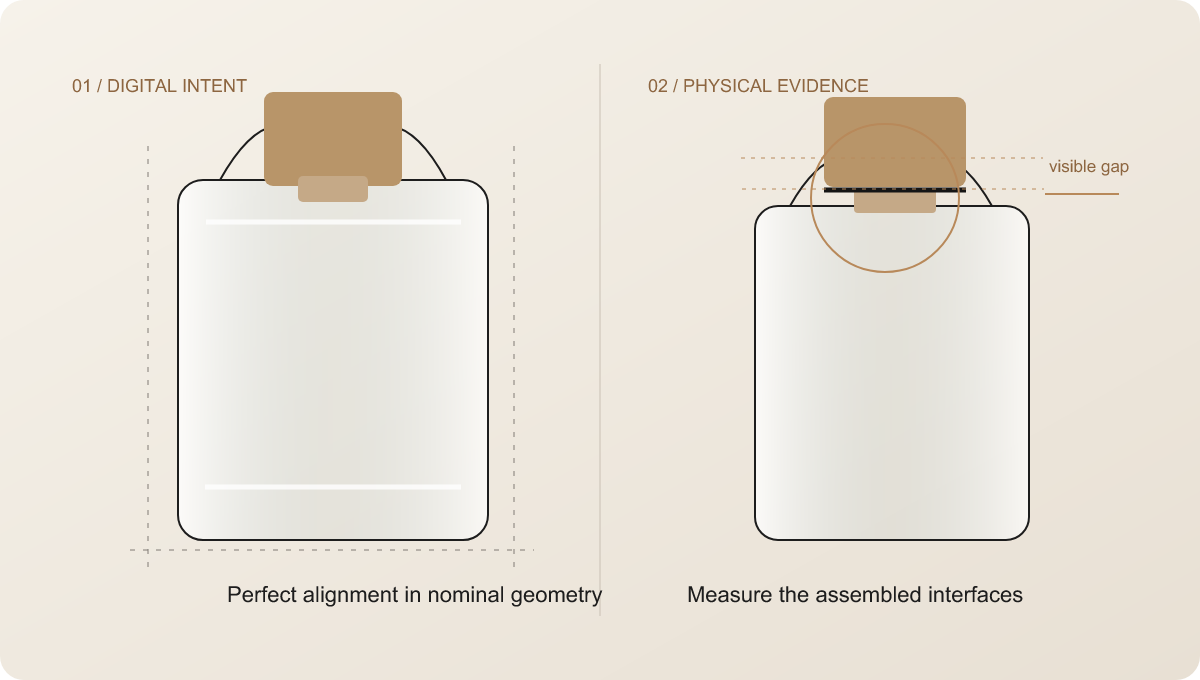
画面上では、パッケージは完成されたように見えた。ボトルは優雅な長方形のプロポーションを保ち、キャップは中心線に正確に位置し、シャンパンカラーのメタリックな表面は互いに調和し、装飾は整然とした領域を占めていた。そのレンダリングからは、目立った不協和音のない、高級感あふれるフレグランス製品という印象が伝わってきた。しかし、実物のサンプルは、それとは異なる実情を物語っていた。.
キャップからボトルへの移行は、まだ解決されていないように感じられた。デジタル画像ではほとんど見えなくなっていたカラーが、実際の光の下では視覚的に目立つようになった。ボトル、ポンプ、キャップは組み立てることができたが、完成したシルエットはコンセプトほど意図的なものには見えなかった。同じ対象が透明なガラスから不透明なプラスチックや反射性のある金属へと移ると、色調が変化した。フラットな画面上でバランスが取れていたアートワークも、曲面状の肩部分や実際のボトルの縁の近くでは異なる挙動を見せた。これらの現象が、本草案で用いられた匿名化された救済シナリオを構成している。具体的なプロジェクトの順序や観察された構成要素は以下の通りである。.
重要な変化は、新たな美的方向性の確立ではありませんでした。クライアント側にはすでに明確なデザインの方向性が定まっていました。私たちの役割は、なぜ物理的なシステムがその方向性を表現できていないのかを突き止め、修正された展示用サンプルによって、量産段階まで同じリスクが隠されたままになる可能性を低減することでした。これにより、問いは「このボトルはどのように見えるべきか」から、「組み立てられたパッケージが意図した通りの見た目や挙動を示せない原因となっている相互作用は何か」へと変わりました。“
この区別は、以下の点で重要である。 オーダーメイド香水ボトルの開発. レンダリングは、プロポーション、仕上げの意図、ブランドの個性を伝えることができます。しかし、ガラスの配置、設置されたポンプの高さ、キャップの保持力、コーティングの厚み、装飾の転写、組み立ての再現性、輸送時の保護については証明できません。これらは物理的な関係であり、材料、工程、公差がすべて満たされた場合にのみ、目に見える形となるのです。.
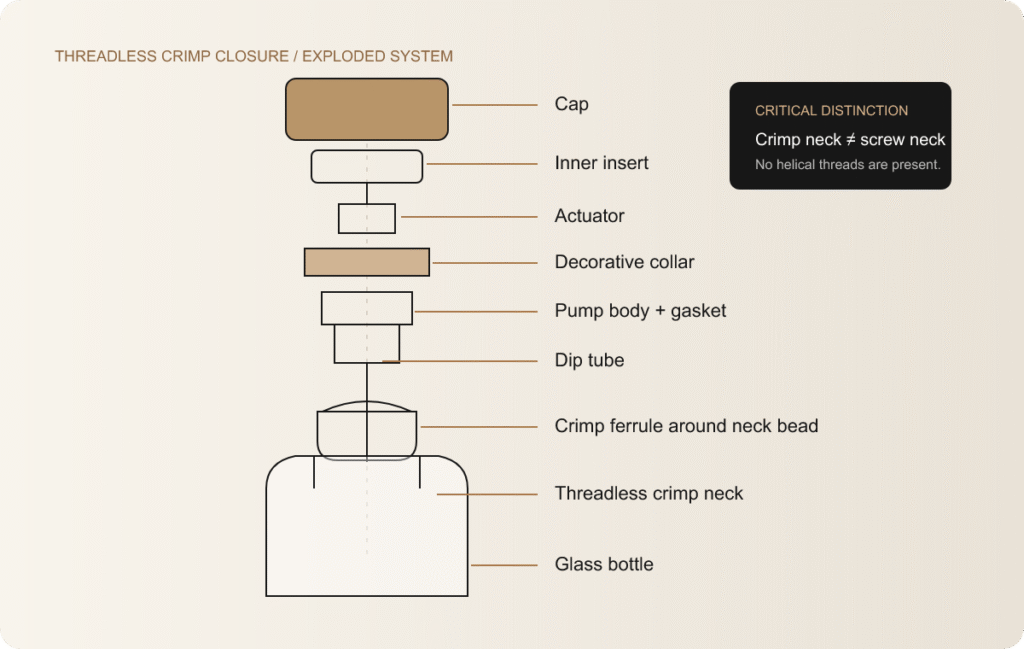
組み立てられたシステム。. 各矢印はインターフェースを表しています。正しいクリンプネックの図解には、ネジ山ではなく、ビードとフェルールが描かれています。.
香水のパッケージは、単一の物体ではありません。それは、ガラス瓶、ネックフィニッシュ、ポンプのガスケットとフェルール、アクチュエータ、カラー、キャップまたはキャップインサート、装飾部品、そして出荷用パッケージといった、相互に関連した部品の連続体です。各部品は、異なるチームによって設計され、異なる素材から作られ、異なる製造工程を経て生産される場合があります。CADでは、各接合部がしばしば理想的な基準値として表現されますが、製造過程では、その値を中心としたばらつきが生じます。.
ガラスは特に複雑な要素をもたらします。ガラスは、完成したブロックを機械加工するのではなく、金型内で高温かつ流動状態の素材から成形されます。ネックの形状、ショルダーへの移行部、壁厚の分布、底部の質量、および冷却条件は相互に関連しています。その後、取り付け時に、ボトルのネジなし圧着仕上げ部分の周囲にポンプフェルールが形成されます。カラーは、取り付けられたポンプやボトルを基準としています。キャップインサートは、カラー、アクチュエータ、あるいはその他の保持機構を基準とする場合があります。最後に、作業者または組立機械が、独自の位置決め条件と力を用いてスタックを組み立てます。.
また、部品を個別に承認する場合、後になって問題が発生することもあります。ボトルサプライヤーは、図面に基づいてボトルのネック部を検査します。ポンプサプライヤーは、フェルールを検査します。キャップサプライヤーは、外形寸法と挿入深さを検査します。それぞれの検査結果は正しいかもしれません。しかし、どの検査結果も、顧客が最も重視する「実際のばらつきがある状況下でも、香水のパッケージシステム全体が視覚的および機械的に許容範囲内であるか」という決定的な疑問には答えられません。パッケージは、各部品を縦方向に、また繰り返し組み立てた状態を横方向に、包括的に検査する必要があります。.
組み立てられた香水瓶の見た目に違和感がある場合、直感的に最も手っ取り早い対応策として、最も目立つ部分を変更しがちです。しかし、それが必ずしも安定した結果にたどり着く最短の道とは限りません。キャップの位置が高すぎるのは、ボトルの首部分、取り付けられたポンプ、カラー、キャップ内部のインサート、あるいは組み立て順序のいずれかが原因である可能性があります。これらの変数を特定せずにキャップの外形金型を変更してしまうと、問題が解消されず、金型加工の負担が増え、次のサンプルの評価が難しくなる恐れがあります。.
この診断手法では、まず原因を特定せずに症状を記述することから始めます。「キャップのサプライヤーに不備があった」というのは結論です。「目に見える円周方向の隙間は片側の方が大きく、組み立て品ごとにばらつきがある」というのは証拠です。後者の記述は、測定したり、一定の照明条件下で写真を撮影したり、接合部の寸法と比較したりすることが可能です。これにより、調査を時期尚早に打ち切るのではなく、検証可能な仮説をいくつか導き出すことができます。.
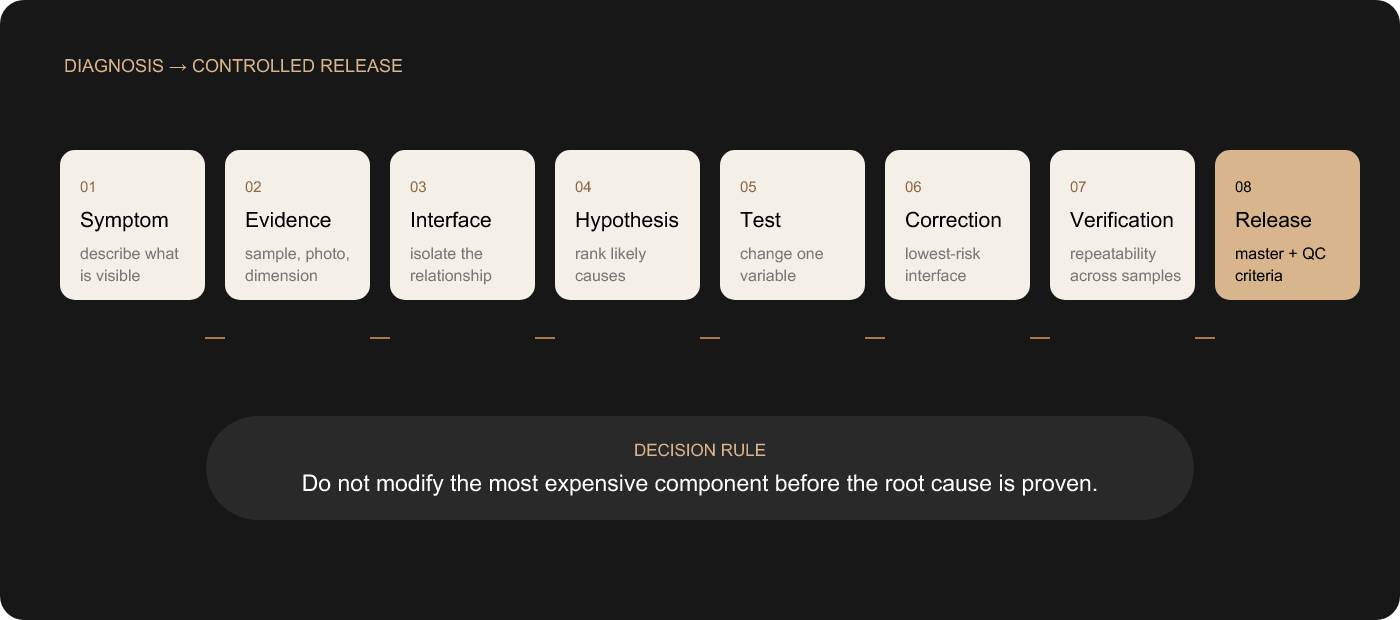
管理された診断。. 是正措置は証拠に基づいて正当化され、再現性が実証されて初めて承認される。.
目に見える問題 | 考えられる根本原因 | まず何を確認すべきか |
キャップの位置が高すぎる | ネック高さ、ポンプ設置高さ、カラー接触、浅い挿入、内部ストッパー位置 | 組み立てられた垂直寸法チェーンと試料間のばらつき |
隙間が不均一です | インサートの中心ずれ、ポンプの傾き、カラーの平坦度、キャップの保持力、ボトル上面の平坦度ばらつき | 回転パターン、直交性、および部品を交換した際に隙間がそれに追従するか否か |
ポンプの遊びを感じる | ネックとフェルールの不整合、圧着状態、ガスケット、または取り付け状態 | 正確なネック形状、フェルール仕様、および取り付け済みサンプル――単なる公称直径だけではありません |
金色のパーツが合っていない | 基板、めっき工程、陽極酸化処理、メタライゼーション、塗装、光沢度または基準値の不一致 | 一貫した照明条件下で、1つの実物原型を基準として各部品をまとめて確認する |
ロゴが歪んで見える | 曲面、図面の縮尺、線の太さ、固定具、コーティング、またはエッジとの距離 | 実際の装飾部分および承認済みの実物サンプル。ベクターファイルのみではありません。 |
Bottle rocks or looks asymmetric | Bottom geometry, glass distribution, mold condition, cooling or inspection datum | Base contact, verticality and relevant geometry across several undecorated samples |
Separate functional risks—retention, sealing, actuation, structural stability—from cosmetic risks such as gap, centering, color and decoration position.
Identify the exact samples, assembly condition, orientation and lighting. Avoid mixing samples from different revisions.
Compare actual neck, installed pump, collar and insert positions with nominal drawings and the final assembled datum.
Determine which variations can add in the same direction and which clearances or constraints absorb them.
Review crimping, collar placement, cap insertion, decoration and handling rather than treating assembly as an invisible step.
Use controlled swaps, temporary inserts, fixtures or comparison samples to change one meaningful variable at a time.
Choose the lowest-risk correction that protects appearance, then confirm repeatability rather than celebrating one successful unit.
Luxury fragrance packaging is unusually sensitive to transitions. The eye does not see a cap, a collar and a shoulder as independent procurement lines. It reads one silhouette. A small change in vertical position can expose more collar, weaken the connection between cap and bottle or make the cap appear undersized. A gap can be uniform and still be too prominent. It can also be nominally narrow but visually poor because one side closes and the other side opens.
This is where technical tolerance and visual tolerance diverge. Technical tolerance asks whether a component lies within an agreed dimensional range and continues to perform its intended function. Visual tolerance asks whether the assembled result remains consistent with a premium design language. A dimension can pass the first test and fail the second. Conversely, an extremely tight visual target that leaves no room for real manufacturing variation can create an unbuildable specification.
The solution is not to demand “zero tolerance.” It is to define the consumer-facing relationship, locate the datums that create it and assign realistic controls to the chain. The target may be a deliberately fine, uniform shadow line rather than no gap at all. The collar may be designed as an intentional visible element instead of an accidental sliver. The cap insert may absorb variation while the outer cap preserves the critical silhouette. These are architecture decisions, not last-minute cosmetic inspection.
In the project framework, cap position was treated as a system output. The exact gap symptom, cap construction and selected correction remain [FACT CHECK / DAXIN TO CONFIRM]. The publishable lesson is independent of those facts: do not alter the glass or external cap until the team knows which datum controls the final visible transition.
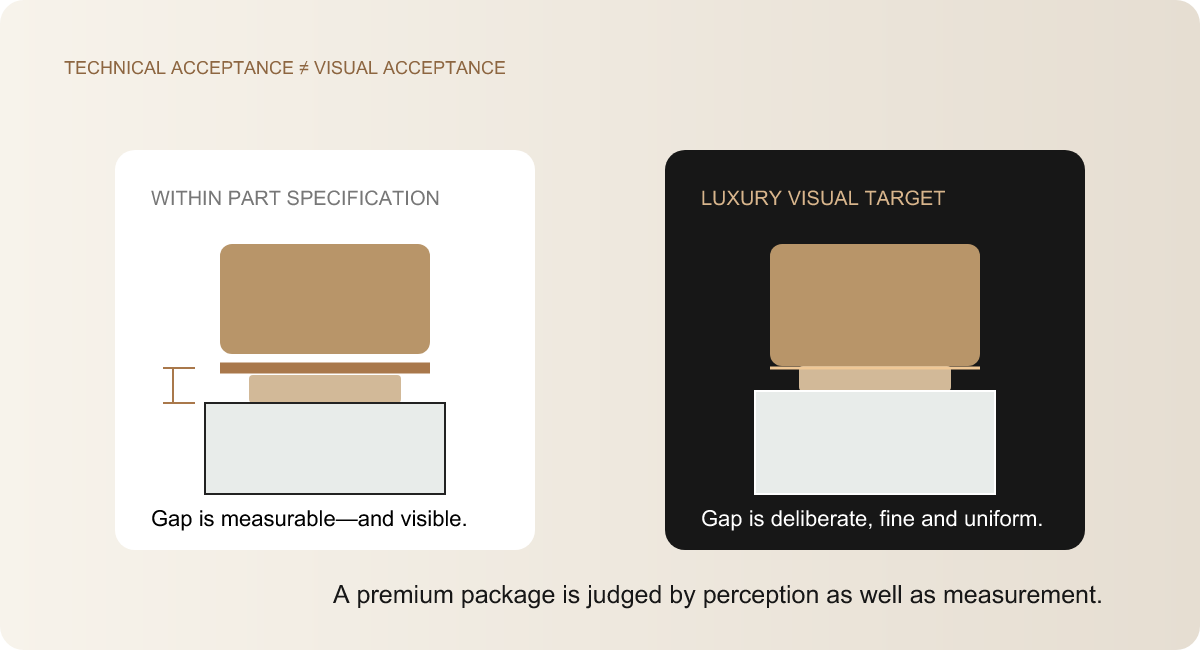
Two acceptance systems. The right target balances a premium shadow line with the variation a repeatable assembly can sustain.
Tolerance stack-up is the combined effect of allowed variation from several dimensions on one final relationship. In a perfume closure, bottle neck height may vary around its nominal condition. The installed pump position may vary because the ferrule forms around the neck. A collar has its own depth and contact surfaces. The cap insert has a retention position. Assembly introduces alignment and seating variation. The final cap gap reflects all of them.
Imagine—not as project data, but as logic—that the neck is toward the high side of its range, the installed pump is also high and the cap insert seats the outer cap slightly shallow. No single part must be defective. Their directions simply add. A second assembly may combine a low neck, lower pump position and deeper insert, producing a visibly different gap from equally compliant components. Inspection certificates for individual parts will not reveal that system behavior unless the assembled chain was part of the specification.
The engineering objective therefore changes. “Are the parts within specification?” remains necessary, but it is insufficient. The stronger question is: “Does the assembled package remain functional and visually acceptable across credible combinations of component and process variation?” Answering it may require a stack analysis, measured samples, controlled component swaps and pilot assembly. It also requires a clear definition of which output matters—cap gap, overall height, collar visibility, actuator clearance, retention or some combination.
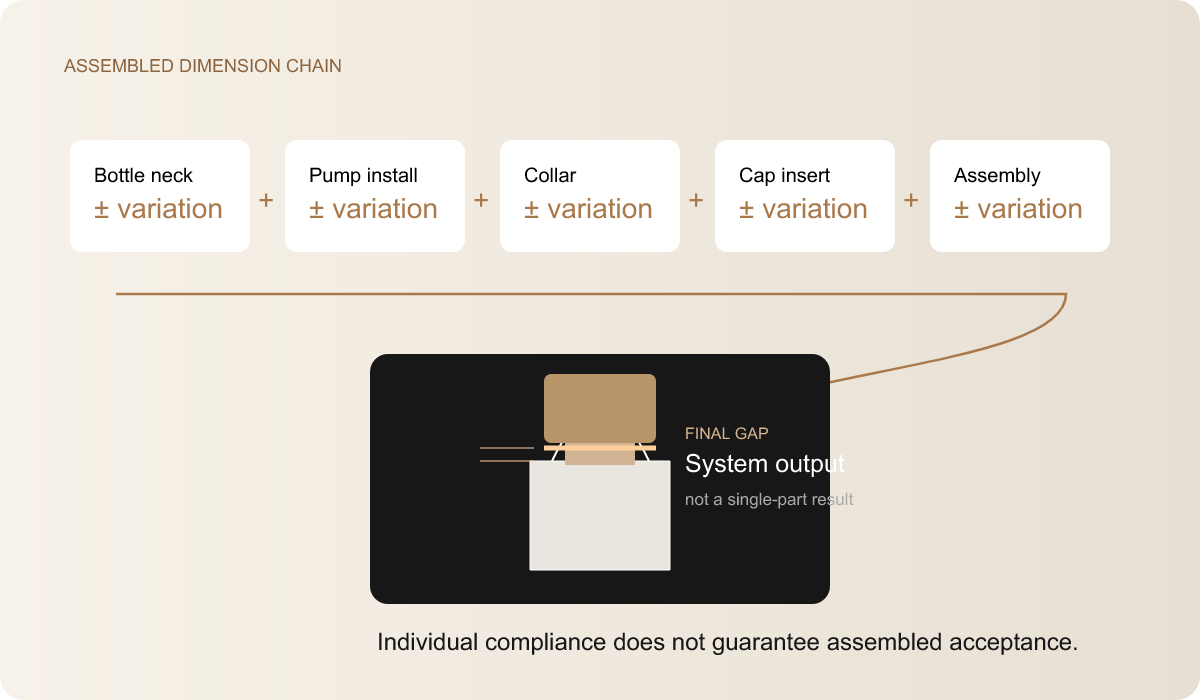
The signature risk. Individually acceptable variation can accumulate into a visible system failure.
Interface | Critical relationship | Typical risk | Verification |
Bottle ↔ pump | Neck profile, gasket contact, ferrule forming, installed height | Poor seating, variable installed position or sealing concern | Drawing review plus installed samples under defined assembly condition |
Pump ↔ collar | Actuator clearance, collar bore, height and contact surface | Binding, exposed ferrule or inconsistent collar position | Dimensional check and repeated actuation after assembly |
Collar ↔ cap | Clearance, centering, visual shadow line and retention path | Rubbing, large gap, off-center appearance | Rotational gap review across several assemblies |
Bottle ↔ cap | Overall silhouette, width transition, vertical position | Disconnected proportion despite component compliance | Master assembly and side-by-side visual approval |
Bottle ↔ decoration | Artwork field, surface curvature, coating and fixture datum | Distortion, misregistration or poor edge control | Decorated physical samples and agreed viewing zones |
Bottle ↔ carton | Contact points, clearance, movement, abrasion and compression path | Scuffing, cap load or movement during transport | Pack-out review using final decorated components |
A standard crimp-neck perfume bottle does not use screw threads. The bottle finish includes a threadless bead and related geometry. During pump installation, the metal ferrule is formed around the finish while a gasket supports the sealing relationship. Above that interface sit the pump body, actuator and decorative collar. The cap may retain on an insert, collar feature or another designed surface. Confusing crimp and screw architectures is not a minor drawing error; it changes how the package is assembled and controlled.
A nominal designation such as “15 mm crimp” is useful, but it should not be treated as complete proof that any pump will fit any bottle carrying the same headline size. The exact neck profile, ferrule, gasket, pump cup, installation tooling and intended assembled height matter. The pump’s dosage and spray quality matter to product delivery. Dip-tube length and cut are capacity-specific. The fragrance formula and gasket compatibility may matter to sealing and material performance. The filling line needs to handle and crimp the selected assembly consistently.
A mismatch can reveal itself indirectly. A pump that installs at the wrong height can push the collar and cap upward. A ferrule that does not form consistently can create variable cap position even if the cap never touches the bottle neck directly. A collar bore can bind on a pump feature. An actuator may lose clearance under a cap. The visible symptom may therefore be “cap fit,” while the root cause sits lower in the closure stack.
DAXIN’s public perfume sprayer options そして custom cap and pump sourcing provide the component context. For a rescue project, availability is only the beginning. The relevant pump must be validated against the actual bottle, assembly process, collar and cap. Any project-specific pump designation, gasket, dosage, crimp setting or compatibility result in the final case requires.
Confirm the complete profile and relevant datums.
Evaluate after real ferrule forming and gasket compression.
Judge collar and cap position from the assembled stack.
Premium fragrance design often asks glass to express mass and precision simultaneously: a visually heavy base, broad flat faces, crisp corners, controlled shoulders and an apparently centered internal cavity. These features are compelling because they create weight, optical depth and architectural light. They can also make stable glass distribution more demanding.
Molten glass must enter and form against the mold while maintaining enough workable temperature to distribute through the body. Abrupt transitions, narrow corners and large differences between thick and thin areas influence that movement. A very heavy-looking base is not simply an external block added in CAD; it is related to internal bottom geometry, glass weight, forming, cooling and the optical result. Large flat walls can reveal waviness or asymmetry more readily than textured surfaces. Sharp shoulders can concentrate visual and forming sensitivity at the transition into the neck.
For a B2B buyer, the point is not to become a glass-forming specialist. It is to recognize the trade-off early. A photorealistic rendering can make every wall perfectly even and every corner infinitely controlled. Production engineering has to decide which radii, transitions, internal contours and weight distribution support a repeatable physical result while keeping the recognizable design language.
In a rescue review, several symptoms might trigger glass investigation: rocking on a reference surface, variable overall height, inconsistent shoulder optics, unstable wall appearance, difficult decoration registration or an assembled closure that changes with neck variation. None proves the glass is at fault by itself. Undecorated samples, dimensional evidence, section understanding and the behavior of alternative components help establish whether mold or forming changes are justified.
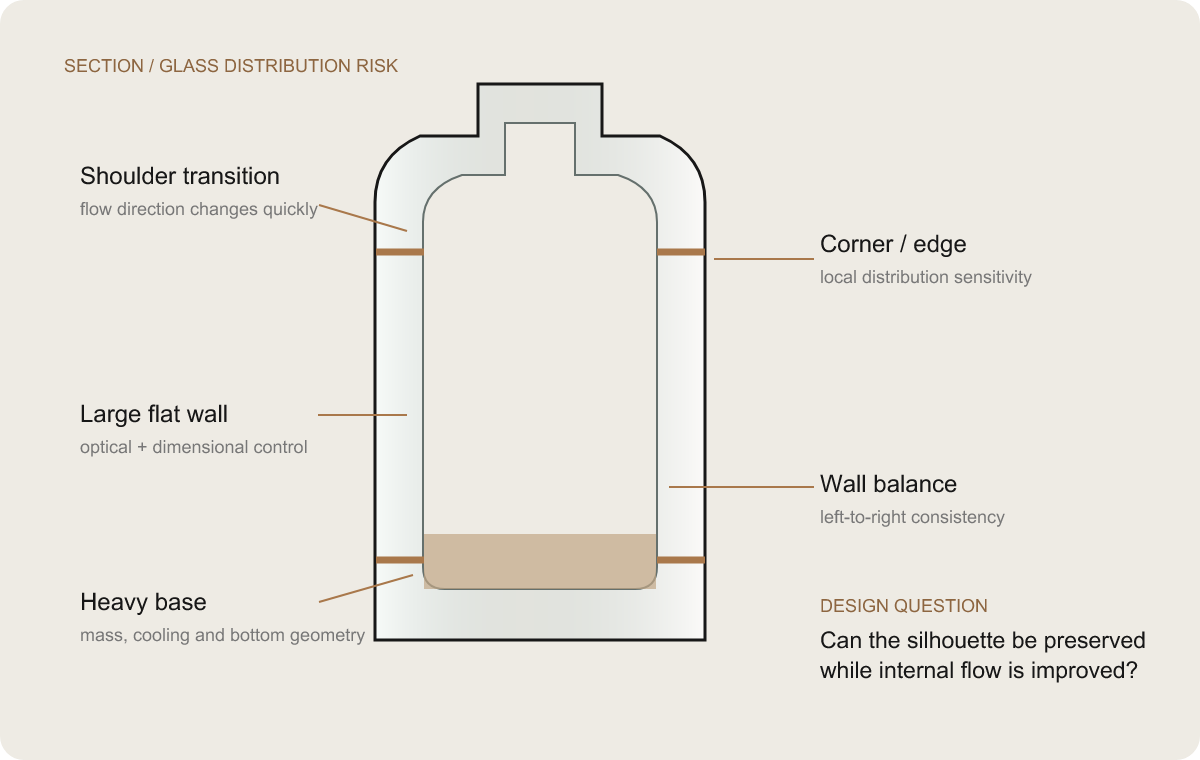
Luxury geometry meets forming reality. The heavy base, broad walls, shoulder transitions and corners influence one another.
Weak engineering simplifies a difficult design until the distinctive idea disappears. Strong engineering identifies which visible and tactile signals make the object valuable, then searches for less visible changes that improve production reliability. The consumer may care about the rectangular stance, broad front face, heavy optical base, shoulder rhythm and cap alignment. They are less likely to perceive a subtle internal radius, refined bottom contour or redistributed transition that preserves those signals.
The decision hierarchy should begin with design intent. What must remain recognizable? Which view carries the brand? Which surface must accept decoration? Which edge creates the premium highlight? Once those invariants are clear, the team can consider a radius refinement, shoulder transition, internal glass distribution, bottom structure, wall balance or neck transition. Any exact geometry change made in the real project is; this diagram explains the principle rather than claiming a recorded modification.
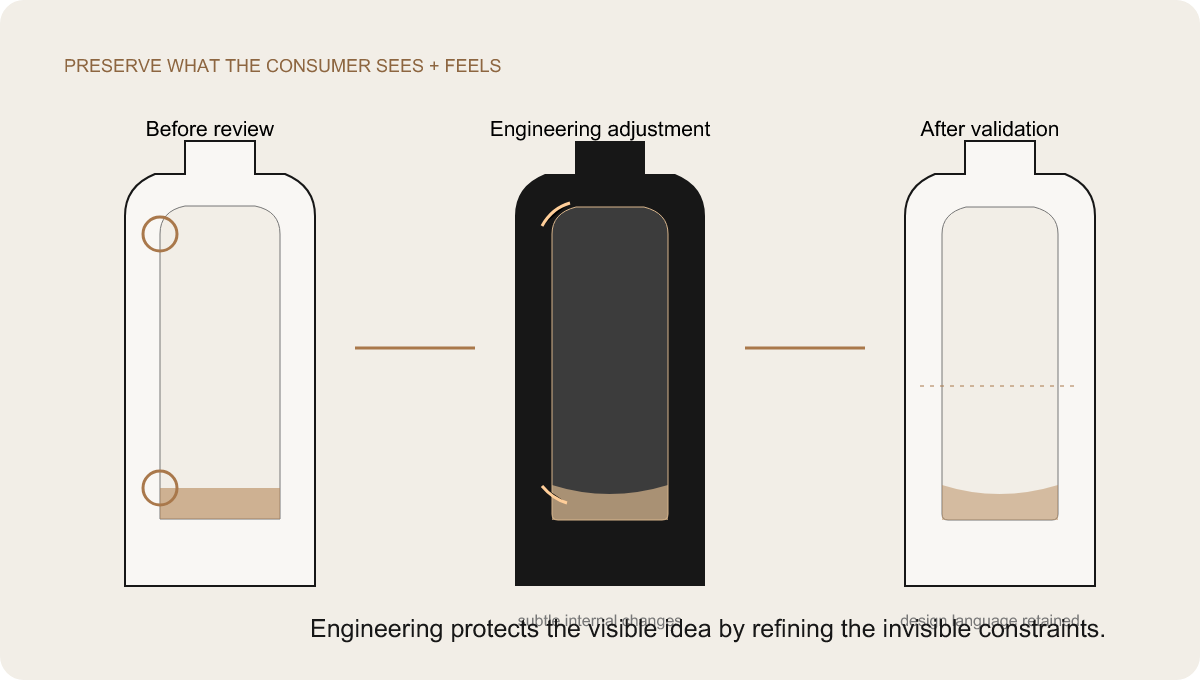
Subtle intervention. Preserve the external idea; refine the internal conditions that support repeatability.
A Pantone reference, digital swatch or approved rendering is essential communication, but it is not the final physical appearance. A transparent spray on clear glass is seen through front and rear surfaces, against liquid, air and whatever sits behind the bottle. An opaque coating creates a different color body. Matte level changes reflected highlight size. Gloss can deepen apparent saturation. Coating thickness, spray consistency and curing affect opacity and surface.
Lighting and viewing geometry compound the difference. A warm studio rendering may make champagne and stone tones agree. A cool retail light can expose undertone differences. Metallic particles rotate and sparkle with angle. A color that appears balanced face-on may shift on a shoulder. Photographs introduce camera white balance, exposure, compression and display calibration. Sending phone images between suppliers is useful for discussion, but it is a weak approval standard for subtle premium color.
The practical response is to define what the color target applies to and approve it physically. Is the target the coated empty bottle, the filled bottle, or the package under a specified viewing condition? Is the matte level part of the master? Is a tolerance range described by boundary samples? Which sample becomes the retained reference for production and later reorders? These questions turn “match the Pantone” into an executable color-control plan.
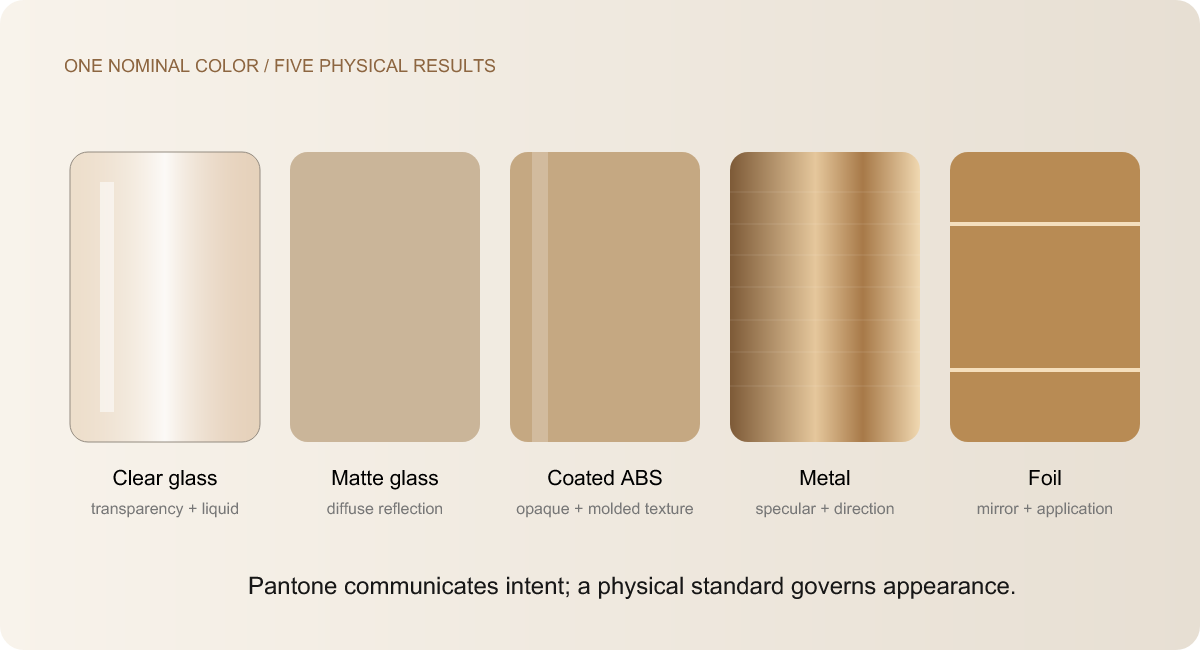
The substrate speaks. One nominal target produces different optical results on transparent, diffuse, opaque and reflective materials.
A perfume package may use the word “gold” for a metallized ABS cap, an aluminum collar, a plated zamac detail, hot-stamping foil and printed decoration. Their color names can match while their appearances do not. Each substrate and process constructs reflectivity differently. Metallization deposits a reflective layer on plastic. Aluminum may be anodized, lacquered or mechanically brushed. Zamac can receive plating over a prepared surface. Foil transfers a thin reflective layer through heat and pressure. Paint depends on pigment, binder, thickness and gloss.
Exact optical identity may be neither practical nor desirable. A brushed aluminum collar will never reflect exactly like mirror foil. The design goal may instead be a controlled family: consistent hue and temperature, with intentional differences in brightness and texture. That decision must be made with all parts together. Approving the cap alone under one lamp and the carton foil later from a photograph invites a surprise at final assembly.
A physical master standard anchors the family. The team can choose the most visually dominant gold—often the cap or another large component—as the reference, then tune adjacent materials relative to it. Viewing conditions, acceptable differences and master retention should be documented. Digital values remain useful for file transfer, but physical CMF approval governs the finished package.
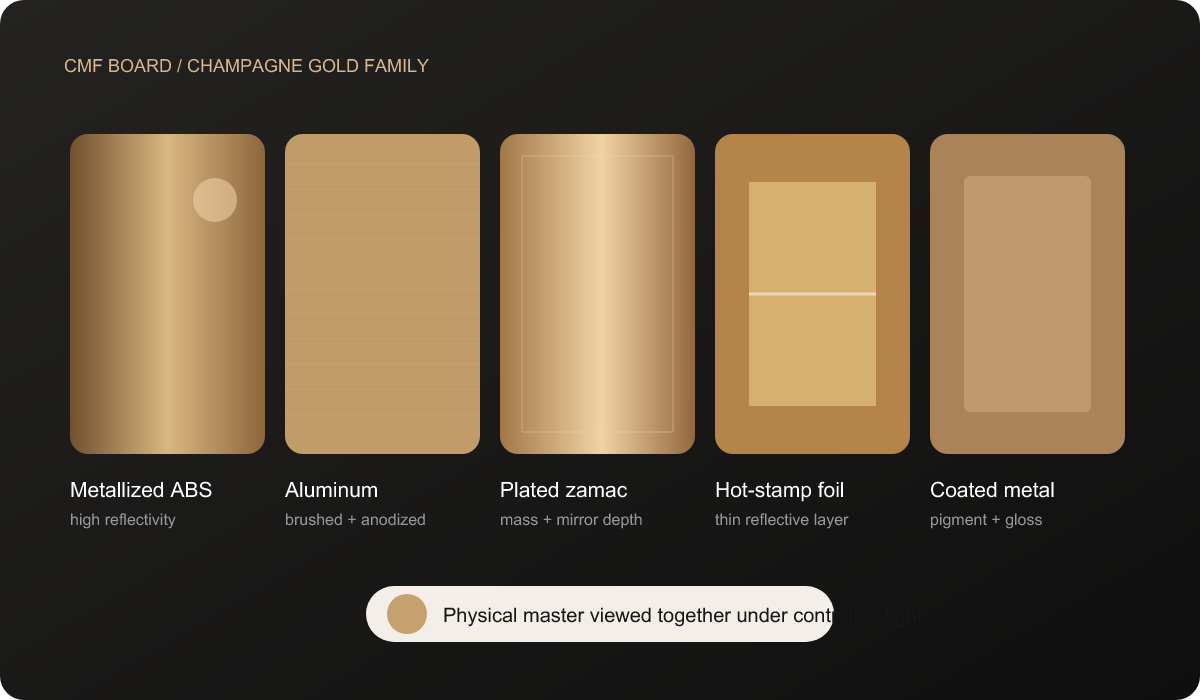
Gold is a material system. Hue, reflectivity, texture and process must be judged as one physical family.
Adobe Illustrator shows ideal vectors on an ideal plane. A perfume bottle presents a three-dimensional surface, manufacturing variation and a specific decoration process. Screen printing deposits ink through a mesh and depends on line weight, opacity, surface preparation, fixture and curing. Hot stamping transfers foil through heat, pressure and contact. Coating changes the surface underneath. Curvature changes how artwork is viewed and how a tool reaches the surface.
Fine lines that look elegant on screen may become weak, uneven or visually lost. Very small text may not maintain legibility. A large foil area can reveal transfer variation more than a compact mark. Artwork close to an edge has less registration margin. A logo that is mathematically centered on the file can appear optically low because of the shoulder, base mass or cap. Front-to-back alignment depends on a reliable bottle datum and fixture.
The decoration review should therefore move from artwork intent to process feasibility. Identify the usable decoration field, minimum feature behavior, optical center, registration datum and viewing zone. Produce a physical sample on the intended bottle finish. Compare scale, position, density, foil character and edge quality as part of the assembled package—not as a detached logo proof. DAXIN’s decorating and finishing page establishes the available process context; the exact decoration route, artwork change and approval result for this case are.
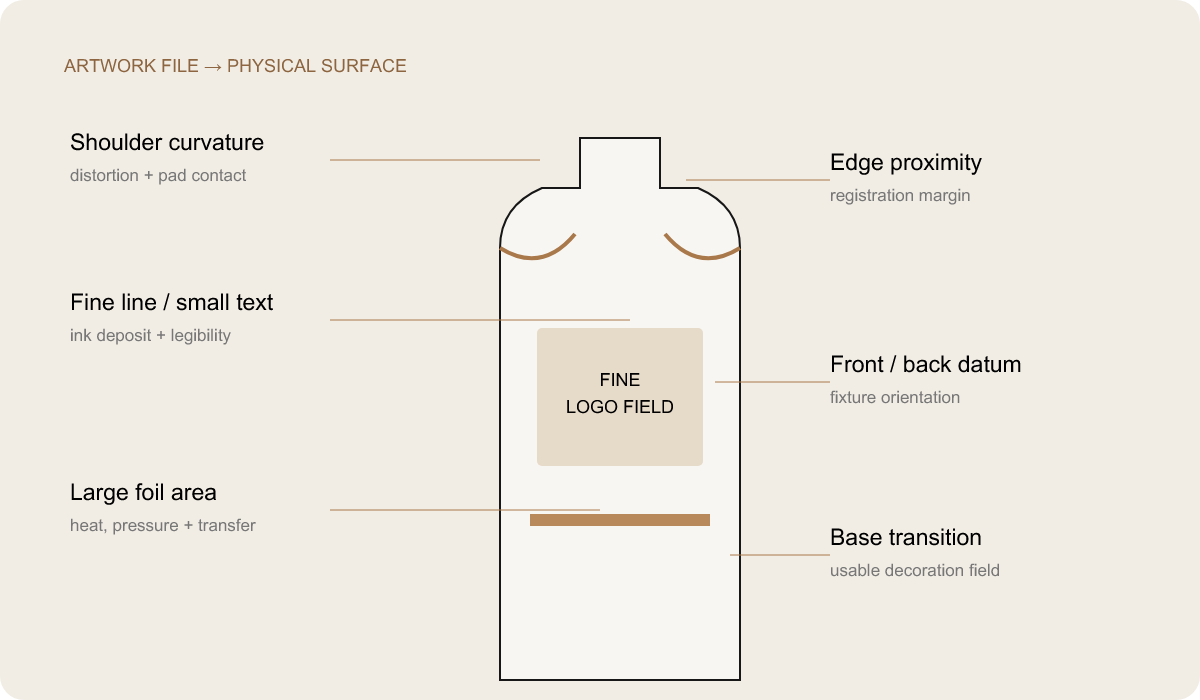
Artwork translation. The vector file defines intent; bottle geometry, coating and process define the physical result.
Functional quality answers whether the package can be assembled, actuated, handled and protected as intended. Cosmetic quality answers whether the consumer-facing object presents the approved color, gloss, geometry, alignment and decoration. Luxury perfume packaging needs both. A beautiful cap that interferes with actuation is unacceptable; so is a fully functional bottle whose tilted cap makes the brand feel inexpensive.
The categories overlap. An uneven pump installation can be a functional risk and the source of a cosmetic gap. A coating defect can be visual, but coating on a fit surface can also change assembly. A bottle that rocks is structurally stable enough to stand yet still presents poorly. Separating the categories helps the team define evidence and ownership, while evaluating the final system prevents the separation from becoming a blind spot.
Area | Cosmetic requirement | Functional requirement | Why both matter |
Cap and collar | Centered, consistent transition, approved finish | Retention, clearance and repeatable assembly | The closure is touched and seen before the fragrance is used |
ボトル | Symmetry, optical quality, stable color and surface | Capacity, structural integrity, neck compatibility and stable base | The glass is both the primary structure and the visual brand object |
ポンプ | Actuator and collar alignment, finish consistency | Correct mounting, actuation and product-delivery performance | A hidden installation issue can alter the visible cap position |
装飾 | Scale, position, density, edge and gloss | Adhesion and suitability for handling and packing | A perfect first impression must survive the distribution chain |
Transport pack | Clean presentation on arrival | Movement, compression and contact control | Protection preserves every cosmetic decision already paid for |
Perfume packaging commonly crosses several organizations: glass producer, pump supplier, cap or insert maker, decorator, metal processor, carton supplier, filler and assembler. When a problem appears, each supplier may demonstrate that its component meets its drawing. That protects a purchase order; it does not rescue the launch.
The investigation should end with a testable corrective action and a verification condition, not a meeting note that says “supplier to improve.” Improvement must have an object: change an insert stop, refine a collar height, control pump installation, adjust a decoration field, modify glass geometry or revise packing contact. The precise action depends on proof. DAXIN’s project-management capability is relevant because the buyer needs one view of the assembled system, even when production crosses suppliers.
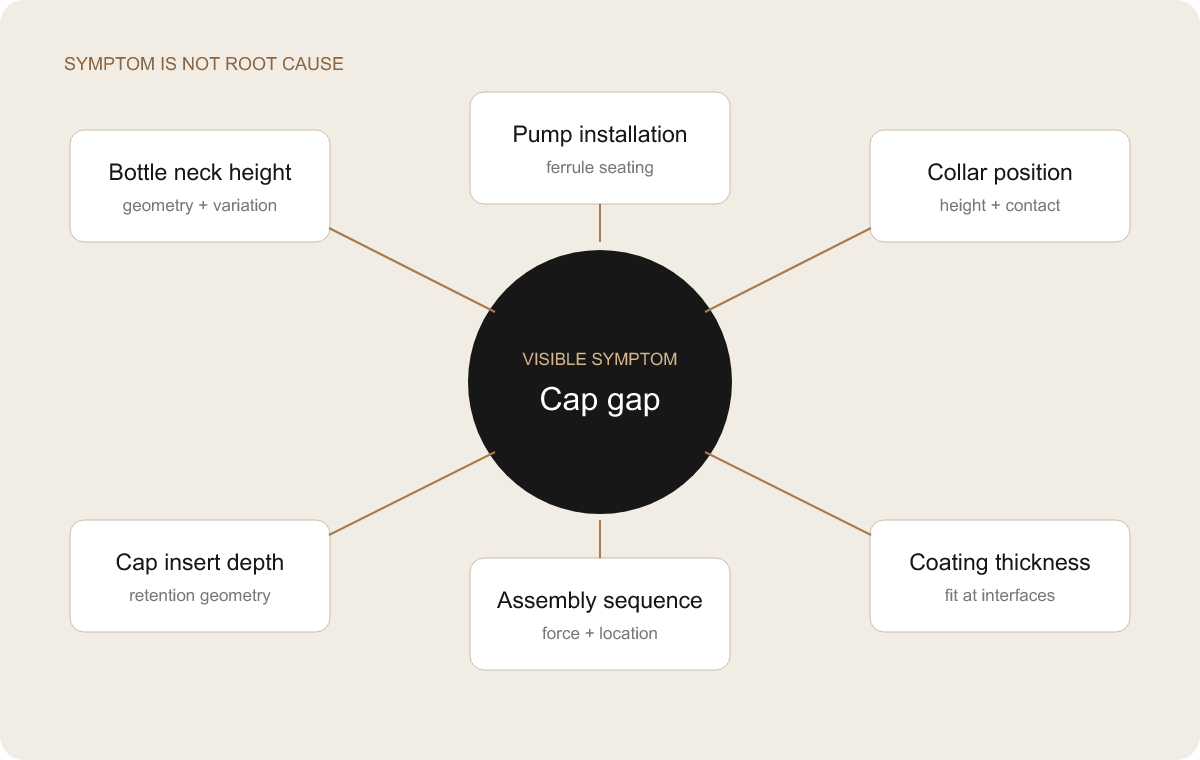
One symptom, several hypotheses. The visible component is not automatically the causal component.
The best correction is not always the change closest to the symptom. The decision should compare tooling impact, schedule impact, production risk, visual impact and reversibility. A plastic insert may be easier to adjust than a finished glass mold. A collar-height change may preserve bottle geometry. A pump change may solve an installed-height problem but create dosage, finish or filling-line work. These are examples of decision logic, not universal rules.
Glass changes deserve particular restraint because they can influence forming, capacity, decoration and every component that references the bottle. That does not make the mold untouchable; it makes evidence essential. If bottle geometry is the root cause and a subtle revision improves the system, avoiding the change only transfers risk downstream. The aim is not the cheapest isolated part. It is the lowest total-risk correction for the package.
Problem | Glass change | Pump change | Cap / insert change | Decoration change | Decision considerations |
Cap sits high | Only if neck geometry or height is proven causal | Consider if installed position drives the stack | Consider stop depth, retention or internal clearance | Unlikely to solve geometry | Measure the full vertical chain first |
Uneven shadow line | Consider top-plane or neck perpendicularity evidence | Check tilt after installation | Check insert centering and cap flatness | Use only if contrast exaggerates a technically acceptable line | Rotate and swap components to see what the symptom follows |
Logo distortion | Consider only if required field geometry is unsuitable | Not relevant | Not relevant | Usually first route: scale, line, datum, process or field | Protect brand intent while respecting the physical surface |
Gold mismatch | Not normally geometric | Finish route may change | Finish, substrate or supplier may change | Foil or ink may be tuned | Approve all parts against one physical master |
Shipping scuff | Surface durability may be reviewed | Protect exposed actuator if relevant | Finish durability and contact points matter | Coating and artwork location matter | Start with pack contact and movement evidence |
A matrix prevents the rescue from becoming a series of disconnected sample requests. Each row links a visible problem to possible causes, risk, controlled action and verification. The entries below are analytical examples; they do not claim project-specific test results.
Problem | Possible cause | Component involved | Risk if unresolved | Possible corrective action | Verification method |
| Cap gap too large | Accumulated vertical position | Neck, pump, collar, insert | Premium silhouette appears disconnected | Correct the proven datum at the lowest-impact interface | Measure and visually compare repeated assembled samples |
| Gap uneven | Tilt, flatness or off-center retention | Pump, collar, cap insert, bottle | Inconsistent appearance and possible rubbing | Control perpendicularity, centering or contact surface | Rotational gap map and component-swap study |
| Pump fit uncertain | Neck/ferrule/gasket mismatch | Bottle neck and pump | Variable installation and closure height | Select compatible specification or adjust approved installation | Installed samples plus relevant functional assessment |
| Gold family disagrees | Different substrates and finish routes | Cap, collar, logo, carton foil | Fragmented CMF expression | Set anchor master; tune hue, gloss and texture by substrate | Side-by-side viewing under agreed light |
| Decoration weak or distorted | Artwork/process/surface conflict | Bottle coating and decoration | Reduced legibility or premium perception | Refine artwork field, line weight, process or fixture datum | Physical decorated samples on intended finish |
| Bottle unstable | Bottom geometry or distribution variation | ガラス瓶 | Rocking, assembly or presentation concern | Prove cause, then refine geometry or forming control | Several undecorated samples against agreed datum |
| Shipping abrasion | Contact, movement or divider weakness | Bottle, cap, divider and carton | Value added by decoration is lost in transit | Isolate surfaces, control movement and strengthen support | Pack-out and route-appropriate transport validation |
A corrected sample can be encouraging and still be misleading. It may combine unusually favorable parts, receive extra hand fitting or avoid the normal assembly sequence. Verification asks whether the correction holds across several samples, relevant dimensions and realistic variation. The number of pieces and exact tests depend on risk; a universal quantity would be false precision.
The plan should state what changed, what stayed constant and what proves success. For a cap-gap correction, check multiple assembled units, gap uniformity, overall height, retention, actuator clearance and the behavior of samples from different component positions. For color, compare against the physical master and boundary references. For decoration, check position, line quality and adhesion appropriate to the process. For packing, use final decorated surfaces and the real cap, not undecorated substitutes that hide abrasion.
Verification also protects against moving the problem. A deeper insert may reduce the gap but interfere with the actuator. A tighter cap may improve alignment but damage a collar finish. A geometry change may stabilize glass and shrink the usable decoration field. Corrective action is complete only when connected requirements have been reviewed and the approved result becomes a drawing, master sample, assembly criterion or QC checkpoint.
A prototype answers, “Can we make this?” It proves that the concept can exist. A production-ready sample asks a harder question: “Can the relevant suppliers repeatedly manufacture, decorate and assemble this package within an agreed acceptable range?” One beautiful unit may depend on selected components, manual adjustment and ideal conditions. Production introduces normal variation, more operators, more cavities, more material lots and more handling.
A production-ready approval therefore includes the surrounding control system. Drawings identify critical interfaces. Physical masters govern attributes that screens cannot. Assembly criteria explain how the components come together. Approved boundary samples clarify cosmetic judgment where useful. Quality checkpoints occur before value-adding stages make recovery more difficult. Export packing is based on the actual decorated package.
This is why “sample approved” can be an ambiguous milestone. Did the sample approve silhouette only, or final glass? Did it include the intended pump installation? Was the color a hand-matched development spray? Was the cap made by production tooling? Did the decoration use the released process? A robust approval names the status and limitations of the evidence.
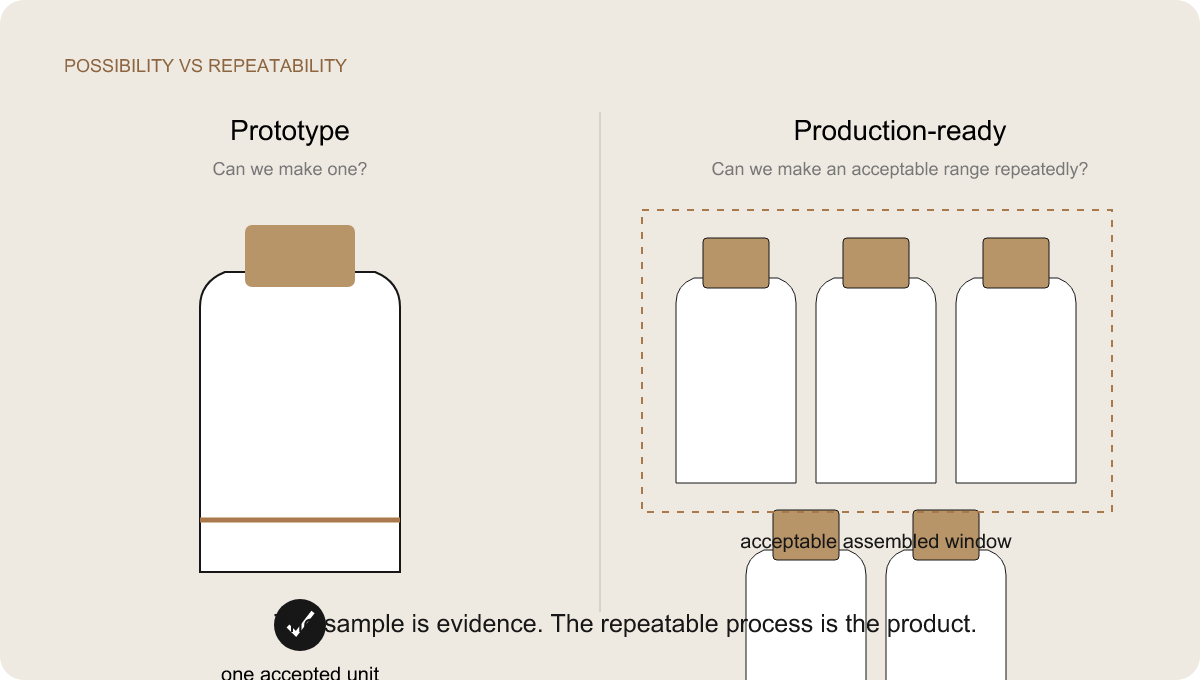
Possibility is not repeatability. The controlled acceptable window—not one selected bottle—is the manufacturing objective.
A generic carton is therefore not automatically adequate for a heavy or highly decorated perfume bottle. Product-specific packing considers where the bottle can be supported, which surfaces must not touch, how movement is limited, whether the cap has vertical clearance, how dividers behave under compression and how the pallet remains stable. The pack must also be practical to assemble consistently; an elegant protective concept that operators cannot repeat is not a control.
The validation route depends on product, destination and agreed requirements, so this case does not invent a drop, vibration or compression result. DAXIN should confirm the actual carton, divider, pallet and verification record before publication. The principle is clear: export packing belongs inside perfume packaging engineering, not after it. DAXIN’s delivery and warehousing content is the relevant next resource for buyers planning this stage.
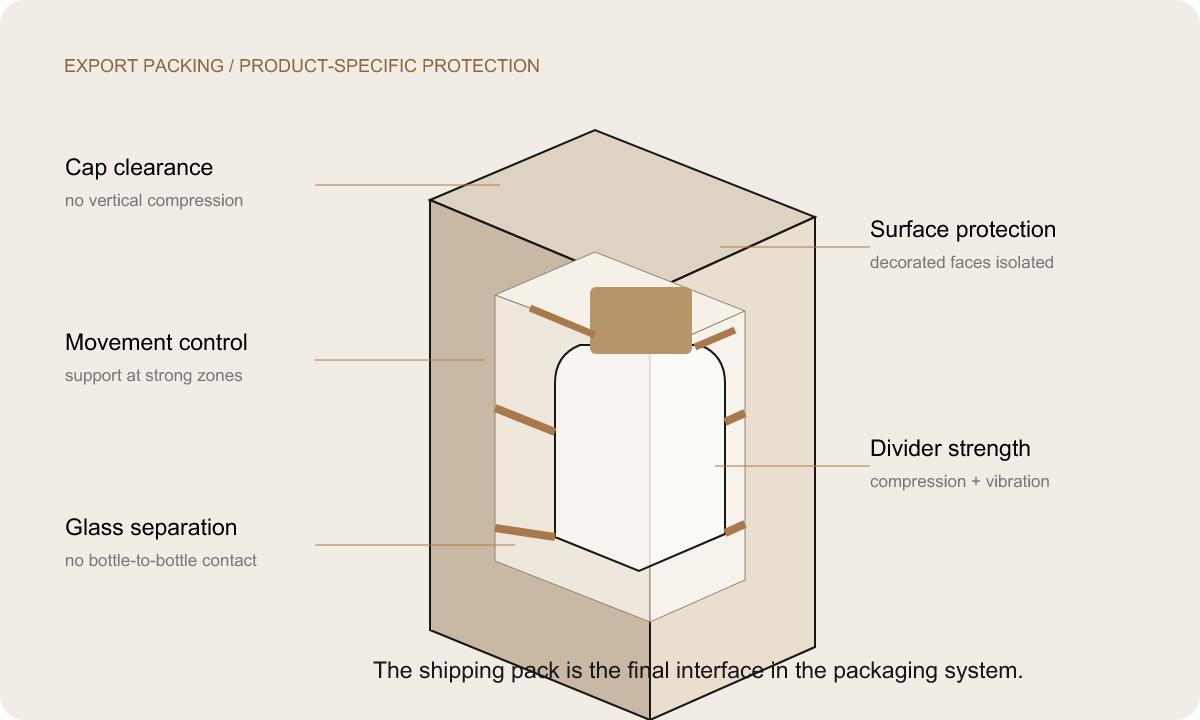
Protection by interface. Separate glass, isolate decorated faces, control movement and keep vertical load away from the cap.
An interface problem discovered during drawing review may require a dimension change and another technical discussion. The same problem discovered after tooling may require tool work and new samples. After component production, it can involve inventory and supplier coordination. After decoration, more value has been added to every affected part. After filling, the fragrance product and filling operation are exposed. After international shipping, distance, delay and market timing enter the recovery.
No invented cost figure is needed to understand the curve. Correction becomes more complex as commitments accumulate and reversibility falls. That is why an early engineering review can create disproportionate value: it tests the high-risk interfaces while the project still has several low-impact choices.
Early review does not guarantee that no problem will ever occur. It changes where the team looks and when evidence is requested. Neck/pump compatibility, assembled cap position, difficult glass geometry, physical color and decoration feasibility can be examined before mass production turns an unclear requirement into a large physical fact.
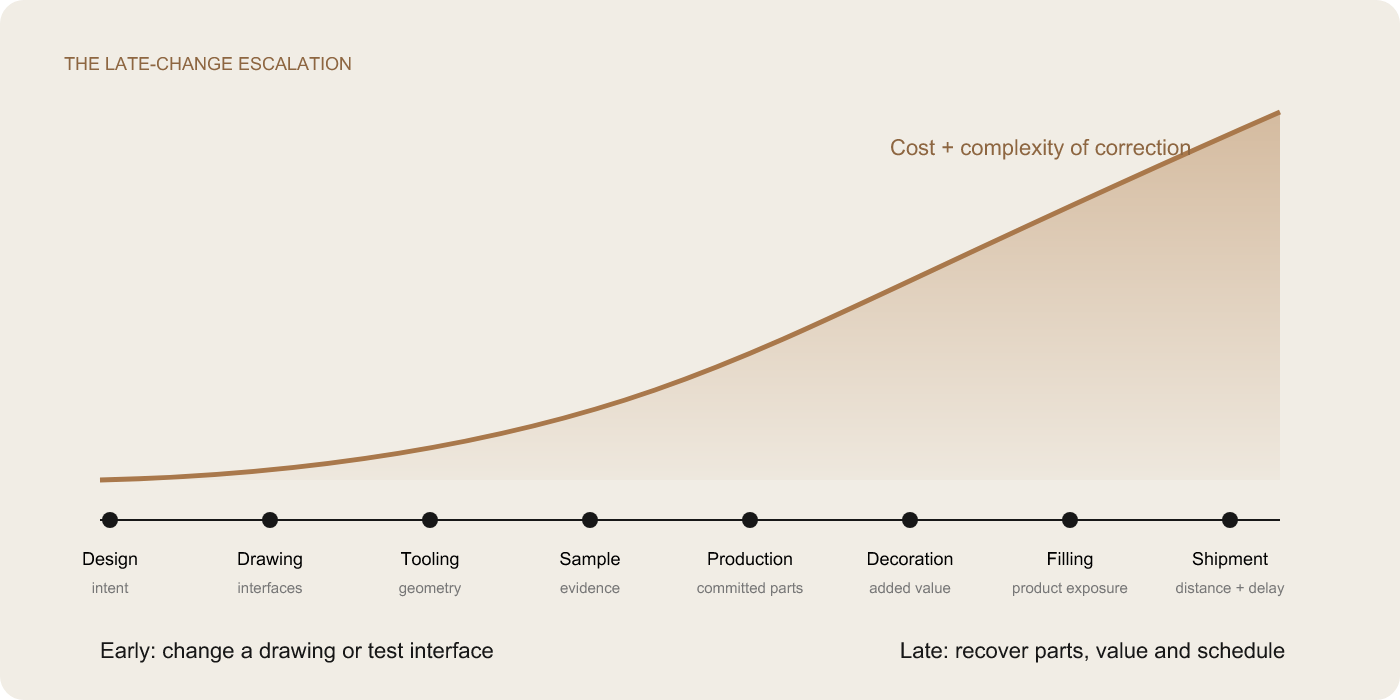
Late-change escalation. The curve is conceptual and intentionally carries no fabricated numerical values.

Engineering protects design quality. A conceptual beauty shot—not a photograph of the referenced customer project.
A production-ready rescue does not end with “we fixed the cap.” It ends with a controlled system: validated bottle geometry, a defined neck and compatible pump, a managed cap-and-collar relationship, approved decoration, physical color and finish masters, an understood assembly sequence, inspection criteria and an export-pack specification built around the actual decorated product.
Those controls do not claim that every future unit will be metaphysically perfect. They define the acceptable range, the evidence used for approval and the points where risk is detected before more value is added. The exact corrected components and project outcome remain. The responsible claim is risk reduction through structured diagnosis, correction and verification—not an unsupported promise that failure became impossible.
これを利用して、シルエット、デザインの意図、ブランドの個性を整合させます。形状、組み立て、視覚的挙動、および製造能力を確認するために、実物サンプルを依頼してください。.
ボトル、ポンプ、キャップは、それぞれ単独では合格とはみなされません。これらが接触する経路と、最終的に組み立てられた状態での性能によって、合格が判断されます。.
コンポーネント図面によって自動的に保護されると仮定するのではなく、消費者向けのシャドウライン、中心位置、およびプロポーションを明確に定義してください。.
まず、ネック、取り付け済みのポンプ、カラー、キャップインサートの寸法を測定してください。ガラスに問題がある場合は、予防的ではなく、意図的に交換してください。.
透明なガラス、塗料、プラスチック、金属、箔は、それぞれ異なる方法で光を反射する。スクリーンは情報を伝達するが、その仕組みは確立された物理的基準によって規定されている。.
承認には、再現可能な範囲が明記され、その根拠となる金型、材料、工程、および組立条件が特定されていなければならない。.
仕切り、クリアランス、および接触ゾーンにより、開発プロセスで形成されたガラス、仕上げ、およびキャップの位置合わせが維持されます。.
単体の単価だけでなく、調整、インターフェース、サンプル、金型への影響、装飾、梱包などを比較してください。.
リバーシブルインサートやカラーの交換は、金型の交換よりも優れた結果をもたらす場合もありますが、場合によってはボトルの修正が必要になることもあります。最終的には実証結果が決め手となります。.
金型製作、表面処理、充填、出荷といった工程が進み、新たな作業が加わると、未解決のインターフェースを再検討するコストはますます高くなります。.
Request a review before tooling when the bottle is highly customized, glass is unusually heavy, shoulders or corners are aggressive, or cap and bottle must align with very little visual margin. Bring engineering into the discussion when a magnetic cap or complex insert creates hidden interfaces; when the pump, bottle and cap come from different suppliers; when metallic color must agree across plastic, aluminum, zamac and foil; or when a large decoration area crosses a curved surface.
Review is equally valuable when the launch schedule is tight or the shipping destination is far from production. Those conditions reduce the room for late correction. If samples already exist, do not send only the component that looks wrong. Send the assembled package, component drawings, revision identity and photographs that show how the symptom changes. A useful investigation needs context.
DAXIN can begin from a render, technical drawing, reference bottle or physical sample. The purpose is not to force every project into a new custom mold. It is to identify the highest-risk interfaces, determine what evidence is missing and decide where to investigate first. Buyers comparing a 香水ボトルのラインナップ, an existing package and a fully custom fragrance packaging route can use the same review logic.
既存のボトルをお探しの場合でも、完全にカスタマイズされたパッケージソリューションをご希望の場合でも、当社の経験豊富なチームが、ボトルのデザインや装飾から、キャップ、梱包、配送に至るまで、お客様のプロジェクトを全面的にサポートいたします。.
 English
  Spanish
  French
  German
  Arabic
  Italian
  Dutch
Dutch  Portuguese
  Russian
  Korean
  Japanese