Het centrale principe van value engineering

Het geanonimiseerde parfumbedrijf achter dit projectkader kwam met een bekende ambitie: een fles die in het winkelschap een solide indruk zou maken, goed op foto’s zou overkomen, bij de eerste aanraking een zelfverzekerd gevoel zou geven en een geloofwaardige luxe prijspositie zou ondersteunen. De oorspronkelijke specificaties leken ook op een catalogus van maatwerk: een nieuwe glasvorm, een metalen dop, een op maat gemaakte pomp en kraag, gelaagde versiering, een stevige presentatiedoos en een op maat gemaakte inleg. Elk onderdeel klonk op zichzelf al premium.
De commerciële opdracht was minder soepel. De eerste bestelling moest rekening houden met een nog niet bevestigde streefhoeveelheid en prijsklasse, de lanceringskalender bood geen ruimte voor een onbeperkt aantal ontwikkelingsrondes en het merk had behoefte aan een oplossing die bij toenemende vraag opnieuw kon worden besteld. Elk exclusief onderdeel zou zijn eigen matrijzen, minimale bestelhoeveelheid, monstercyclus, afhankelijkheid van leveranciers en restvoorraadprofiel met zich meebrengen. De vraag veranderde daarom van “Kan elk onderdeel op maat worden gemaakt?” naar “Welke maatwerkbeslissingen zal de consument daadwerkelijk waarderen?”
De rol van DAXIN bij dit soort evaluaties is niet om de ambitie uit het project te halen. Het doel is juist om het merkconcept te beschermen en tegelijkertijd de commerciële gevolgen bloot te leggen die in de visualisatie verborgen liggen. Dat houdt in dat een bestaande fles wordt vergeleken met een nieuwe mal, dat wordt getoetst of de decoratie de identiteit kan uitdragen, dat wordt bepaald of de tactiele eigenschappen van de dop een groter deel van het budget verdienen, dat functionele interfaces waar nodig worden gestandaardiseerd, en dat de prijs wordt beoordeeld op basis van het totale traject in plaats van op basis van de offerte voor één onderdeel.
Het onderstaande overzicht is een besluitvormingsmodel dat nog moet worden goedgekeurd in het kader van het interne project. Er wordt bewust afgezien van exacte klantgegevens, besparingen, minimale afnamehoeveelheden (MOQ’s), doorlooptijden en prestatieclaims. De waarde ervan ligt in de methode: klantverzoek → implicaties voor kosten, MOQ’s en risico’s → realistische alternatieven → ontwerpbeslissing → gevolgen voor de consument → commerciële gevolgen.
Het centrale principe van value engineering
De gewenste verpakking vereiste de visuele strakheid die past bij de lancering van een premium parfum: een zelfverzekerd silhouet, een gecontroleerde glashelderheid, een dop die een doordacht ontwerp uitstraalde, nauwkeurige metalen details en een buitenverpakking die de fles niet op het laatste moment zou ondermijnen. De doelmarkt, het distributiekanaal en de uiteindelijke winkelcontext blijven ongewijzigd, maar de onderliggende spanning is gemeenschappelijk voor oprichters, productontwikkelaars en inkoopteams: het ontwerp wordt beoordeeld door consumenten, terwijl het ontwerpproces wordt beperkt door volume, budget, tijd en leveringscapaciteit.
Een hoogwaardige verpakking is daarom in de eerste plaats een zakelijke beslissing en pas in de tweede plaats een kwestie van vormgeving. Een eigen fles kan zorgen voor een sterke herkenbaarheid in het schap, maar er gaat ook een aanzienlijk deel van het budget naar een glazen verpakking en de verkoopprognose moet die keuze ondersteunen. Een zamac-dop kan onmiddellijk een gevoel van degelijkheid geven, maar heeft gevolgen voor de kosten van de onderdelen, het vrachtgewicht en de omvang van de voorraadverplichting. Een stevige doos kan zorgen voor een indrukwekkende onthulling, maar kan ook het volumengewicht verhogen en opslagruimte in beslag nemen. Geen van deze keuzes is verkeerd. Voor elke keuze is een reden nodig die aansluit bij de merkpositie.
De evaluatie begon met het indelen van de vereisten in drie groepen. Onveranderlijke merksignalen dat waren de aspecten die er onderscheidend moesten uitzien of aanvoelen. Functionele vereisten de prestaties van de verstuiver, de pasvorm van de sluiting, de montage en de bescherming. commerciële beperkingen het begrote projectbudget, de minimumeisen op componentniveau, de timing van de lancering, de coördinatie met leveranciers en de haalbaarheid van herhaalbestellingen. Een voorstel zou worden beoordeeld op basis van alle drie deze aspecten, en niet louter op basis van de esthetische kwaliteit ervan.
Een parfumverpakking lijkt eenvoudig wanneer deze in elkaar is gezet. Onder de dop gaat echter een reeks beslissingen schuil: de glazen fles en hals, de pomp, de zuigbuis, de kraag, de dopbehuizing en het inzetstuk, de oppervlakteversiering, de kartonnen doos en de interne inrichting. Indien elk element een eigen ontwerp wordt, neemt het aantal onderlinge relaties sneller toe dan het zichtbare aantal onderdelen. De op maat gemaakte dop moet passen op de gekozen kraag. De kraag moet rekening houden met de hoogte van de geïnstalleerde pomp. De pomp moet geschikt zijn voor de flessenhals en de afgifte van de geur. De versierde fles moet de inzet en de transportverpakking doorstaan zonder beschadigingen.
Maatwerk brengt ook administratieve processen met zich mee. Een nieuw onderdeel kan betekenen dat er nog een tekening, een beslissing over het eigendom van gereedschap, een fysiek referentie-exemplaar, goedkeuring van de kleur, een inkooporder, een inspectienorm en een doorlooptijd voor nabestelling nodig zijn. Een onderdeel dat in een offerte goedkoop lijkt, kan veel coördinatieverwerkingen met zich meebrengen als het van een aparte leverancier komt, een starre partijgrootte heeft of een assemblagebewerking vereist waarvoor niemand verantwoordelijk is.
De eerste aanpassing was dan ook van conceptuele aard: het aantal op maat gemaakte onderdelen niet langer gelijkstellen aan luxe. Consumenten bestuderen geen stuklijst. Zij ervaren verhoudingen, evenwicht, afwerking, tactiele eigenschappen, spuitpatroon en de volgorde van het openen. Het project dient alleen complex te zijn wanneer die complexiteit de ervaring beïnvloedt of de prestaties waarborgt.
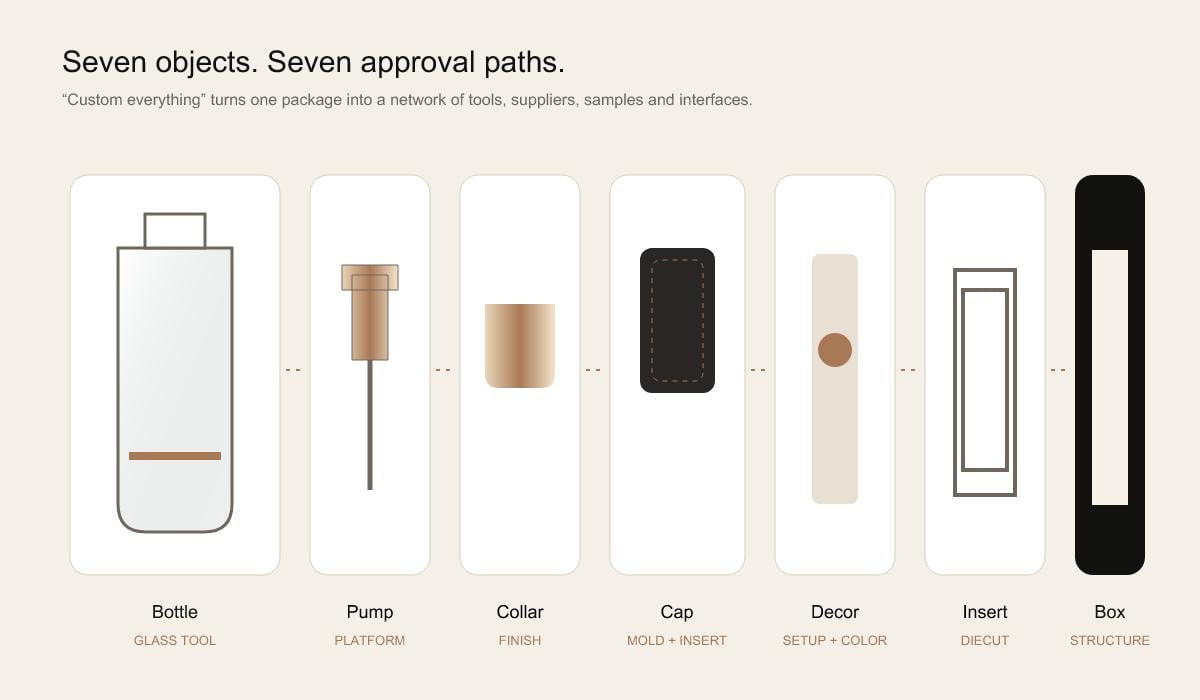
Alles op maat: een toelichting. Zeven zichtbare objecten kunnen zeven trajecten op het gebied van gereedschap, monsters, minimale bestelhoeveelheid en goedkeuring genereren, voordat er rekening wordt gehouden met de onderlinge compatibiliteit. Technisch diagram in SVG-formaat.
Bij verpakkingen voor luxe parfums houdt ‘value engineering’ in dat de kenmerken die klanten kunnen zien, aanraken en met het merk associëren, behouden blijven, terwijl elementen waarvan de extra kosten geen evenredige waarde voor de consument opleveren, worden vereenvoudigd of gestandaardiseerd. Het is geen wedloop naar de laagste specificaties. Een dunne, onstabiele fles of een zwakke doseringsmechanisme zou de waarde verminderen, zelfs als dit de prijs zou verlagen. Hetzelfde geldt voor een afwerking die er op foto’s slecht uitziet, een dop die rammelt of een doos die in de winkel in elkaar zakt.
De methode stelt twee onderling samenhangende vragen. Ten eerste, Wat bepaalt de waargenomen waarde? Hierbij kan het gaan om het silhouet, de verdeling van het glas, het gevoel van de dop, de afwerking, de nauwkeurigheid van het logo en de ervaring bij het openen. Ten tweede, Wat waarborgt de geleverde waarde? Hieronder vallen onder meer de hals, de dosering van de pomp, de afdichting, de hechting van de decoratie, de ondersteuning van het inzetstuk en de reproduceerbare kwaliteit. Sommige elementen vallen onder beide categorieën; andere zijn juist commercieel belangrijk omdat de consument ze nooit opmerkt wanneer ze naar behoren functioneren.
Een onderdeel doorstaat de value-engineeringbeoordeling wanneer het ontwerpvoordeel, het toekomstige nut en de merkwaarde de kosten voor de matrijzen, de minimale afname, de bemonstering, de timing en de risico’s rechtvaardigen. Indien het voordeel onzeker is, kan het verstandiger zijn om een prototype te maken of de investering in fasen uit te voeren, in plaats van deze onmiddellijk goed te keuren of af te wijzen. Dit leidt tot een eerlijkere opdrachtomschrijving voor een projectbeheer op het gebied van verpakkingen gesprek.
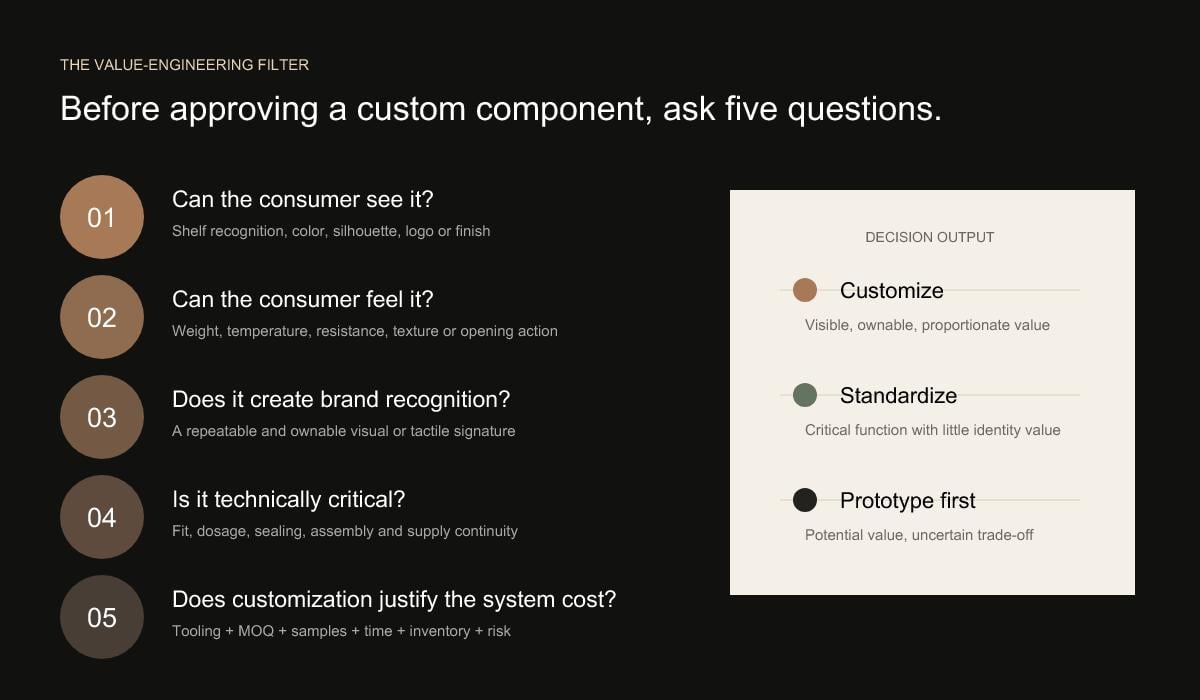
Het kenmerkende beslissingsfilter. De zichtbaarheid voor de consument, de tastbaarheid, de merkherkenning, het technische belang en de totale systeemkosten worden gezamenlijk beoordeeld. Technisch diagram in SVG-formaat.
Een koper die een parfumverpakking tegenkomt, doorloopt een reeks stappen. Van een afstand zorgen het silhouet, de verhoudingen, de kleur en de verhouding tussen fles en dop voor herkenning. In de hand bepalen de gewichtsverdeling, het comfort van de randen, de temperatuur van de dop en de weerstand bij het verwijderen de kwaliteit. Tijdens het gebruik bevestigen of weerleggen het gevoel bij het bedienen van de verstuiver en de verstuivingsprestaties de belofte. Wanneer de verpakking wordt geopend of teruggeplaatst in het schap, versterken de structuur en de pasvorm van de doos de herinnering.
Deze voorbeelden maken duidelijk waarom de prioriteit bij maatwerk niet mag worden bepaald door de prijs van de onderdelen. Een klein logo kan meer aandacht van de consument trekken dan een veel groter, verborgen inzetstuk. Een nauwkeurig gezeefdrukt merkteken kan meer herkenning opleveren dan een onzichtbaar, op maat gemaakt pomponderdeel. Omgekeerd kan de pomp een hogere technische prioriteit verdienen dan de zichtbaarheid doet vermoeden, omdat een slechte verstuiving de productervaring onmiddellijk aantast.
Het praktische verschil is zichtbare identiteit tegenover verborgen techniek. Zichtbare identiteit nodigt uit tot selectieve differentiatie. Verborgen techniek vraagt om beproefde platforms, gecontroleerde interfaces en validatie. Dit is een kader, geen universele regel: een gepatenteerde doseringservaring, een navulsysteem of een zichtbaar mechanisch detail zou een normaal gesproken verborgen onderdeel tot een centraal onderdeel van het merk kunnen maken. Maar de uitzondering dient te worden vermeld, en mag niet als vanzelfsprekend worden beschouwd.
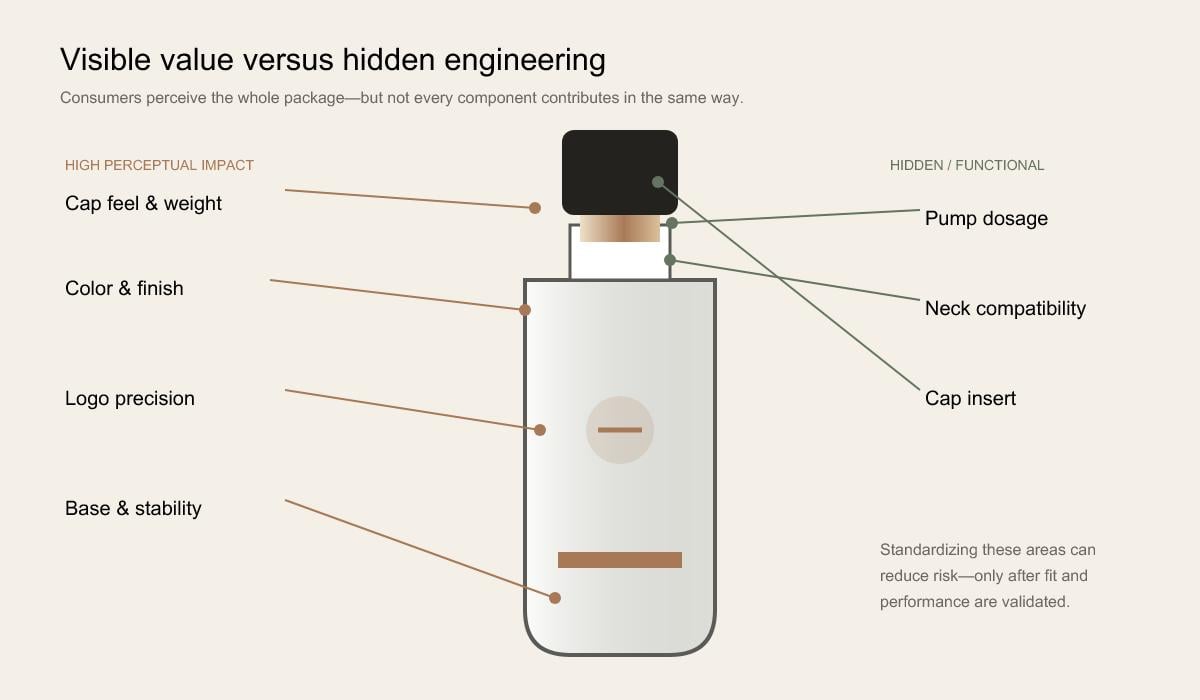
Perceptiekaart. De dop, de afwerking, het logo en de voet dragen bij aan de uitstraling van het merk; de hals, de pomp en het inzetstuk waarborgen de functionaliteit, ook al zijn deze grotendeels aan het oog onttrokken. Technisch diagram in SVG-formaat.
De keuze van de fles heeft een onevenredig grote invloed, omdat de geometrie van het glas van invloed is op de merkherkenning, het decoratieoppervlak, het vulvolume, het gewicht, de afmetingen van de verpakking, het vormgevingsproces en de raakvlakken tussen onderdelen. Een volledig op maat gemaakte fles is een rationele keuze wanneer het eigen silhouet een duurzaam merkelement vormt – iets wat de klant herkent in verschillende campagnes en toekomstige geuren. Dit biedt exacte controle over de schouder, de basis, de voetafdruk en de verhoudingen, maar vereist dat het project de kosten dekt voor gereedschap, engineering, proefmonsters en productievalidatie.
Een bestaande platform voor parfumflesjes biedt een bekende vormgeving en een snellere weg naar fysieke monsters. Het kan de noodzaak van vroege toezeggingen verminderen en een merk helpen de vraag te valideren. De beperking ervan is niet dat het er alledaags uit moet zien; het is dat het structurele silhouet mogelijk ook voor andere kopers beschikbaar is. Het merk moet op een andere manier een gevoel van eigenaarschap creëren.
De commercieel meest veelbelovende tussenweg is een aangepaste standaardfles: de bestaande glasconstructie gecombineerd met een op maat gemaakte afwerking, dop, decoratie en kartonnen verpakking die hierop zijn afgestemd. Aangezien het oorspronkelijke silhouet van de klant nog niet was vastgesteld als het belangrijkste herkenningskenmerk, verdiende deze aanpak een grondige afweging alvorens een nieuwe glasmal te goedkeuren. Hierdoor werd het budget verschoven van onzichtbare ontwikkelingscomplexiteit naar de aspecten die mensen daadwerkelijk zouden zien en aanraken.
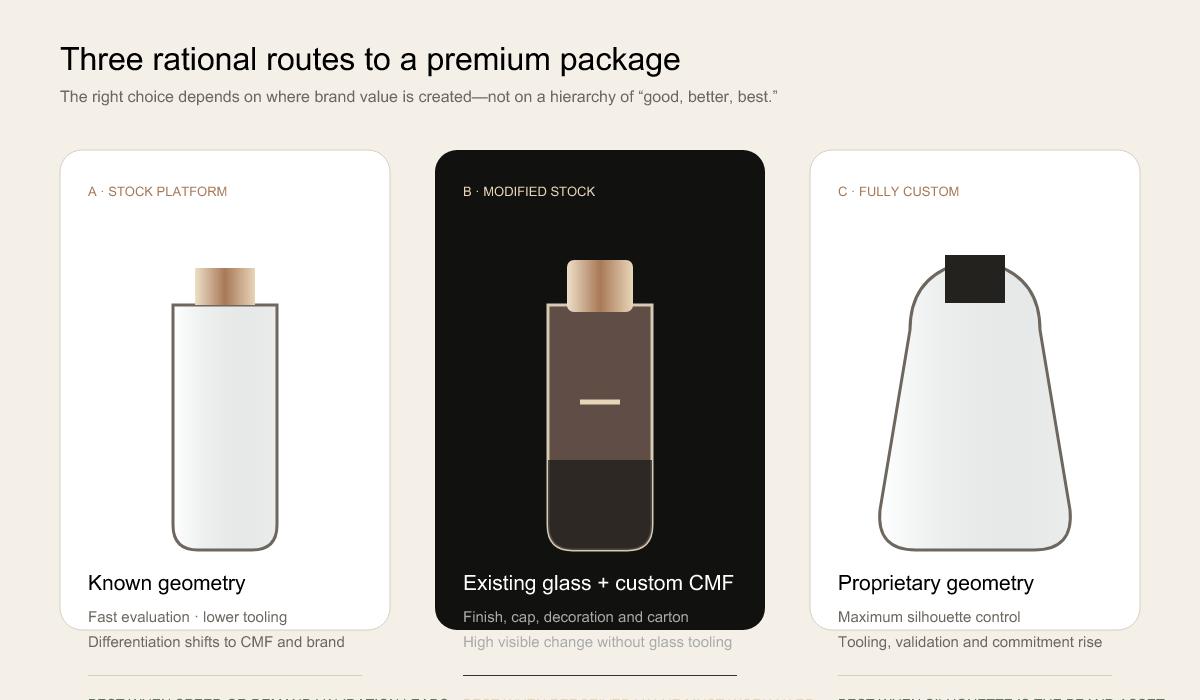
Drie rationele benaderingen. Standaardmodellen worden niet als inferieur beschouwd; aangepaste standaardmodellen kunnen hun waarde vooral in CMF tot uiting brengen, terwijl volledig op maat gemaakte modellen het sterkst uitkomen wanneer het silhouet de investering rechtvaardigt. Technisch diagram in SVG-formaat.
Factor | Standaardfles | Aangepaste standaardfles | Volledig op maat gemaakte fles |
Gereedschap | Bestaand constructiegereedschap; projectspecifiek decoratiegereedschap kan aanwezig blijven | Geen nieuwe glasmal; eventueel een opstelling voor de dop, de bedrukking of de afwerking | Nieuwe glasvormen en de bijbehorende technische ontwikkeling of validatie |
Snelheid | Meestal de kortste route voor een bouwkundige beoordeling wanneer er voorraad beschikbaar is | Voegt CMF- en componentmonstercycli toe | Omvat geometrie, gereedschappen, proefproducties en goedkeuringsafhankelijkheden |
MOQ-logica | Afhankelijk van de beschikbaarheid en de gekozen inrichting | Vaak bepaald door de minst flexibele maatwerkafwerking of het minst flexibele onderdeel | De glasproductie en alle daaruit voortvloeiende onderdelen moeten worden ondersteund |
Exclusiviteit | Beperkt op het niveau van de glasgeometrie | De visuele identiteit kan sterk zijn; de structuur blijft niet-exclusief | Mogelijk de sterkste structurele eigendomsverhouding, onder voorbehoud van overeenkomsten |
Ontwerpvrijheid | De verhoudingen en het decoratiegebied liggen vast | Grote keuzevrijheid wat betreft kleur, afwerking, dop, bedrukking en verpakking | Optimale controle over het silhouet en de verhoudingen binnen de grenzen van de produceerbaarheid |
Ontwikkelingsrisico | Minder structurele onzekerheid; de compatibiliteit moet nog worden gecontroleerd | Met de nadruk op CMF, assemblage en de passing van onderdelen | Hoger omdat de geometrie, de gereedschappen en de reproduceerbaarheid van de productie nieuw zijn |
Schaalbaarheid | Dit hangt af van de continuïteit van het platform en de planning van de leverancier | Kan goed worden opgeschaald met gecontroleerde bestanden en afwerkingsmasters | Een sterke betrokkenheid wanneer het toekomstige volume de tool ondersteunt |
De meest geschikte commerciële toepassing | Belastingstests, snelheid of een ontwerp waarin grafische elementen en capaciteit centraal staan | Een sterke waargenomen differentiatie zonder nieuwe glasgeometrie | Een herkenbaar silhouet dat van cruciaal belang is voor de merkwaarde op lange termijn |
CMF – kleur, materiaal en afwerking – wordt soms beschouwd als een decoratief element dat pas wordt aangebracht nadat het “echte” ontwerp voltooid is. Bij parfumverpakkingen kan het juist het ontwerp zelf zijn. Een doorschijnend rookkleurig kleurverloop beïnvloedt de waargenomen omvang en schaduw. Een warme, matte coating verandert dezelfde geometrische vorm in een zachter ogend object. Een klein metallic detail kan een bewust aandachtspunt creëren. Een dop met een andere materiaaltemperatuur of een ander gewicht verandert de eerste aanraking.
Bij de op waarde gerichte aanpak werd het bestaande glazen platform beschouwd als een betrouwbaar uitgangspunt in plaats van als een compromis. Onderscheidende kenmerken konden worden aangebracht door middel van gecontroleerd spuitlakken, doorschijnendheid, zeefdruk of warmstempelen, en vervolgens versterkt door een dop en een kartonnen verpakking die als één geheel waren ontworpen. DAXIN’s inrichting en afwerking Op deze pagina wordt de context beschreven; de precieze werkwijzen, kleurreferenties en hechtingseisen voor het geanonimiseerde project moeten nog worden bevestigd.
Deze methode kent beperkingen. Bestaande randen, zijwanden en ondergronden kunnen het afplakken en de decoratie beperken. Diepe uitsparingen, scherpe hoeken of verzonken delen kunnen moeilijk gelijkmatig worden afgewerkt. Een coating kan niet het kenmerkende of direct herkenbare silhouet van nieuw glas creëren. CMF kent bovendien eigen minimumafnamehoeveelheden, kleurtoleranties en verplichtingen inzake monsters. Value engineering houdt niet in dat men doet alsof decoratie gratis is; het gaat erom te vergelijken waar de kosten daarvan meer zichtbare verandering opleveren dan structurele aanpassingen aan de matrijzen.
Transparante, getinte, matte en ondoorzichtige afwerkingen beïnvloeden de manier waarop licht en vloeistof in wisselwerking staan met een bestaande fles.
Glas, metaal, kunststof en papier moeten een gemeenschappelijke visuele intentie hebben, zelfs wanneer hun fysieke oppervlakken niet exact met elkaar overeenkomen.
Voor glans, textuur, dekkracht en metaalachtige reflectie zijn echte monsters onder gecontroleerde kijkomstandigheden nodig, en niet alleen afbeeldingen op het scherm.
Parfummerken gebruiken het gewicht vaak als maatstaf voor kwaliteit. Een zwaardere basis kan de stabiliteit verbeteren, een rijkere lichtbreking creëren en ervoor zorgen dat een fles stevig aanvoelt wanneer men deze optilt. Het gewicht kan met name van pas komen wanneer de uiterlijke vormgeving ingetogen is en het merk meer behoefte heeft aan fysieke aanwezigheid dan aan decoratieve complexiteit.
Toch is “zwaarder” geen doelstelling zonder beperkingen. Extra glas heeft invloed op de massa per eenheid, de vereisten voor karton, de ondersteuning van de inlegstukken, het gewicht van de mastercase, de palletbelading en de vrachtkosten. Een zeer dikke bodem kan tevens de glasverdeling en de visuele kwaliteit bemoeilijken indien de geometrie wordt doorgevoerd zonder rekening te houden met het gietgedrag. Duurzaamheidsdoelstellingen kunnen de aanvaardbare balans tussen waargenomen stevigheid en materiaalintensiteit verder veranderen.
Het technische doel zou daarom moeten zijn waargenomen gewicht, niet het maximale gewicht. De verhoudingen, het lage zwaartepunt, de stabiele voetafdruk, de dichtheid van de dop en de manier waarop de fles in de hand ligt, beïnvloeden allemaal die beleving. Een evenwichtige fles met een goed afgewogen voet en een stevige dop kan een meer volmaakte indruk maken dan een zwaardere fles waarvan de massa willekeurig lijkt. Het gekozen gewicht en de glasverdeling voor de daadwerkelijke verpakking moeten door DAXIN worden bevestigd.
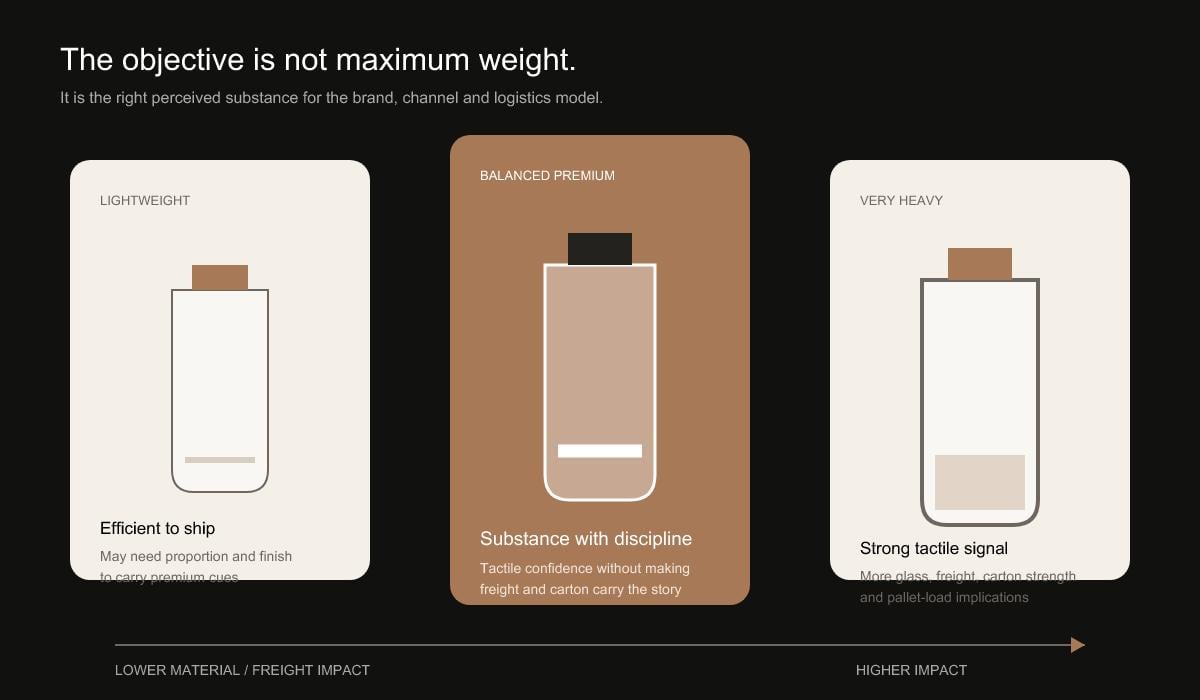
Afweging tussen gewicht en andere factoren. Meer glas kan de tactiele ervaring versterken, maar brengt tegelijkertijd ook grotere gevolgen met zich mee op het gebied van verpakking en logistiek; wat het beste is, hangt af van de specifieke toepassing. Technisch diagram in SVG-formaat.
De dop neemt visueel minder ruimte in dan de fles, maar consumenten raken hem herhaaldelijk aan. Het gewicht, de temperatuur, de uitlijning, de kracht die nodig is om hem te verwijderen en het geluid kunnen de waargenomen kwaliteit versterken of juist een discrepantie aan het licht brengen. Bovendien bevindt de dop zich bovenaan het silhouet, waar een opvallende verhouding zowel op foto’s als in het schap herkenbaar is.
Dit biedt een waardevol alternatief: het combineren van een beproefd glasplatform met een meer opvallende dop. Een verzwaarde ABS-constructie, een strakke aluminium behuizing of een sculpturale zamac-vorm kunnen een tastbaar en visueel herkenbaar karakter creëren, zonder dat er een nieuwe glasgeometrie nodig is. Met een op maat gemaakte inzetstuk kan de buitendop worden aangepast aan een gestandaardiseerde sluitingshuls – mits de bevestiging, de verticale positie, de rotatie-uitlijning en het materiaalgedrag zijn gevalideerd.
Het nadeel is dat de dop geen op zichzelf staand object is. Een zeer zware dop kan de verpakking topzwaar maken. Een brede dop kan in conflict komen met de vormgeving van de schouder of de vrije ruimte in de doos. Een metalen afwerking die er in een render luxueus uitziet, kan niet goed samengaan met een warmdruk of een kraag wanneer deze op een ander substraat worden geproduceerd. Om deze reden dient het budget voor de dop niet alleen de offerte voor de schaal te omvatten, maar ook de fysieke pasvorm en de goedkeuring van CMF.
Een strategische keuze, geen algemene regel
ABS biedt een grote flexibiliteit wat betreft vormgeving en decoratie bij een relatief laag gewicht. Het materiaal kan worden gekleurd, gecoat of gemetalliseerd, en door middel van een inwendig gewicht kan de tactiele eigenschap worden aangepast zonder dat de zichtbare buitenkant verandert. De waargenomen waarde hangt af van het ontwerp van de wanden, de afwerking van de naden, de oppervlakteafwerking, de kwaliteit van de inzetstukken en de manier waarop het materiaal aansluit op de fles.
Aluminium zorgt voor een van nature metaalachtige buitenlaag en voelt in eerste instantie koel aan. Het leent zich uitstekend voor een strakke, precieze vormentaal zonder de zwaarte van zamac. De productiemethode, de wanddikte, de vervormingsgrenzen, de keuzes op het gebied van anodiseren of afwerking en de verhouding tot een interne kunststofstructuur zijn allemaal van invloed op het eindresultaat. Het is niet simpelweg een kwestie van “metaal, dus hoogwaardig”.”
Zamac biedt een aanzienlijk gewicht, een compacte dichtheid en meer sculpturale vormen. Dat maakt het een krachtig materiaal voor merken waarvan de dop een verzamelobject of een kenmerkend element is. Het kan echter ook aanzienlijke investeringen in matrijzen, nauwkeurige afwerkingscontrole en verzendingsaspecten vereisen. Het juiste advies vloeit voort uit de merkpositionering, de gewenste tactiele eigenschappen, de geometrie, de hoeveelheid en het budget – niet uit een algemene ranglijst van materialen. De pagina’s van DAXIN over Zamac-deksels en plastic deksels aanvullende context met betrekking tot de herkomst bieden.
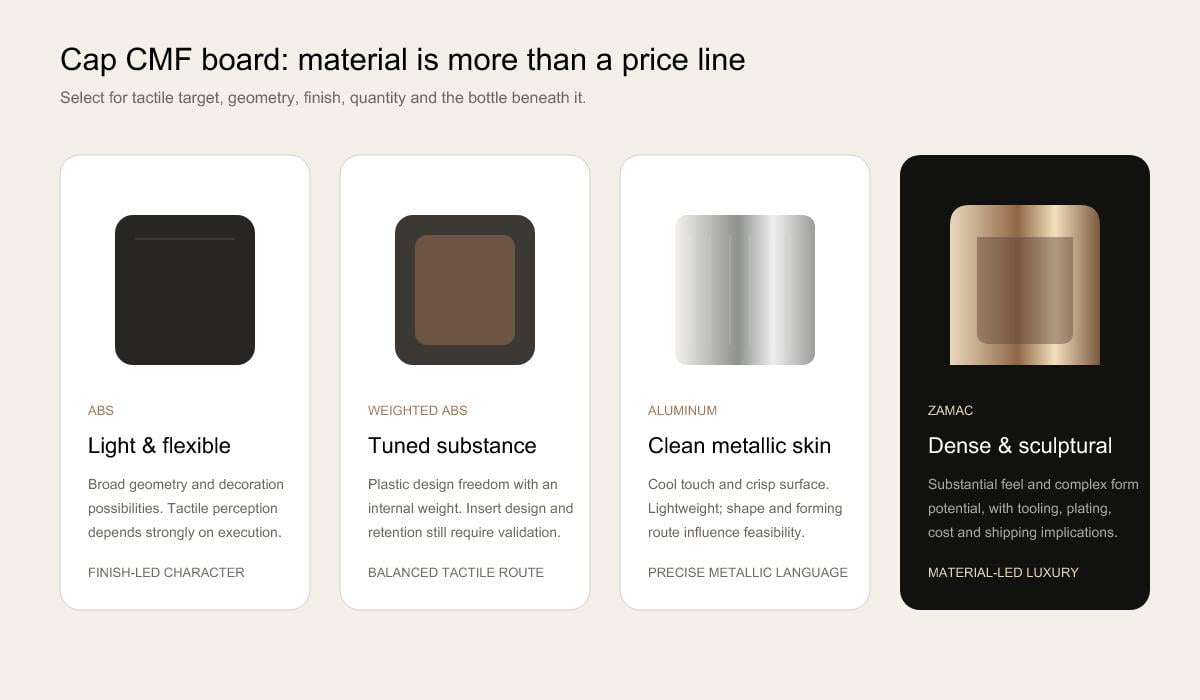
CMF-printplaat. De materiaaleigenschappen, geometrie, interne structuur en oppervlakteafwerking moeten in hun onderlinge samenhang worden beoordeeld. Technisch diagram in SVG-formaat.
Component | Zichtbaarheid voor de consument | Functioneel belang | Kosten en risico’s van maatwerk | Merkwaarde | Aanbevolen strategie |
|---|---|---|---|---|---|
Glazen fles | Hoog | Hoog | Gemiddeld tot hoog wanneer de geometrie nieuw is | Hoog wanneer het silhouet of de verdeling van het glas herkenbaar is | Pas dit aan wanneer de structuur de identiteit bezit; anders dient u de standaardwaarde + CMF te hanteren |
Nek | Laag na montage | Hoog | Hoog indien een niet-standaard interface wordt geïntroduceerd | Meestal laag, tenzij er bewust blootstelling plaatsvindt | Geef de voorkeur aan een beproefde interface die de beschikbaarheid van pompen en doppen ondersteunt |
Pomp | Laag tot gemiddeld | Hoog | Gemiddeld tot hoog voor een nieuw platform | Medium wanneer de verstuiver of bedieningsknop deel uitmaakt van de ervaring | Standaardiseer het platform, tenzij een onderscheidende functie de ontwikkeling rechtvaardigt |
Halsband | Medium | Medium | Gemiddeld, omdat de pasvorm en de afwerking op elkaar inwerken | Het tussenstuk als overgang tussen glas en dop | Gebruik een compatibel platform en pas het oppervlak of de verhoudingen selectief aan |
Cap | Hoog | Gemiddeld tot hoog | Gemiddeld tot hoog, afhankelijk van het materiaal en het gereedschap | Hoog, omdat consumenten het kunnen zien en aanraken | Een sterke kandidaat voor gerichte investeringen in gereedschap of materiaal |
Decoratie | Hoog | Medium | Medium; de instelling en de herhaalbaarheid zijn van belang | Uitstekend op het gebied van kleur, logo en herkenbaarheid | Gebruik dit als een krachtig onderscheidend kenmerk in combinatie met fysieke masters |
Kader | Hoog vóór de opening | Gemiddeld tot hoog qua bescherming | Medium; structuur en opdruk hebben elk een eigen effect | Hoogtepunt voor het retailverhaal en de onthulling | Pas de ervaring aan en bepaal zelf de maat en de beschermingsgraad |
Invoegen | Laag tot gemiddeld | Uitstekend wat betreft behoud en bescherming | Laag tot gemiddeld, afhankelijk van het materiaal en de structuur | Meestal lager, tenzij zichtbaar tijdens het openen | Geef prioriteit aan pasvorm, bescherming en efficiëntie van de uitrusting boven uiterlijke versieringen |
De pomp is na montage grotendeels aan het oog onttrokken, maar het is een van de meest veeleisende gebieden voor het aanbrengen van symbolische aanpassingen. De spuitdosering, de spuitnevel, de weerstand van de actuator, de compatibiliteit van pakkingen, de kwaliteit van de krimpverbinding, de inbouwhoogte, de lengte van de dompelbuis en de continuïteit van de toevoer zijn van invloed op het gebruik en de montage. Een innovatieve buitenste actuator of een zichtbare afwerking kan de ontwikkeling rechtvaardigen; een op maat gemaakt intern platform dat voor de gebruiker geen wezenlijk verschil oplevert, kan het risico daarentegen alleen maar vergroten.
Het robuuste standaardraamwerk is: Standaardiseer de onzichtbare techniek, pas de zichtbare identiteit aan. Met “standaardiseren” wordt hier niet bedoeld dat u willekeurig een kant-en-klare pomp uit het assortiment kiest. Het betekent dat u een beproefde en beschikbare pompserie kiest die compatibel is met de hals, de samenstelling, de afvulmethode, de beoogde dosering en het dopsysteem, en vervolgens het eindresultaat vaststelt. DAXIN’s opties voor parfumverstuivers dit dient als uitgangspunt, niet als automatische goedkeuring voor een specifiek product.
Een gestandaardiseerd platform kan vervanging, herbestellingsplanning en leverancierscontinuïteit vereenvoudigen. Het kan tevens het ontwerp van de dop en de kraag vergemakkelijken, aangezien de geïnstalleerde omhulling bekend is. De pomp dient alleen op maat te worden gemaakt indien de spuitervaring, de zichtbare actuator, het navulconcept of een ander bewust gekozen kenmerk voldoende consumenten- of functionele waarde oplevert. De compatibiliteit met de formule en de prestatie-eisen voor het geanonimiseerde geval moeten nog worden bevestigd.
Vraag een specificatie van het onderdeel en een gemonteerd monster aan, en beoordeel vervolgens de spuitkwaliteit, de dosering, de bediening, het risico op lekkage, de krimp- of schroefverbinding, het gedrag van de dompelbuis, de inbouwhoogte en de uiterlijke afwerking. De fles, de pomp, de kraag en de dop dienen als een geheel te worden beoordeeld.
Decoratie is vaak een van de meest rendabele manieren om het budget in te zetten, omdat het het naar de consument gerichte oppervlak direct verandert. Door middel van spuitlakken kunnen dekkende kleuren, doorschijnendheid of diepte door kleurverlopen worden aangebracht. Een matte of gesatineerde afwerking verandert de lichtval en de tactiele eigenschappen. Zeefdruk kan een scherp grafisch ritme creëren. Warmstempelen of een klein metalen element kan de aandacht trekken zonder het glas te bedekken.
De meerwaarde ontstaat door terughoudendheid en afstemming. Vijf losstaande effecten kunnen minder hoogwaardig overkomen dan één zorgvuldig uitgewerkte afwerking met een exacte plaatsing van het logo. Een afwerking dient de vorm van de fles en het materiaal van de dop te ondersteunen, in plaats van daarmee te concurreren. Het ontwerp moet rekening houden met de bedrukbare gebieden, hoekradii en procesbeperkingen. Metallische details op glas, dop, kraag en karton moeten een visuele eenheid vormen, zelfs wanneer verschillen in het substraat een perfecte fysieke overeenkomst onmogelijk maken.
Bij decoratie komen ook minimale productieseries, instellingen, kleuraanpassing, afplakken, hechtingstests, uitharding en proefseries kijken. Bij een project waarbij voor bestaand glas wordt gekozen om matrijskosten te vermijden, mogen deze vereisten niet over het hoofd worden gezien. Het voordeel hiervan is dat het ontwikkelingsrisico zich concentreert op het zichtbare oppervlak, in plaats van tegelijkertijd verdeeld te zijn over zowel een nieuwe structuur als een nieuw oppervlak.
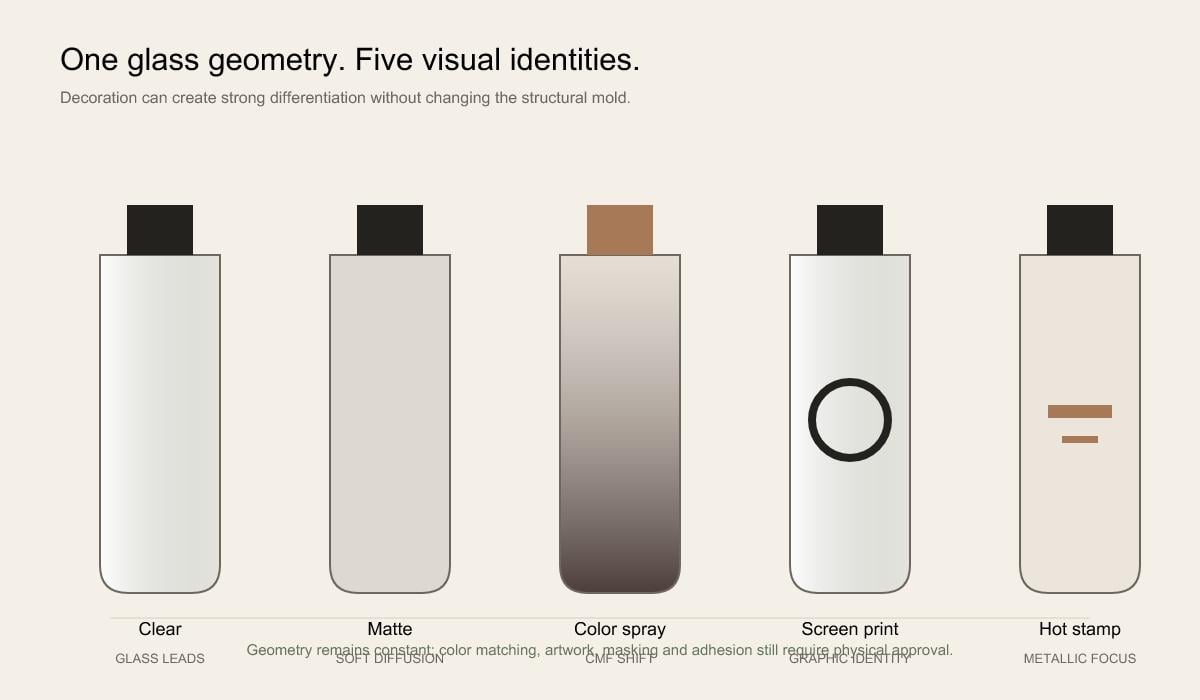
Een transformatie van de inrichting. De structuur blijft ongewijzigd, terwijl het licht, de kleur en de grafische identiteit veranderen; de fysieke kleur en de goedkeuring van de hechting blijven van essentieel belang. Technisch diagram in SVG-formaat.
Het “80/20”-principe is een kader voor besluitvorming, geen vaststaande wet. Het dwingt een team om de impact te rangschikken in plaats van aan elk onderdeel evenveel emotioneel gewicht toe te kennen. Bij veel parfumprojecten dragen de vorm, de basis, de dop, de kleur, de afwerking, de nauwkeurigheid van het logo en de eerste geurervaring in grote mate bij aan de waargenomen kwaliteit. Verborgen onderdelen van de pomp en details met betrekking tot de bevestiging van de dop kunnen weliswaar cruciaal zijn voor de functionaliteit, maar vereisen niet automatisch een eigen, gepatenteerde vormgeving.
De rangschikking verschilt per concept. Bij een navulbare geur kan het sluitmechanisme een belangrijk onderdeel van het verhaal vormen. Bij een minimalistische, doorzichtige fles kan de uitstraling vrijwel volledig afhangen van de verdeling van het glas en een klein gedrukt merkteken. Bij een rijkelijk versierd regionaal concept kan de identiteit meer in de dop en de verpakking liggen dan in de fles zelf. De waardematrix maakt daarom gebruik van kwalitatieve beoordelingen en toelichtingen in plaats van onechte, universele scores.
De matrix maakt tevens onderscheid tussen zichtbaarheid voor de consument uit functioneel belang. Een lage zichtbaarheid mag nooit worden opgevat als een lage prioriteit. De pomp en de hals kunnen onderdelen zijn die van groot belang zijn maar weinig opvallen, waarbij robuuste standaardisatie de beste strategie is. Decoratie daarentegen kan wel opvallen maar van minder structureel belang zijn, waardoor het een sterke kandidaat is voor merkopbouw, maar geen vervanging vormt voor de technische aspecten.
Oppervlakte | Cosmetische eis | Functionele eis | Waarom beide van belang zijn |
Pet en kraag | Centraal geplaatste, consistente overgang, goedgekeurde afwerking | Bevestiging, vrije doorgang en herhaalbare montage | De sluiting wordt aangeraakt en bekeken voordat het parfum wordt gebruikt |
Fles | Symmetrie, optische kwaliteit, kleur- en oppervlaktebestendigheid | Capaciteit, constructieve integriteit, compatibiliteit met de hals en een stabiele basis | Het glas vormt zowel de hoofdstructuur als het visuele kenmerk van het merk |
Pomp | Uitlijning van de actuator en de kraag, consistentie van de afwerking | Correcte montage, bediening en prestaties bij de productafgifte | Een verborgen installatieprobleem kan de zichtbare positie van de afdekking beïnvloeden |
Decoratie | Schaal, positie, dichtheid, rand en glans | Hechting en geschiktheid voor verwerking en verpakking | Een perfecte eerste indruk moet de hele distributieketen doorstaan |
Transportpakket | Een nette uitstraling bij aankomst | Bewegings-, compressie- en contactcontrole | De beschermingsregeling waarborgt dat elke cosmetische ingreep waarvoor reeds is betaald, behouden blijft |
Een compleet parfumarrangement doorloopt niet één enkel productieproces. Voor een bestaande glazen fles kan één beschikbaarheidsvoorwaarde gelden, voor een afwerking met verstuiver een andere batchvereiste, voor een op maat gemaakte dop een andere productiedrempel, voor een pomp een andere leveringsregel en voor een bedrukte doos een andere efficiënte afnamehoeveelheid. De aanmaak van productiegereedschappen kan al een verbintenis met zich meebrengen nog voordat er afgewerkte eenheden zijn besteld. Kleurvarianten kunnen een anderszins bruikbaar volume opsplitsen in kleinere batches.
De betere vraag is: Welk onderdeel zorgt binnen dit verpakkingssysteem voor de strengste of juist de minst flexibele MOQ-beperking? Die vraag maakt duidelijk of het gevraagde pakket aansluit bij de prognose van de eerste orde. Het wijst tevens in de richting van het juiste herontwerp. Indien een op maat gemaakte dop het knelpunt vormt, kan het merk overwegen om een bestaande dop met een projectspecifieke afwerking te gebruiken, de dop voor toekomstige geuren te hergebruiken, de op maat gemaakte matrijs geleidelijk uit te faseren, of extra voorraad te accepteren omdat de dop voldoende merkwaarde vertegenwoordigt.
De minimale bestelhoeveelheid (MOQ) dient op component- en procesniveau in kaart te worden gebracht voordat het definitieve concept wordt vastgelegd. Deze inventarisatie dient het glas, elke decoratiebewerking, de dop en het inzetstuk, de pomp en de kraag, de doos, het inzetstuk en eventuele assemblages of accessoires te omvatten. De exacte DAXIN-hoeveelheden moeten afkomstig zijn uit een actuele offerte; in deze casestudy wordt bewust afgezien van het publiceren van niet-geverifieerde algemene cijfers.
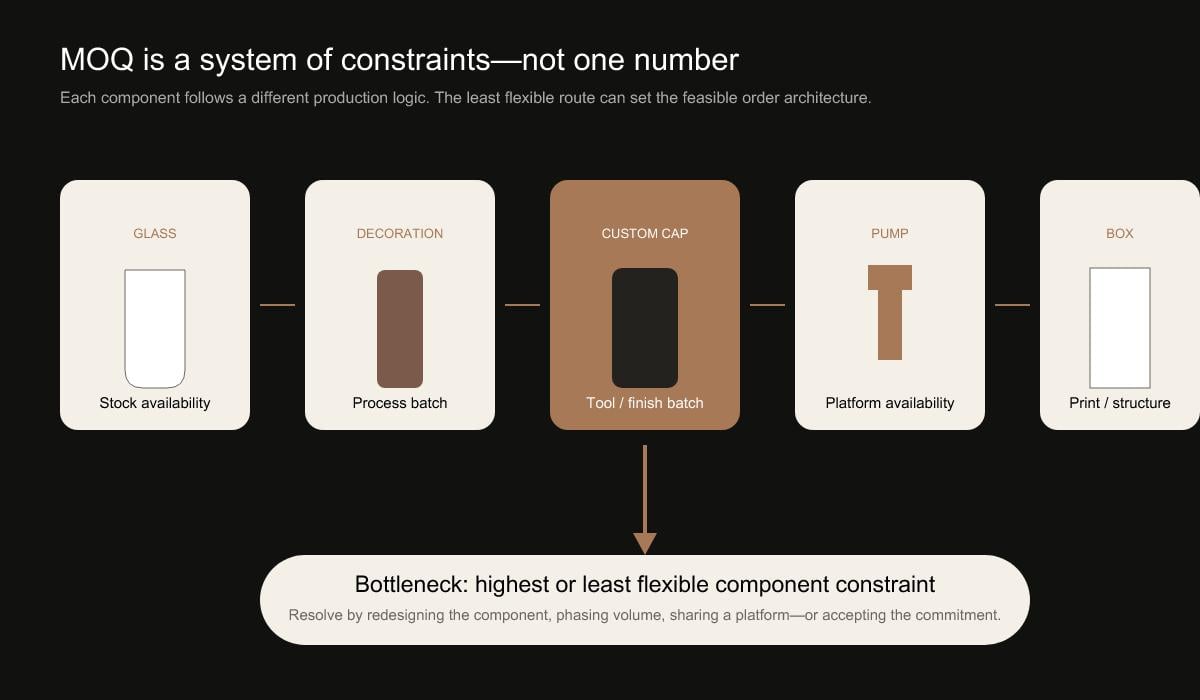
Logica achter de minimale bestelhoeveelheid (MOQ). De gemarkeerde limiet dient ter illustratie en vormt geen claim met betrekking tot de DAXIN-hoeveelheid; een daadwerkelijk project kan onderhevig zijn aan willekeurige componenten of processen. Technisch diagram in SVG-formaat.
Stel u een project voor waarbij een bestaande fles beschikbaar is in een hoeveelheid die aansluit bij de lancering, de geplande coating in een andere batchgrootte kan worden geproduceerd, de op maat gemaakte dop een grotere afname vereist, de pomp in een andere verpakkingsgrootte wordt besteld en de kartonleverancier aparte drukkosten hanteert. Er is geen enkel getal dat dit systeem volledig weergeeft. Het merk kan meer doppen ontvangen dan bedrukte flessen, meer pompen dan dozen, of overgebleven bijsluiters die niet kunnen worden hergebruikt.
De eerste reactie mag niet zijn om elk cijfer afzonderlijk naar beneden te onderhandelen. Een kleine productieserie die een efficiënt proces verstoort, kan de kosten per eenheid verhogen of de productiestabiliteit verminderen. In plaats daarvan dient het team vast te stellen welke afwijking een risico voor het werkkapitaal vormt en of de architectuur dit kan opvangen. Een standaardpomp kan wellicht voor toekomstige projecten worden gebruikt. Een onversierde dop kan later worden afgewerkt. Een neutraal inzetstuk kan wellicht voor twee verschillende verpakkingsontwerpen worden gebruikt. Deze opties vereisen bevestiging door de leverancier, maar zij illustreren waarom het gebruik van gemeenschappelijke componenten financiële waarde heeft.
Het knelpunt kan ook tijd zijn in plaats van hoeveelheid. Een onderdeel kan weliswaar een aanvaardbare minimale bestelhoeveelheid (MOQ) hebben, maar geen beschikbare productietermijn. Voor een ander onderdeel kan een kleurmonster vereist zijn dat op het kritieke pad ligt. De inkoopafdeling dient daarom de minimale bestelhoeveelheid, de doorlooptijd, de houdbaarheid (indien van toepassing), het opslagvolume en de hergebruiksmogelijkheden gezamenlijk in kaart te brengen. Hierdoor wordt de MOQ niet langer een frustrerende vraag vanuit de verkoop, maar een input voor het ontwerp.
Geef aan welk onderdeel of welk proces de minst flexibele combinatie van hoeveelheid, timing en specificaties heeft.
Vraag u af of die op maat gemaakte functie voldoende naamsbekendheid of prestaties oplevert om de investering te rechtvaardigen.
Standaardiseren, delen, in fasen uitvoeren, later afronden of de voorraad bewust accepteren — afhankelijk van de haalbaarheid bij de leverancier.
Met een verpakkingsbudget kan een op maat gemaakte glasvorm, een dopvorm, een metalen versiering of een inlegmatrijs worden gefinancierd, of juist helemaal geen nieuw constructiegereedschap. De juiste keuze is niet de meest in het oog springende post op de offerte van een leverancier. Het is het gereedschap waarvan de output waardevol blijft gedurende voldoende consumenteninteracties en toekomstige bestellingen.
Een op maat gemaakte flesmal kan zeer effectief zijn wanneer het silhouet wordt beschermd en binnen een hele productreeks consistent kan worden gerealiseerd. Met een dopmal kan de investering worden geconcentreerd op het onderdeel dat de consument daadwerkelijk aanraakt. Een klein metalen ornament kan een herkenbaar blikpunt vormen, terwijl de structuur van de fles en de dop standaard kan blijven. Een op maat gemaakte inzet kan gerechtvaardigd zijn wanneer deze een ongebruikelijke fles beschermt of zorgt voor een gecontroleerde onthulling, maar decoratieve complexiteit die onder het product verborgen blijft, levert wellicht niet voldoende rendement op om de kosten te rechtvaardigen.
Elk voorstel voor productietools dient te worden beoordeeld op basis van zichtbaarheid voor de consument, onderscheidend vermogen van het merk, verwachte productievolumes, hergebruik voor verschillende SKU’s, eigendoms- of exclusiviteitsvoorwaarden, doorlooptijd, productievalidatie en technische risico’s. DAXIN’s eigen spuitgietproductie De informatie is relevant voor de op maat gemaakte route, maar het daadwerkelijke matrijstype, de eigendomsvoorwaarden en de planning moeten voor een specifiek project worden bevestigd.
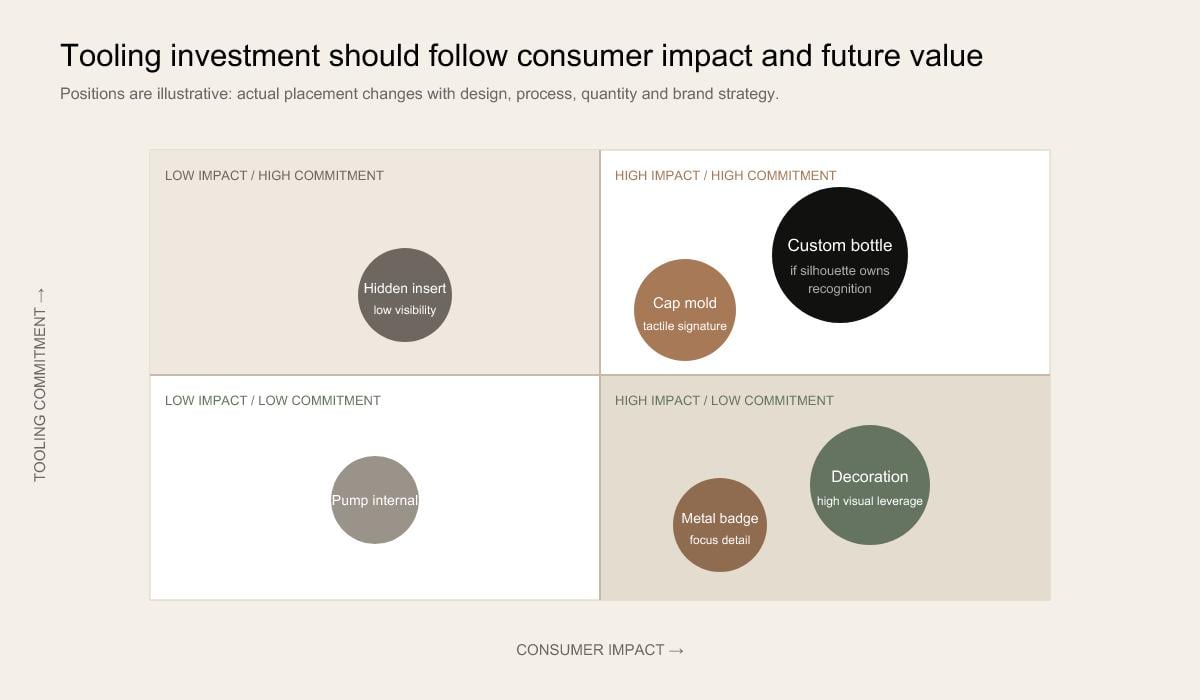
Gereedschapsmatrix. De plaatsing is conceptueel en moet in lijn zijn met het ontwerp; dit voorkomt dat teams uit gewoonte middelen toewijzen aan een functie die veel inzet vereist maar weinig effect heeft. Technisch diagram in SVG-formaat.
Beleggingsroute | Gevolgen voor de consument | Waarde op lange termijn | Belangrijkste risico | Gebruik wanneer |
Op maat gemaakte flessenmal | Mogelijk hoog door het silhouet en de verdeling van het glas | Hoog indien hergebruikt als herkenbaar merkplatform | Gereedschappen, proefproducties en productieverplichting | De vorm van de fles staat centraal in de identiteit en de prognose ondersteunt dit |
Matrijs voor op maat gemaakte doppen | Opvallend door de textuur, het gewicht en het silhouet van de bovenlijn | Hoog, indien de samenwerking bij toekomstige lanceringen kan worden voortgezet | Pasvorm, plaatsing, afwerking, minimale bestelhoeveelheid en een ontwerp met een zwaartepunt aan de bovenkant | De dop kan een kenmerkend element worden zonder het glas te ingewikkeld te maken |
Op maat gemaakt metalen ornament | Gemiddeld tot hoog als specifiek detail | Medium waarbij het kunstwerk of de afwerking zich rond één onderdeel kan ontwikkelen | Bevestiging, slijtage, consistentie van de beplating en aanvullende montage | Een klein, herkenbaar detail zorgt voor voldoende herkenbaarheid |
Aangepaste inzet | Meestal laag na de opening | Medium, wanneer dit een stabiel verpakkingsformaat waarborgt | Overtollige hoeveelheden, materiaal, pasvorm en SKU-specifieke voorraad | Een verdedigings- of openingschoreografie heeft dit werkelijk nodig |
Geen nieuwe structurele gereedschappen | Hoog wanneer CMF en samenstelling sterk zijn | Gemiddeld tot hoog, met gecontroleerde masteropnames en bestanden | Minder structurele exclusiviteit | Snelheid, risico van de eerste orde of een door het oppervlak bepaalde identiteit speelt de hoofdrol |
Een lage flesprijs kan legitiem zijn en toch tot een duur project leiden. Indien voor de fles een aparte leverancier van doppen nodig is, een extra vrachtvervoer, twee extra monsterrondes, lokale assemblage en een nieuwe inspectieoverdracht, kan het prijsverschil op de onderdelenlijn teniet worden gedaan. Indien na de decoratie een afwijking wordt ontdekt, beperken de kosten zich niet langer tot het vervangende onderdeel; zij omvatten ook de voorraad afgewerkte producten, herbewerking, vertraging in de planning en aandacht die van de marktintroductie wordt afgeleid.
De totale projectkosten omvatten gereedschap, monsters, onderdelen, afwerking, vrachtkosten, kwaliteitscontrole, coördinatie, assemblage, risico op herbewerking, voorraad en vertraging. Sommige categorieën zijn zichtbaar in offertes van leveranciers. Andere komen voor in de interne kosten van het merk voor arbeid, magazijn, het lanceringsplan of afschrijvingen. Door middel van value engineering worden deze verborgen categorieën vergelijkbaar gemaakt voordat een definitieve aanpak wordt gekozen.
Dit betekent niet dat een voorstel met één leverancier automatisch de beste keuze is. Gespecialiseerde leveranciers kunnen belangrijke materiële of technische meerwaarde bieden. De vraag is of die meerwaarde opweegt tegen de interfacekosten en of de verantwoordelijkheid voor tekeningen, sjablonen, logistiek, keuring en eindmontage duidelijk is. DAXIN’s toeleveringsketen en kwaliteitsbeheer Op deze pagina’s worden de relevante mogelijkheden beschreven; voor projectspecifieke inspectieplannen en -resultaten is documentatie vereist.
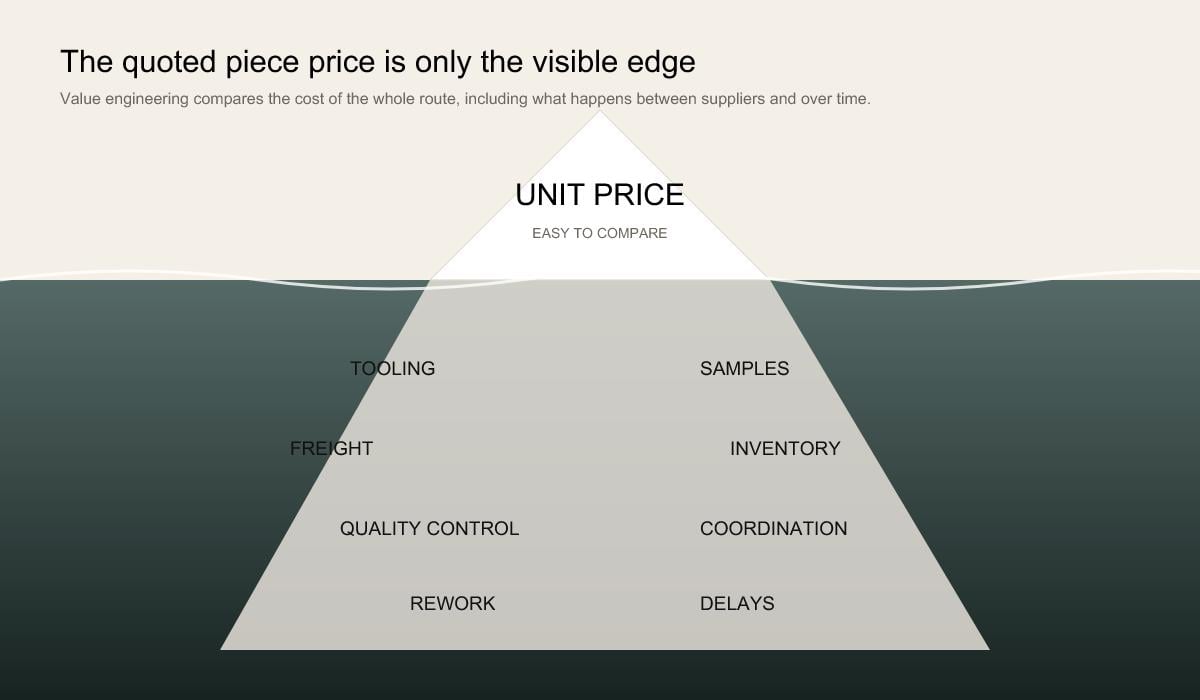
De kostenijsberg. De eenheidsprijs is het gemakkelijkst te vergelijken, terwijl de commerciële uitkomst vaak al vóór de offerte wordt bepaald. Technisch diagram in SVG-formaat.
Complexiteit is gerechtvaardigd wanneer deze de herkenbaarheid, de tactiele eigenschappen, de prestaties of de bescherming verbetert. Een op maat gemaakte vormgeving van de dop die consumenten herkennen en binnen het gehele assortiment hergebruiken, kan een vorm van complexiteit zijn die toegevoegde waarde biedt. Een tweede metallic afwerking die er vrijwel identiek uitziet, maar waarvoor een andere leverancier, een andere matrijs en een nieuwe monstercyclus nodig zijn, kan daarentegen een vorm van complexiteit zijn die geen toegevoegde waarde biedt.
Elk extra materiaal, elke extra leverancier, kleur, onderdeel, matrijs, afwerking en SKU creëert een afhankelijkheid. Afhankelijkheden vereisen specificaties, verantwoordelijken, termijnen en acceptatiecriteria. Zij kunnen tevens storingsscenario’s veroorzaken: een vertraagde levering van een dop vertraagt de goedkeuring van de verpakkingspasvorm; een aangepaste coating beïnvloedt de hechting van de warmdruk; een vervanging van de pomp verandert de inbouwhoogte. De kosten van complexiteit zijn derhalve deels financieel en deels probabilistisch — de verpakking kent meer mogelijkheden om vertraging op te lopen, onverenigbaar te worden of moeilijk opnieuw te bestellen.
De oplossing ligt niet in minimalisme omwille van het minimalisme zelf. Het gaat om een expliciet complexiteitsregister. Voor elk uitzonderlijk onderdeel legt het team de consumenten- of technische waarde vast, de nieuwe afhankelijkheid die hierdoor ontstaat, de persoon die verantwoordelijk is voor de interface en het plan voor toekomstig hergebruik. Indien de waarde niet duidelijk kan worden omschreven, verdient vereenvoudiging uw aandacht.
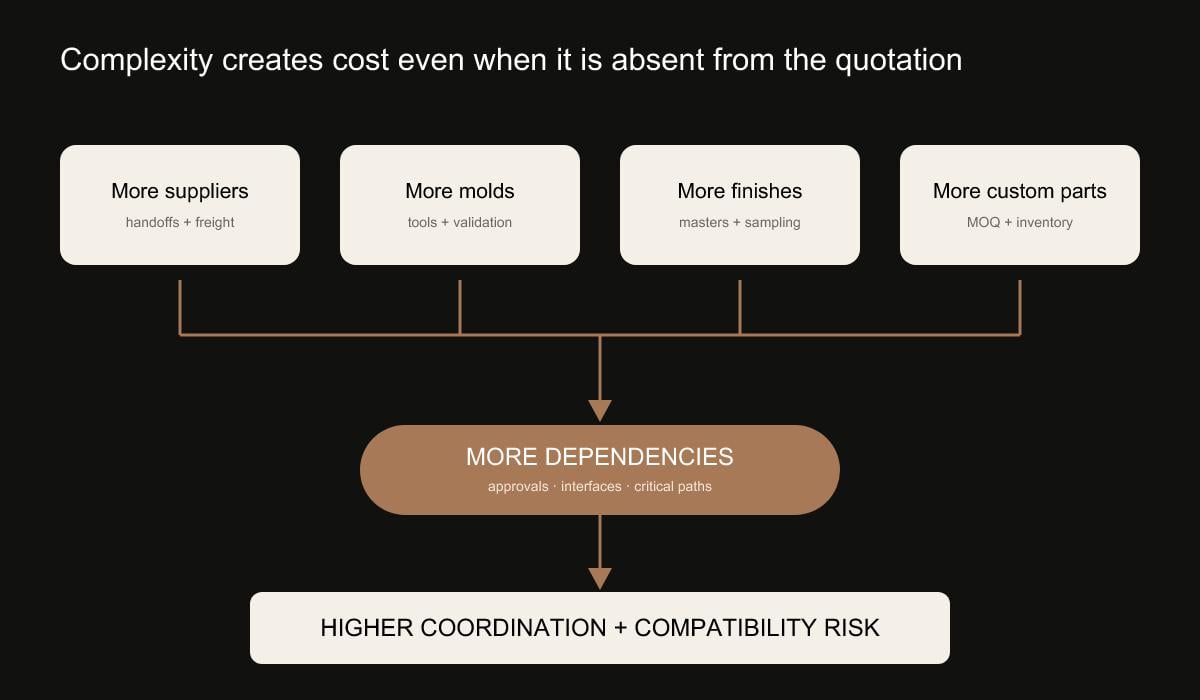
Kosten als gevolg van complexiteit. Een groter aantal onderdelen is op zich geen probleem; het probleem ligt bij onbeheerde of onbeloonde afhankelijkheden. Technisch diagram in SVG-formaat.
Een goedkoper onderdeel dat een lancering vertraagt, kan in commerciële zin duur uitvallen. De ontwikkeling van gereedschappen, de vervaardiging van matrijzen, proefproductie, oppervlaktemonsters, compatibiliteitstests en definitieve goedkeuring vormen een onderling afhankelijke keten. Sommige taken kunnen parallel worden uitgevoerd; andere kunnen pas van start gaan wanneer een interface of een fysiek monster definitief is vastgesteld.
Een merk dat te maken heeft met een vaste beoordelingscyclus voor het retailassortiment, een campagneshoot of een seizoenslancering, hecht een andere waarde aan tijd dan een oprichter die een concept valideert zonder vaste deadline. In het eerste geval kan een bestaande fles in combinatie met op maat gemaakte CMF het lanceringsvenster veiligstellen. In het tweede geval kan een op maat gemaakte fles de omweg waard zijn, omdat het silhouet centraal staat in de bedrijfsvoering. Value engineering dient die keuze duidelijk te maken, in plaats van snelheid stilletjes tot een universele doelstelling te verheffen.
Het tijdschema dient de relatieve fasen, de goedkeuringsverantwoordelijken en het kritieke pad weer te geven. Het dient tevens de beslissingstijd aan de kant van de klant te bevatten. Een monster dat nog niet is beoordeeld, leidt nog steeds tot vertraging in het project. Er wordt hier geen exacte duur vermeld, aangezien de daadwerkelijke beschikbaarheid van gereedschappen, capaciteit, bemonstering en productie pas kan worden bevestigd wanneer de specificatie bekend is.
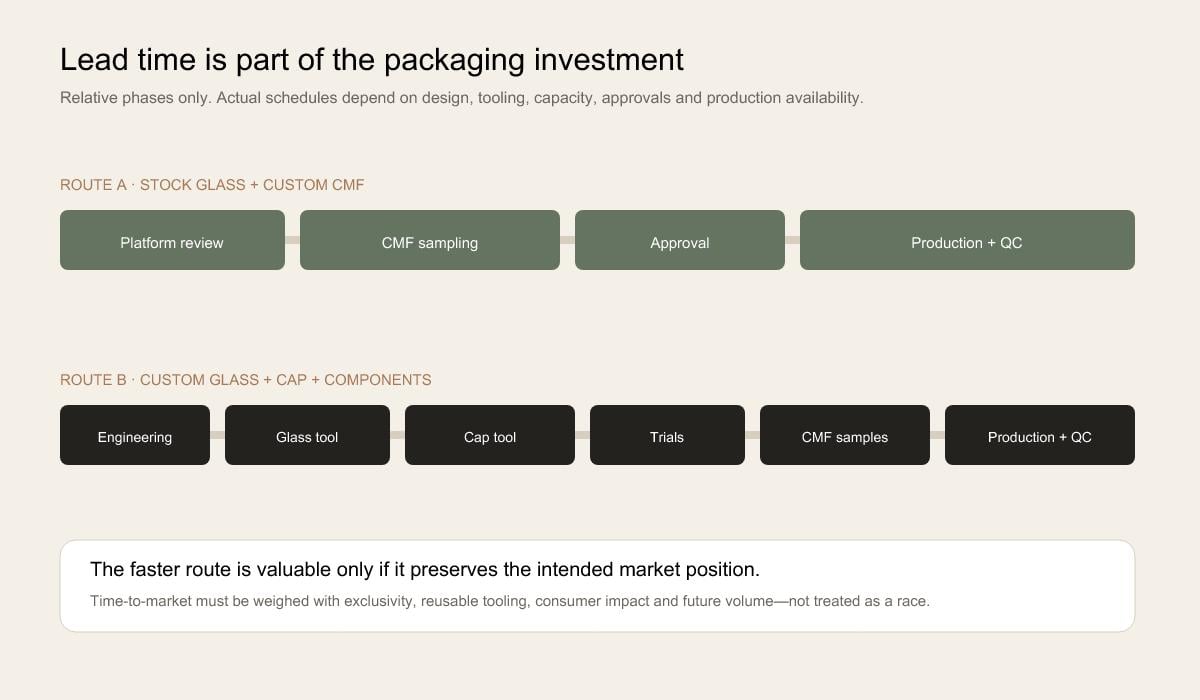
Relatieve ontwikkelingstrajecten. Het diagram vergelijkt fasen, geen kalenderdagen; de projectplanning maakt deel uit van de waardevergelijking. Technisch diagram in SVG-formaat.
De goedkoopste eerste-ordetraject kan kwetsbaar worden als deze afhankelijk is van een tijdelijke voorraadpartij, een niet-gedocumenteerde kleurovereenkomst of het geheugen van één persoon met betrekking tot de assemblage. Omgekeerd kan een hoge investering in gereedschappen verloren gaan als deze slechts een eenmalige esthetische behoefte oplost zonder toekomstige capaciteiten of geuren te ondersteunen. De verpakkingsarchitectuur dient te worden beoordeeld als een herhaalbaar commercieel systeem.
Voor herhaalbestellingen heeft het team gecontroleerde tekeningen, illustratiemateriaal, kleurstandaarden, fysieke originelen, goedgekeurde onderdeelnummers, montage-instructies en inzicht in de revisiegeschiedenis nodig. De continuïteit van leveranciers en de regels voor vervanging zijn van belang. Indien een pomp niet meer leverbaar is, dient het merk te weten welke afmetingen en prestatiekenmerken cruciaal zijn voordat een vervangend product wordt voorgesteld. Indien een coating opnieuw wordt besteld, dient de goedgekeurde referentie van betere kwaliteit te zijn dan een foto die met een mobiele telefoon is gemaakt.
Gereedschap wordt beoordeeld op basis van het verwachte productievolume gedurende de gehele levensduur, niet alleen op basis van de eerste aankoop. Een op maat gemaakte dop die bij vijf productlanceringen kan worden gebruikt, kan rationeler zijn dan een goedkoper, exclusief accessoire dat voor elke SKU wordt aangepast. Een bestaande fles kan eveneens als platform voor de lange termijn dienen wanneer het CMF-systeem zorgvuldig wordt beheerd. Schaalbaarheid is niet synoniem met maatwerk of standaardproducten; het vloeit voort uit beslissingen die beheersbaar blijven.
Een pakket is schaalbaar wanneer het beoogde uiterlijk en de beoogde prestaties kunnen worden gereproduceerd zonder de projectgeschiedenis te hoeven reconstrueren. Documentatie en de mate van gemeenschappelijkheid tussen componenten maken daarom deel uit van een eersteklas ontwerp, ook al krijgen consumenten deze nooit te zien.
Als elk onderdeel uniek is voor één geur, zijn er voor de resterende voorraad maar weinig mogelijkheden om in de toekomst nog waarde te genereren. Een gewijzigd ontwerp kan ervoor zorgen dat bedrukte doppen onbruikbaar worden. Een aangepaste fles kan ervoor zorgen dat bijlagen onbruikbaar worden. Een uit productie genomen afwerking kan ervoor zorgen dat pompjes overblijven waarvan de kleur niet meer overeenkomt. De kosten bestaan niet alleen uit opslag; het gaat ook om werkkapitaal dat vastzit in een specificatie die het merk wellicht niet meer zal gebruiken.
Door selectief gebruik te maken van gemeenschappelijke onderdelen kan die blootstelling worden beperkt zonder dat dit leidt tot een generieke consumentenervaring. Verschillende geuren kunnen bijvoorbeeld hetzelfde pompsysteem, dezelfde dopinzet, dezelfde vormgeving van de hals of dezelfde onbedrukte kartonnen verpakking delen, terwijl ze verschillen in coating, bedrukking, afwerking van de buitendop of omhulsel. Gemeenschappelijke onderdelen bundelen de vraag en kunnen de bevoorrading veerkrachtiger maken. De gevolgen voor het grote aantal SKU’s moeten nog steeds zorgvuldig worden gepland, maar het commerciële doel is hier voorraadflexibiliteit in plaats van coördinatie van de collectie.
Merken dienen zich af te vragen of elk exclusief onderdeel kan worden hergebruikt voor een toekomstige productiecapaciteit, een gelimiteerde oplage of een navulling, of het achteraf kan worden bedrukt en of er neutrale voorraad kan worden aangehouden in afwachting van de definitieve ontwerptekening. Dit zijn vragen met betrekking tot de haalbaarheid, geen garanties. De voorkeursaanpak hangt af van de houdbaarheid, het materiaal, de afwerkingsmethode, de werkwijze van de leverancier en de betrouwbaarheid van de prognoses.
Houd SKU-specifieke onderdelen in voorkenmerk die consumenten herkennen of die nodig zijn voor de werking van het product.
Gebruik gemeenschappelijke pompen, inzetstukken of basisconstructies wanneer de klantervaring geen verschillen vereist.
Neutrale onderdelen die later worden afgewerkt of geprint, kunnen hun flexibiliteit behouden, afhankelijk van de proces- en leveranciersbeperkingen.
De aannemelijke uiteindelijke architectuur behield de meest waardevolle, op de consument gerichte keuzes en stelde de overige ter discussie. Een bestaand glazen platform zou kunnen worden gehandhaafd indien uit fysieke evaluatie zou blijken dat de verhoudingen, de voet, het decoratiegebied en de kwaliteit ervan geschikt waren. Differentiatie zou worden gerealiseerd door middel van een gecontroleerde rookkleurige of matte afwerking, een nauwkeurige logo-uitvoering, een meer tactiele dop en een strak vormgegeven kartonnen verpakking. Het pompplatform en de verborgen interfaces zouden beproefd en compatibel blijven, in plaats van vernieuwend te zijn louter omwille van het uiterlijk.
Het ontwerp zou alleen worden goedgekeurd indien het een herbruikbaar herkenningspunt opleverde – mogelijk de dop of een specifiek merkelement –, terwijl de beslissing over de glasvorm zou kunnen worden uitgesteld totdat de prognoses, de merkwaarde en het belang van het silhouet duidelijker waren. Fysieke normen voor kleur en afwerking zouden glas, dop, kraag en karton op elkaar afstemmen. De verpakking zou worden beoordeeld in gemonteerde, verpakte staat en klaar voor toekomstige nabestellingen, in plaats van te worden goedgekeurd als aantrekkelijke, op zichzelf staande monsters.
Deze aanpak vormt een aanbevelingskader en is geen bewering over een definitief resultaat voor de klant. De uiteindelijke keuze voor de fles, het materiaal van de dop, de bedrukking, de verpakking, het productieproces, de hoeveelheid en de gemeten besparingen staan nog open. Het beoogde commerciële resultaat is duidelijk: het budget wordt geconcentreerd op die aspecten waar de consument dit kan waarderen, waarbij onnodige minimale afnamehoeveelheden, voorraad en ontwikkelingsafhankelijkheden worden geëlimineerd.
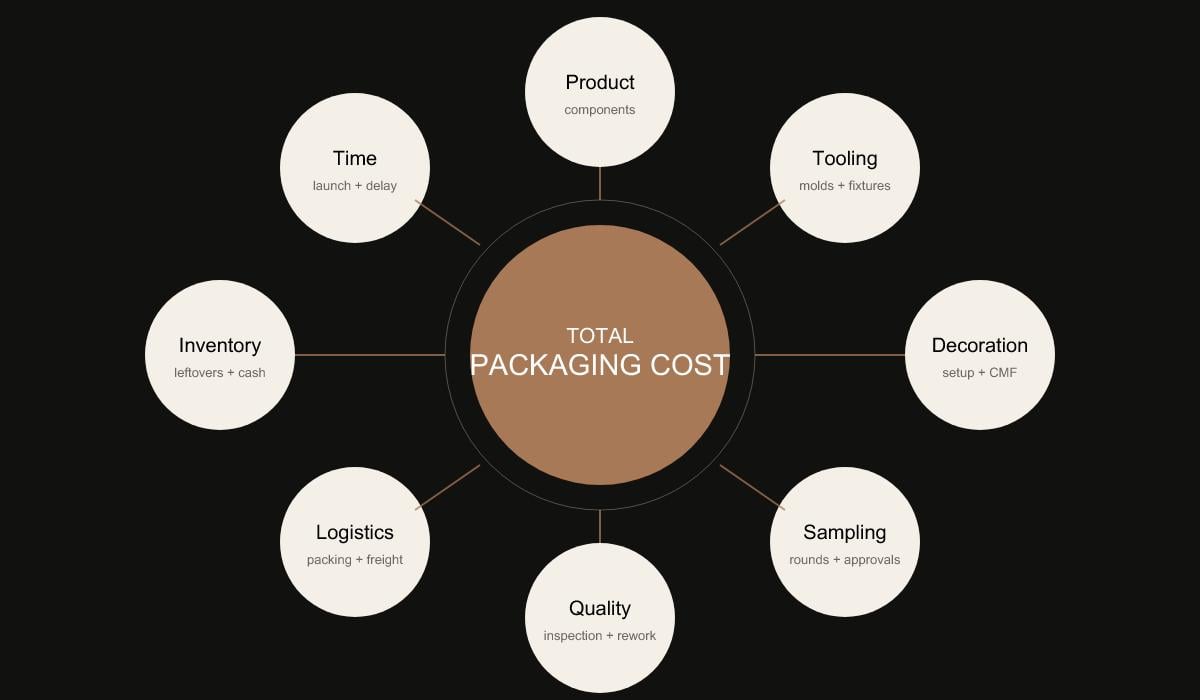
Overzicht van de totale verpakkingskosten. De definitieve route moet logisch zijn als product, als bevoorradingssysteem en als tijdschema. Technisch diagram in SVG-formaat.
In casestudy’s van leveranciers wordt doorgaans de nadruk gelegd op alles wat is toegevoegd. Bij value engineering wordt echter ook vastgelegd wat er is weggelaten. Voor de interne onderdelen van de pomp was geen eigen platform nodig, aangezien een beproefde optie de vereiste verstuiving kon leveren, op de gekozen hals paste en beschikbaar bleef. Het op maat maken van een onzichtbaar mechanisme zonder duidelijk omschreven voordeel voor de gebruiker zou kwalificatie- en vervangingsrisico’s met zich meebrengen, zonder dat dit de herkenbaarheid zou versterken.
De hals hoefde geen exclusieve interface te worden als een compatibele standaard de architectuur van pomp, kraag en dop zou kunnen ondersteunen. Een vernieuwende hals die onder de sluiting verborgen zou blijven, zou toekomstige inkoop bemoeilijken en tegelijkertijd weinig toegevoegde waarde voor de consument bieden. Het inzetstuk hoefde geen uitgebreide verborgen versiering te hebben als het daadwerkelijke doel ervan was om de fles op zijn plaats te houden, te beschermen en netjes te presenteren. Het budget voor versiering dient zichtbaar te zijn tijdens het openen, en mag niet verborgen blijven nadat het product is verwijderd.
Een nieuwe flesmal hoefde niet automatisch te worden goedgekeurd, louter omdat dit technisch mogelijk was. Indien de sterkste kenmerken van het merk de afwerking, de dop en de grafische precisie waren, zou nieuw glas matrijzen en tijd vergen zonder dat dit een evenredige impact in het schap zou opleveren. De beslissing zou opnieuw kunnen worden bekeken wanneer het productievolume, aantoonbare vraag of een werkelijk onderscheidend silhouet dit zouden rechtvaardigen.
Zeggen dat “voor dit onderdeel geen op maat gemaakt hulpmiddel nodig is”, betekent niet dat men innovatie afwijst. Het is een kwestie van commerciële integriteit. Het spaart budget voor de functies die de consument daadwerkelijk ervaart, vermindert het aantal minimumaantallen en mastergegevens dat het merk moet beheren, en zorgt voor een duidelijkere route bij het opnieuw bestellen. Het beste antwoord van een leverancier is niet altijd de langste lijst met mogelijkheden; het is een architectuur die uitlegt waarom elke mogelijkheid wel of juist niet moet worden gebruikt.
Consumenten ervaren een samenhangend geheel, niet een optelsom van op maat gemaakte onderdelen. Maatwerk is waardevol wanneer het herkenbaarheid, tactiele ervaring, functionaliteit of bescherming biedt; anders kan het wel een grotere betrokkenheid vereisen, zonder dat dit de waargenomen kwaliteit verhoogt.
Rangschik het silhouet, de pet, de kleur, de afwerking, het logo en de ervaring bij het openen op basis van hun rol binnen het merk. Een kleiner onderdeel dat veel aandacht trekt, verdient wellicht meer aandacht dan een groot, verborgen onderdeel.
Beproefde platforms voor halsstukken, pompen en inzetstukken kunnen het risico bij kwalificatie en nabestelling verminderen wanneer ze geen zichtbare identificatie hoeven te dragen. Standaardisatie vereist echter nog steeds validatie van de compatibiliteit en prestaties.
Breng elk glas, elke versiering, elke dop, elke pomp, elke kraag, elke doos en elk inlegstuk afzonderlijk in kaart. De minst flexibele vereiste – niet alleen het aantal flessen – bepaalt vaak de blootstelling aan werkkapitaal.
Kwaliteit en stabiliteit kunnen een premiumpositionering ondersteunen, maar meer glas heeft ook invloed op de stevigheid van de kartonnen verpakking, de vrachtkosten en het materiaalverbruik. Richt je op het juiste waargenomen gewicht in plaats van op het maximale fysieke gewicht.
Wanneer het structurele silhouet niet het belangrijkste merkelement is, kunnen een zorgvuldig gekozen CMF en nauwkeurig artwork per eenheid ontwikkelingscomplexiteit een grotere zichtbare verandering teweegbrengen. Voor decoraties is nog steeds een procesgebonden goedkeuring vereist.
Houd rekening met extra leveranciers, vrachtkosten, monsters, inspecties, montage, voorraad en het risico op herbewerking. Een besparing op onderdelen moet het hele traject doorstaan voordat deze daadwerkelijk als besparing kan worden aangemerkt.
Beoordeel of de mal een herbruikbaar, eigen bezit vormt voor toekomstige productlanceringen. Een hulpmiddel dat slechts één tijdelijke ontwerpkeuze oplost, zal zijn operationele complexiteit wellicht nooit terugverdienen.
Elk extra materiaal, elke afwerking, elke leverancier en elke mal zorgt voor afhankelijkheden. Behoud de complexiteit die klanten waarderen of die vanuit technisch oogpunt noodzakelijk is, en stel de rest ter discussie voordat je goedkeuring verleent.
Een route die een verkoop- of campagneperiode mist, kan commercieel gezien duur uitvallen, zelfs als de afzonderlijke onderdelen ervan gunstig geprijsd zijn. Weeg snelheid, exclusiviteit en de inzet van productiemiddelen af tegen de daadwerkelijke lanceringscontext.

Een slimme vereenvoudiging moet er nog steeds hoogwaardig uitzien. Dit conceptontwerp geeft de ontwerprichting weer; het is geen foto van het geanonimiseerde klantproject. Op maat gemaakte visuele illustratie.
De conclusie is niet dat standaardproducten beter zijn dan op maat gemaakte, dat ABS beter is dan zamac of dat decoratie beter is dan glasvormen. Het gaat erom dat elke beslissing zijn plaats moet verdienen. Een goede op maat gemaakte parfumverpakking ontstaat door precies te weten waar je moet investeren, waar je moet standaardiseren en hoe elke keuze de merkperceptie, de minimale bestelhoeveelheid (MOQ), de totale kosten, het risico en de time-to-market beïnvloedt.
Of u nu een bestaande fles nodig hebt of een volledig op maat gemaakte verpakkingsoplossing, ons ervaren team staat klaar om uw project te ondersteunen – van het ontwerp en de decoratie van de flessen tot de sluitingen, de verpakking en de levering.
 English
  Spanish
  French
  German
  Arabic
  Italian
  Dutch
Dutch  Portuguese
  Russian
  Korean
  Japanese