
Introdução
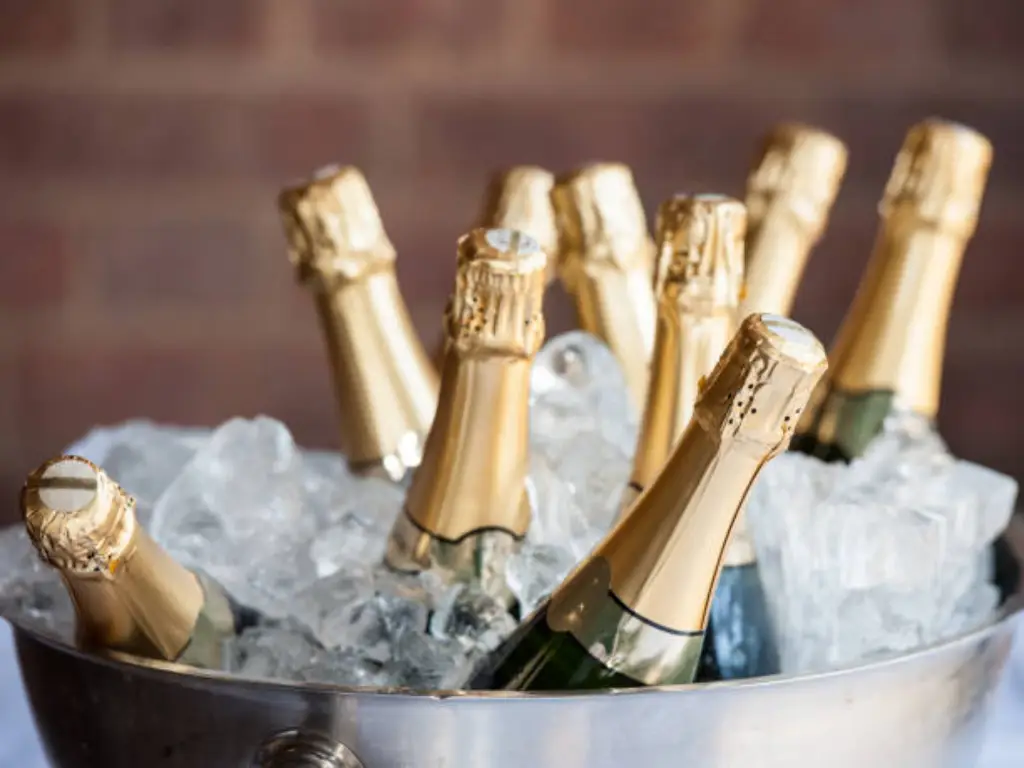
É importante conhecer os tamanhos das garrafas de champanhe, seja em termos do número de porções a serem servidas em ocasiões especiais, seja em relação à embalagem a ser utilizada por uma nova marca de vinho. A maioria dos recursos apenas menciona os nomes tradicionais, mas este guia oferece uma análise técnica detalhada. Temos a garrafa padrão, a gigante Melquisedeque e toda a gama de tamanhos de garrafas de champanhe, com não apenas os volumes por porção, mas também as especificações técnicas de altura, diâmetro e peso, que devem ser conhecidas para se tomar uma decisão informada.
Tabela Completa dos Tamanhos das Garrafas de Champanhe
Para se orientar no jargão dos vinhos espumantes, é preciso um ponto de referência, que é fornecido neste guia completo. O setor possui uma nomenclatura que se baseia, em grande parte, no Antigo Testamento para classificar o volume.
Escolher o recipiente adequado exige mais do que apenas conhecer os nomes; trata-se de um cálculo baseado no porte do seu evento. Ao planejar eventos especiais ou outras ocasiões excepcionais, o principal fator a ser considerado é o número de convidados. Embora uma garrafa padrão seja suficiente para jantares íntimos, optar por um volume maior é uma escolha comum que pode agilizar significativamente o serviço e realçar o impacto visual. A tabela abaixo detalha toda a variedade de tamanhos de garrafas de champanhe, desde porções individuais até formatos grandes, convertendo litros em equivalentes e indicando o melhor formato a ser utilizado em situações específicas.
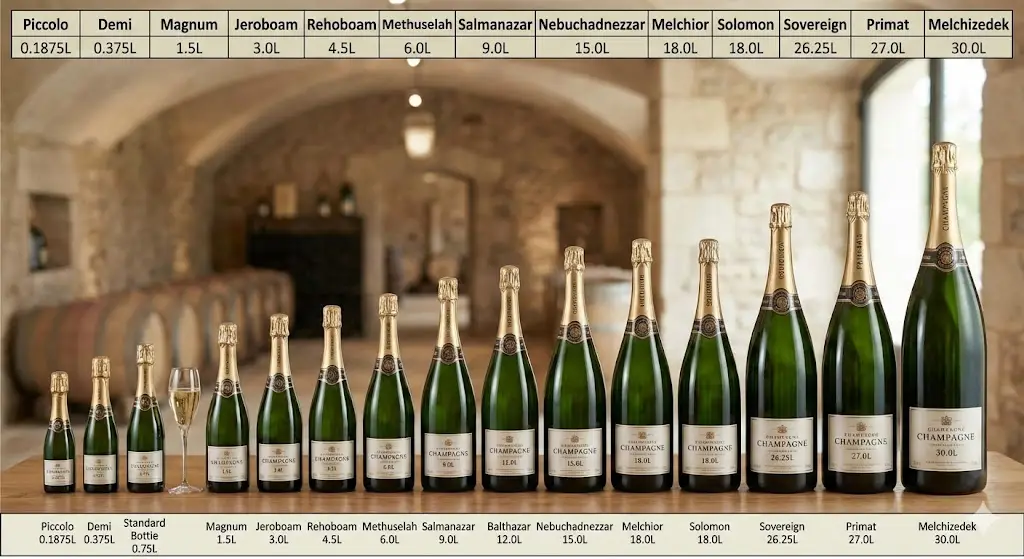
| Nome da garrafa | Volume (litros) | Garrafas padrão equivalentes | Porções (aprox. 125 ml) | Ideal para / Usos comuns |
| Pequeno / Quarter | 0,1875 L | 0.25 (1/4) | 1.5 | Companhias aéreas, minibares, porções individuais |
| Demi / Metade | 0,375 litros | 0.5 (1/2) | 3 | Jantar para dois, cestas de presentes, degustação |
| Garrafa padrão | Três quartos de litro | 1 | 6 | Padrão de varejo, Jantares, Presentes |
| Ótimo | 1,5 L | 2 | 12 | Processo de envelhecimento, Coletores, Mesas para 4 a 6 pessoas |
| Jeroboão | 3,0 L | 4 | 24 | Casamentos, pódios do automobilismo, festas |
| Roboão | 4,5 L | 6 | 36 | Lançamentos vintage raros (que estão se tornando cada vez mais difíceis de encontrar) |
| Matusalém | 6,0 L | 8 | 48 | Centros de mesa grandiosos, presentes marcantes |
| Salmanazar | 9,0 L | 12 | 72 | Grandes banquetes, aniversários corporativos |
| Balthazar | 12,0 litros | 16 | 96 | Boates de luxo, jantares de gala |
| Nabucodonosor | 15,0 litros | 20 | 120 | Lobbies de hotéis, inaugurações de grande porte, ações de relações públicas |
| Melchior | 18,0 litros | 24 | 144 | Eventos ultraexclusivos, peças de destaque |
| Salomão | 18,0 litros | 24 | 144 | Coleções particulares (extremamente raras) |
| Soberano | 26,25 L | 35 | 210 | Lançamentos de navios (batismo) |
| Primat / Goliath | 27,0 litros | 36 | 216 | Exposições em museus, coleções históricas |
| Melquisedeque | 30,0 litros | 40 | 240 | O símbolo de status definitivo para grandes ocasiões |
Por que o tamanho importa: potencial de envelhecimento e sabor
A escolha entre diferentes tamanhos de garrafas de champanhe não determina apenas o número de pessoas a serem servidas, mas o tamanho específico da garrafa também altera a qualidade do vinho de maneira fundamental.
O princípio científico reside na proporção entre o líquido e o ar que fica confinado no gargalo da garrafa (espaço vazio). O vinho precisa de um pouco de oxigênio para amadurecer; no entanto, o excesso de oxigênio faz com que ele se oxide, conferindo-lhe um sabor cansado.
- Garrafa padrão: Estabelece uma taxa mínima de envelhecimento.
- Meia garrafa: Com meia garrafa de champanhe, a oxidação ocorre mais rapidamente devido à menor quantidade de líquido em relação ao ar. Esses vinhos devem ser consumidos enquanto ainda são jovens.
- Garrafa Magnum: Esse formato é geralmente considerado pelos apreciadores de champanhe e pelos produtores de vinho como o mais desejável para o envelhecimento em adega. O espaço vazio no interior da garrafa é semelhante ao de uma garrafa comum, com a diferença de que a quantidade de vinho é o dobro. Isso reduz a proporção entre oxigênio e líquido, o que torna a troca de ar mais lenta. O resultado é um processo de envelhecimento mais harmonioso, que mantém o frescor e permite a formação de um paladar aromático complexo (notas de torrado e brioche) ao longo de décadas.
Nota sobre a produção: Quando se trata das maiores garrafas de champanhe (geralmente maiores do que um Jeroboam de 3 L), os produtores costumam recorrer ao método de transvasamento. O champanhe passa por uma segunda fermentação em garrafas comuns e, em seguida, é transferido sob pressão para a garrafa grande. Assim, as garrafas Magnum e Jeroboam são, via de regra, os maiores formatos nos quais o vinho fermentou na garrafa específica que você está comprando e, portanto, apresentam a maior consistência.
Especificações técnicas: altura, diâmetro e peso
A precisão técnica é o aspecto mais importante para os profissionais do setor, gerentes de compras e proprietários de marcas. Uma garrafa de champanhe é uma peça industrial que deve se encaixar perfeitamente nas linhas de envase, nas máquinas de rotulagem e nas caixas de transporte.
A seguir, apresentam-se as dimensões técnicas mais comuns dos tamanhos de produção mais frequentes. Observe que certas dimensões podem variar ligeiramente, dependendo do projeto do molde (por exemplo, formato padrão e formato exclusivo).
| Formato da garrafa | Volume | Faixa de altura | Faixa de diâmetro da base | Peso típico do vidro | Acabamento (pescoço) |
| Pequeno | 187 ml | Duzentos a duzentos e cinco milímetros | 56 – 58 mm | Duzentos e quarenta a duzentos e sessenta gramas | Coroa de 26 mm |
| Demi / Metade | 375 ml | Duzentos e quarenta – duzentos e cinquenta milímetros | 66 – 70 mm | 430 g – 460 g | Coroa de 29 mm / Rolha |
| Padrão | 750 ml | 298 – 305 mm | Oitenta e oito a noventa milímetros | 835 g – 900 g | Coroa de 29 mm / Rolha |
| Ótimo | 1,5 L | 370 – 385 mm | 112 – 116 mm | 1,75 kg – 1,9 kg | 29 mm / Cortiça especial |
| Jeroboão | 3,0 L | 470 – 485 mm | 134 – 138 mm | 3,0 kg – 3,25 kg | Special Cork |
| Matusalém | 6,0 L | 570 – 590mm | 170 – 176mm | 5.1kg – 5.4kg | Special Cork |
| Salmanazar | 9,0 L | 640 – 655mm | 190 – 195mm | 7.5kg – 7.8kg | Special Cork |
| Balthazar | 12,0 litros | 710 – 725mm | 210 – 220mm | 9.3kg – 9.8kg | Special Cork |
| Nabucodonosor | 15,0 litros | 760 – 780mm | 230 – 240mm | 11.5kg – 12.5kg | Special Cork |
It is important to know the diameter. Even a few millimeters in the base diameter can influence the number of bottles that can be placed on a conveyor belt and the size of the secondary packaging. In Daxin, we maintain strict dimensional tolerance so that our standard bottles of champagne and bigger formats can fit perfectly into your existing bottling system.
Manufacturing Standards: Pressure Ratings and Safety
Production of various sizes of champagne bottles is an engineering problem. A champagne bottle is a pressure vessel, unlike still wine bottles which merely contain liquid. Carbon dioxide is produced during secondary fermentation, which causes an internal pressure of 6 to 8 bars. This is approximately three times the pressure in a car tire.
The glass should be able to resist this force, and this means that it should be of high safety standards:
- Glass Thickness: Walls of a champagne bottle are much thicker than the walls of a still wine bottle. This thickness is enhanced with the bigger volume formats to ensure structural integrity.
- The Punt: The deep cut at the bottom of the bottle is not just ornamental. It enhances the surface area of the glass, which makes the bottle resistant to internal pressure and impact.
- Pressure Testing: Safety is not negotiable. In Daxin Glass, we have random sampling in our manufacturing process of burst pressure tests and thermal shock tests. We make sure that all the bottle formats, including the standard and Nebuchadnezzar, are rated to withstand the enormous pressure that is created during fermentation and transportation.
Strategic Selection Matrix: Brand & Procurement Guide
To the procurement officer or brand owner, the choice of the right bottle mix is a strategic choice. It involves a tradeoff between the complexity cost and the market differentiation possibility.
The table below shows the best usage of each size category depending on channel strategy and manufacturing limitations.
| Strategic Goal | Recommended Format | Economic Rationale | Manufacturing & Sourcing Reality | Logistics & Supply Chain Impact |
| Mass Market / Volume | Standard (750ml) | Maximizes operational efficiency; lowest CAPEX for tooling. | Fully Automatic: Global standard molds available. High-speed automation (300+ bpm). Lightweight options (835g → 800g) available for sustainability goals. | High Density: Max pallet utilization (1,000+ units/pallet). Lowest shipping cost per liter. |
| Brand Premiumization | Magnum (1.5L) | Signals quality and longevity; justifies a 2.5x price point for 2x volume. | Automatic / Semi-Auto: Requires distinct filling equipment settings but generally utilizes standard glass processes. High consistency. | Medium Density: Pallet count drops by ~40%. Requires stronger secondary packaging (cartons) to prevent scuffing. |
| Product Sampling / Travel | Piccolo (187ml) / Demi (375ml) | Lowers barrier to entry; high velocity in airlines and travel retail. | High Volume Required: High MOQs are necessary to amortize machine setup costs. Cap handling (Crown vs. Cork) often requires specific capping lines. | Complex Handling: Often requires “Cluster Packs” or specialized trays. Higher risk of breakage if loose-loaded. |
| Nightlife Visibility (On-Trade) | Jeroboam (3L) | The “Club Standard.” High visibility maximizes on-premise markup. | The “Complexity Threshold”: This is often the limit of fully automated production. Anything larger typically requires changing to semi-auto suppliers with higher tolerances. | Low Density: Usually packed 1 per box or 3 per case. Warehousing footprint increases significantly per liter. |
| PR & Brand Dominance | Methuselah (6L) – Nebuchadnezzar (15L) | Creates viral marketing moments; establishes brand dominance. | High Technical Barrier: Semi-automatic or hand-blown production only. High rejection rates during QC due to pressure requirements. Extended lead times (12-16 weeks). | Special Handling: Requires individual wooden crates (OWC). Manual palletization often required. Expensive last-mile delivery. |
The Step Cost of changing Magnums to Jeroboams is often underestimated by the brands. Although 750ml and 1.5L bottles are commodity products, anything 3L and above is a specialty product. This brings about supply chain risks such as non-certified suppliers with inconsistent wall thickness and increased breakage rates during transit.
Customization Options for Brand Distinction
Packaging is the main differentiator in a saturated market. Although the conventional shape and size of a champagne bottle are iconic, most brands are in search of a distinctive visual identity. The history of champagne is replete with the instances of proprietary molds that make the best cuvée.
There are a number of levels of customization that manufacturers can provide across different sizes of champagne bottles:
- Color: In addition to the standard color, Champagne Green (Antique Green), there is Flint (clear) to filter UV light (Rosé), Dead Leaf or dark Amber.
- Custom Molds: Brands have the option to change the slope of the shoulder, the length of the neck, or the depth of the punt.
- Embossing: Glass relief (crests, names, or patterns) may be embossed into the bottle, which removes the necessity of paper labels and makes the product an outstanding bottle.
The creation of a tailor-made mold needs accurate engineering and tooling. Get in touch with our experts today to talk about the process—from 3D rendering to final production—and find out how we can help you to create unique designs in different sizes that define your brand.
Logistics Guide: Case Counts and Pallet Loading
The sourcing of various sizes of champagne bottles has a great impact on logistics and warehousing. The effectiveness of a supply chain is based on the correct calculation of the number of cases and pallet density.
- Standard Format (750ml): These are normally packed in 6 or 12 cartons. The number of bottles that can be stacked on a standard pallet is 1,000 to 1,200 bottles (typically 5 to 7 layers). This format is the most convenient to store.
- Magnum (1.5L): It is typically sold in 3 or 6 cases. The pallet density is reduced by about 40 percent relative to the standard bottles because of the increased diameter.
- Large Formats (3L+): Bottles like Jeroboam or Methuselah are too large to fit into a regular carton and might need to be shipped in separate wooden crates (OWC). This secures the expensive glass but greatly limits the amount of liters of champagne that can be carried in a container.
To the procurement managers, the optimization of the pack out is critical in the control of the freight costs. In the case of Daxin Glass, our logistics department will offer specific palletization plans of all sizes of champagne bottles in your order to ensure optimal use of containers.
FAQ: Common Questions on Sizes and Specs
Q: What is the number of glasses in a typical champagne bottle?
The average champagne bottle (750ml) will give 6 glasses of champagne, assuming a standard commercial pour of 125ml. A Magnum (1.5L) serves 12 glasses, which is effective in bigger tables.
Q: How come that big champagne bottles are so costly?
The big bottles are not sold at a linear price; this is because of the difficulty in manufacturing them. The complex manual glass blowing or special molding techniques needed to produce a Nebuchadnezzar (15L) lead to increased rejection rates and increased thickness of the glass needed to withstand the pressure.
Q: What is the weight of an empty champagne bottle?
The weight of an empty standard champagne bottle varies between 835g and 900g.
Conclusão
The selection of the appropriate champagne bottle formats is a tactical compromise between the aesthetics and the industrial reality. You need standard stock to be efficient or a unique mold to be a brand, Daxin provides high quality production that is of high standards of the world in terms of durability and design. Willing to supply your production with all the varieties of champagne bottles? Browse our catalog at daxinglassbottles.com or call our team today to get a competitive quote.

 English
  Spanish
  French
  German
  Arabic
  Italian
  Dutch
Dutch  Portuguese
  Russian
  Korean
  Japanese