
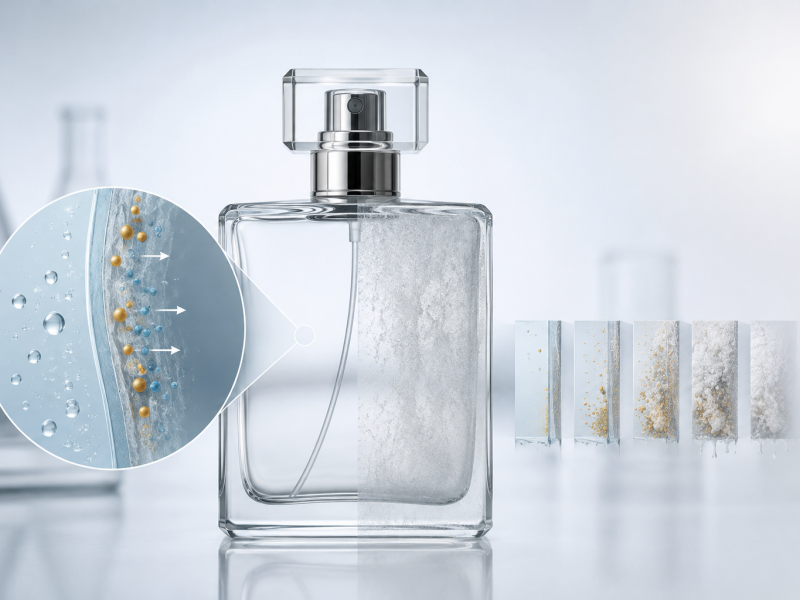
O vidro é amplamente utilizado em embalagens de perfumes, cosméticos, alimentos, bebidas e produtos farmacêuticos devido à sua transparência, propriedades de barreira, estabilidade química e aparência sofisticada.
No entanto, o vidro não é totalmente inerte.
Quando uma superfície de vidro é exposta à água, à umidade, ao calor ou a determinados ambientes químicos por um longo período, pequenas quantidades de íons alcalinos podem migrar da superfície do vidro. Em condições desfavoráveis de armazenamento ou uso, isso pode levar gradualmente a desgaste do vidro, manchas alcalinas, névoa branca, manchas na superfície ou perda de transparência.
Para os compradores de embalagens, essa não é apenas uma questão de laboratório. Uma garrafa que parece perfeitamente transparente ao sair da fábrica pode passar várias semanas no mar e vários meses em um depósito antes de chegar à linha de envase. Se a composição do vidro, o estado da superfície, a embalagem ou o ambiente de armazenamento não forem adequados, podem ocorrer alterações visíveis na superfície durante esse período.
É por isso que A resistência hidrolítica é um importante indicador da durabilidade química das garrafas de vidro.
Neste guia, explicamos o que significa resistência hidrolítica, por que ocorre a eflorescência alcalina, como os recipientes de vidro são testados, o que afeta sua durabilidade química e o que os compradores de embalagens para perfumes e cosméticos devem levar em consideração ao avaliar frascos de vidro.
O que é a resistência hidrolítica de uma garrafa de vidro?
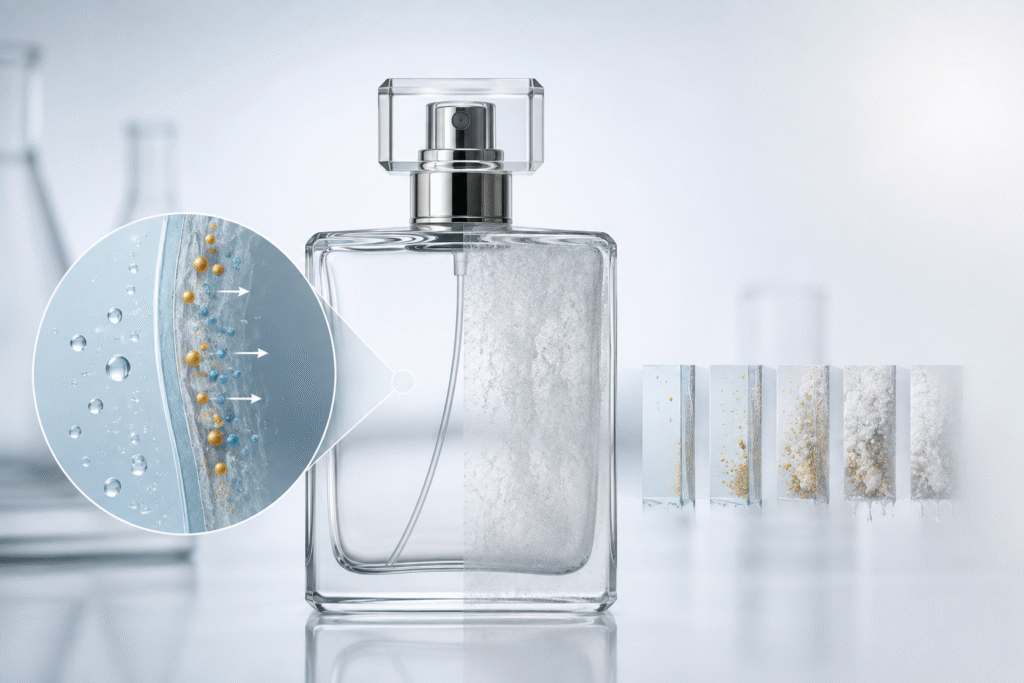
A resistência hidrolítica descreve a capacidade de uma superfície de vidro de resistir ao ataque químico da água.
Quando a água entra em contato com o vidro de cal-soda-sílica, pode ocorrer um processo de troca iônica na superfície. Os íons alcalinos — especialmente os íons de sódio — podem migrar do vidro e ser substituídos por espécies que contêm hidrogênio provenientes da água.
Quanto melhor for a resistência hidrolítica, menor será a quantidade de álcali liberada sob condições de ensaio especificadas.
| Uma alta resistência hidrolítica significa que há menor liberação de álcali da superfície do vidro quando este é exposto à água. |
Essa propriedade é particularmente importante quando o conteúdo permanece em contato direto com o vidro por longos períodos ou quando o recipiente é exposto a temperaturas elevadas durante o processamento. É também um indicador útil da durabilidade química geral de um recipiente de vidro.
Por que as garrafas de vidro apresentam uma névoa branca ou uma camada alcalina?
Uma das formas visíveis mais comuns de deterioração da superfície do vidro é descrita como:
- névoa branca;
- vidro fosco;
- manchas brancas;
- floração alcalina;
- criação de carbonato;
- intemperismo do vidro;
- embaçamento da superfície;
- ou formação de manchas no vidro.
Em alguns mercados, esse fenômeno também é conhecido informalmente como “mofo do vidro”. O processo geralmente começa com a umidade.
1. A umidade atinge a superfície do vidro
As moléculas de água do ar úmido são adsorvidas na superfície do vidro. Mesmo quando uma garrafa de vidro está vazia, a umidade da atmosfera ao redor pode interagir com a superfície do vidro.
2. Os íons alcalinos migram
No vidro convencional de soda-cal-sílica, os íons alcalinos móveis, particularmente os íons de sódio, podem migrar em direção à superfície e participar de reações de troca iônica com a água. A superfície, portanto, passa gradualmente a apresentar características químicas diferentes das do vidro original.
3. Formulário de produtos alcalinos para superfícies
O álcali liberado pode reagir com a umidade e o dióxido de carbono presentes no ar. Com o tempo, carbonatos que contêm sódio e outros compostos alcalinos solúveis podem se acumular na superfície. Como esses compostos costumam ser higroscópicos, eles podem atrair mais umidade e acelerar novas reações na superfície.
4. Aparecem manchas, resíduos ou uma camada opaca
À medida que o processo avança, a garrafa pode apresentar:
- uma fina camada nebulosa;
- depósitos cristalinos brancos;
- manchas com aparência de arco-íris;
- manchas brancas localizadas;
- uma superfície um pouco escorregadia;
- ou, em casos graves, perda permanente da transparência.
Em um estágio inicial, alguns resíduos superficiais ainda podem ser removidos por meio de limpeza. No entanto, se a própria superfície do vidro já tiver sofrido danos químicos, a opacidade resultante pode se tornar permanente.
A formação de sal alcalino é o mesmo que baixa resistência hidrolítica?
Não exatamente. Essa distinção é importante.
Resistência à hidrólise é uma medição em laboratório que avalia como uma superfície de vidro se comporta quando exposta à água em condições controladas.
Intemperismo do vidro ou eflorescência alcalina é uma deterioração visível da superfície que pode ocorrer durante o armazenamento ou a exposição ambiental.
Os dois estão relacionados porque ambos envolvem a interação entre a água e a superfície do vidro, mas não são indicadores de qualidade idênticos.
Uma garrafa de vidro pode atender a um requisito específico de resistência hidrolítica e, mesmo assim, exigir embalagem e armazenamento adequados para minimizar o desgaste causado pelas intempéries a longo prazo. Para os compradores, a abordagem correta é, portanto, não se basear apenas no resultado de um único teste. A composição do vidro, as condições de fabricação, o tratamento de superfície, o método de embalagem, o ambiente de armazenamento e o conteúdo pretendido devem ser avaliados em conjunto.
Como é testada a resistência hidrolítica de recipientes de vidro?
One internationally recognized method is ISO 4802-1:2023 — Glassware — Hydrolytic resistance of the interior surfaces of glass containers — Part 1: Determination by titration method and classification.
The principle of the test is relatively straightforward. A specified amount of water is placed inside the glass container. The bottle is then exposed to elevated temperature under controlled conditions. Alkali released from the inner glass surface enters the water.
The extraction solution is subsequently titrated with a standardized acid solution. The amount of acid required indicates how much alkaline material has been released from the glass.
| The lower the amount of extractable alkali, the better the hydrolytic resistance of the glass surface. |
A typical test procedure includes:
1. Selecting the required number of glass containers.
2. Cleaning the samples according to the standard.
3. Filling them with the specified test water.
4. Heating the containers under controlled temperature and time conditions.
5. Collecting the extraction solution.
6. Titrating the solution using a standardized acid.
7. Calculating and classifying the result according to the applicable standard.
For formal quality control, the exact test temperature, filling volume, sample quantity, titration method and acceptance limits must always follow the applicable standard.
Understanding HCT1, HCT2 and HCT3 Glass Classes
Under ISO 4802-1 terminology, glass containers may be classified according to their inner-surface hydrolytic resistance. A simplified interpretation is:
HCT1
Glass containers with very high hydrolytic resistance. This category is typically associated with glass compositions such as borosilicate or neutral glass, where high chemical resistance is primarily achieved through the glass composition itself.
HCT2
Usually soda-lime-silica glass containers whose inner surfaces have been specially treated to improve hydrolytic resistance.
HCT3
Typically untreated soda-lime-silica glass containers with moderate hydrolytic resistance.
| Within these classifications, HCT1 represents higher hydrolytic resistance than HCT2, and HCT2 is higher than HCT3. |
However, buyers should not simply specify the highest possible class without considering the actual application. Pharmaceutical, food, beverage, perfume and cosmetic packaging have very different performance and regulatory requirements.
A Note on GB/T 4548 in China
For glass containers manufactured and tested in China, GB/T 4548 is an important standard relating to the hydrolytic resistance of the inner surface of glass containers.
The new edition, GB/T 4548-2026, was published on April 30, 2026 and is scheduled to take effect on November 1, 2026.
Until its effective date, manufacturers and laboratories should confirm which edition is currently applicable to the specific inspection or customer requirement.
Various Chinese standards for food and beverage glass containers have historically specified hydrolytic-resistance requirements such as HC3. However, this does não mean that HC3 is automatically a mandatory requirement for every perfume or cosmetic glass bottle.
For fragrance and cosmetic packaging, the appropriate requirement should be determined according to:
- the destination market;
- the customer’s technical specification;
- the product formulation;
- applicable regulations;
- the agreed inspection standard;
- and the expected storage and use conditions.
What Factors Affect the Hydrolytic Resistance of Glass?
1. Glass Composition
Chemical composition is one of the most important factors. Soda-lime-silica packaging glass is primarily based on a silica network, with sodium, calcium and other oxides added to achieve suitable melting, forming and mechanical properties.
In general, a stronger and more chemically stable glass network reduces the mobility and release of alkali ions. Increasing chemical durability typically involves controlling the proportion and interaction of the oxides that form and modify the glass network.
Borosilicate glass normally provides higher intrinsic hydrolytic resistance than conventional soda-lime glass. This is one reason borosilicate glass is widely used in demanding pharmaceutical applications.
However, borosilicate glass is not automatically required for conventional perfume bottles, cosmetic bottles, beverage bottles or food jars. The correct glass type should always be selected according to the intended application.
2. Manufacturing and Annealing Conditions
Glass production does not end when the bottle leaves the mould. The melting process, forming temperature and annealing conditions can influence the final properties of the glass. Poor process control may create inconsistent performance even when the nominal glass composition remains unchanged. Correct annealing is particularly important for controlling residual stress and ensuring stable quality.
3. Inner-Surface Treatment
For some applications, the inner surface of soda-lime glass may be treated to reduce alkali release. This process is commonly referred to as dealkalization or internal surface treatment.
The purpose is to reduce the concentration or mobility of alkaline species at the inner surface of the bottle. Appropriate treatment can significantly improve the hydrolytic resistance of soda-lime-silica glass containers.
However, the treatment should be verified by standardized testing rather than assumed from the treatment process alone.
4. Temperature
Temperature strongly influences chemical reaction rates. A glass bottle stored for months in a hot warehouse can therefore experience more aggressive surface weathering than an identical bottle stored under cool and stable conditions.
This becomes especially important during international shipping. Shipping containers exposed to direct sunlight may experience significantly higher temperatures than normal indoor storage environments.
5. Humidity
Humidity is one of the main drivers of glass weathering. Water adsorbed from humid air provides the medium necessary for ion exchange and subsequent surface reactions. For this reason, long-term storage in tropical, coastal or otherwise humid regions requires greater attention.
6. Storage Time
Glass weathering is time-dependent. A bottle that looks perfect immediately after production may behave differently after six or twelve months of poor storage.
This is particularly relevant for imported packaging, where empty containers may move through the following chain:
| glass factory → export warehouse → ocean freight → import warehouse → filling factory → finished product warehouse |
The actual storage period can therefore be much longer than many buyers initially expect.
Why Hydrolytic Resistance Matters for Perfume and Cosmetic Glass Bottles
Perfume packaging is different from pharmaceutical packaging, but chemical durability still matters.
Appearance Is Part of the Product
A luxury perfume bottle is not merely a container. It is part of the brand experience.
White haze, surface fogging or visible alkaline deposits can make an otherwise functional bottle commercially unacceptable. A small visual defect that might be tolerated on a commodity container can be unacceptable on a premium perfume bottle displayed under strong retail lighting.
International Shipping Creates Harsh Conditions
Perfume bottles exported internationally may spend several weeks in containers and warehouses. Routes passing through the Middle East, Southeast Asia and other hot or humid regions can expose glass packaging to challenging environmental conditions. Glass quality therefore needs to be supported by suitable packaging and storage conditions.
Long-Term Inventory Increases Risk
Perfume brands often purchase packaging several months before filling. Packaging distributors may hold bottles for even longer periods. The longer the storage period, the more important it becomes to control humidity, temperature and inventory rotation.
Product Compatibility Must Be Evaluated Separately
Hydrolytic resistance is important, but it does não prove complete compatibility with a perfume formula.
Fragrance products may contain:
- ethanol;
- water;
- fragrance oils;
- colorants;
- solvents;
- fixatives;
- and other formulation ingredients.
For important projects, a compatibility test using the actual fragrance formula is more meaningful than relying only on the hydrolytic-resistance classification.
The complete packaging system should also be evaluated, including:
- glass bottle;
- pump;
- gasket;
- collar;
- dip tube;
- cap;
- and decorative coatings where relevant.
Does External Spraying or Frosting Improve Hydrolytic Resistance?
Normally, no.
Processes such as:
- color spraying;
- frosting;
- screen printing;
- hot stamping;
- decal decoration;
- metallization;
- and external coating
are mainly applied to the outside surface of the bottle. They should not be confused with internal surface treatment.
A sprayed or frosted perfume bottle may still have essentially the same inner-surface hydrolytic properties as the original clear bottle before decoration. This is an important distinction when reviewing a supplier’s technical specifications.
How Can Glass Bottle Weathering and Alkali Bloom Be Reduced?
There is no single solution. The best results come from controlling several factors together.
Choose the Appropriate Glass Composition
The glass formulation should provide adequate chemical durability for the intended application. For conventional perfume and cosmetic packaging, properly manufactured soda-lime glass is widely used and suitable for most applications. For more demanding applications, higher-performance glass compositions may be considered.
Control the Manufacturing Process
Stable melting, forming and annealing conditions are essential for maintaining consistent quality from one production batch to another. Process control is just as important as the nominal glass formulation.
Use Inner-Surface Treatment When Required
When an application requires increased hydrolytic resistance, an appropriate internal surface treatment may be specified. The effectiveness of the treatment should then be verified by laboratory testing.
Keep Bottles Dry During Storage
Empty bottles should be stored in a dry and ventilated environment. Persistent condensation and high humidity should be avoided. Large temperature fluctuations that cause moisture to condense inside cartons can also increase the risk of glass weathering.
Keep Packaging Materials Dry
Cartons, partitions, trays and protective packaging should remain dry. Wet or moisture-absorbing packaging materials can create a localized high-humidity environment around the glass surface. This may accelerate the formation of haze or alkaline deposits.
Use Suitable Bottle Separation
Bottle-to-bottle contact can cause mechanical marks and may also trap moisture between adjacent glass surfaces. Proper cardboard partitions, trays or protective packaging can reduce both physical and moisture-related damage.
Control Inventory Age
A practical first-in, first-out (FIFO) inventory system is strongly recommended. The longer empty bottles remain in storage, especially in high-temperature and high-humidity conditions, the greater the risk of weathering.
What Should Buyers Ask a Glass Bottle Supplier?
When glass chemical durability matters, do not simply ask: “Is the glass quality good?” That question is too vague. Ask for measurable specifications.
A professional buyer may ask:
1. What type of glass is used?
2. Is the bottle made from soda-lime-silica or borosilicate glass?
3. Which hydrolytic-resistance standard is used?
4. What acceptance class is required?
5. Has the inner surface received any special treatment?
6. Is the test performed in-house or by an independent laboratory?
7. What storage conditions are recommended?
8. How long can the empty bottles normally be stored?
9. Are production retention samples maintained?
10. Has compatibility testing been carried out using the intended product formulation?
For perfume packaging, buyers should also confirm neck tolerances, pump compatibility, crimping performance and leakage resistance.
Is HC3 Good Enough for a Perfume Bottle?
There is no universal answer. This is an area where buyers sometimes make an incorrect assumption.
A hydrolytic-resistance class that is appropriate for one type of glass container should not automatically be applied to every other type.
For a conventional soda-lime perfume bottle, the appropriate specification depends on:
- fragrance formulation;
- expected storage period;
- destination climate;
- brand requirements;
- customer specifications;
- and applicable regulations.
If a customer specifically requires an HC or HCT classification, the requirement should be clearly written into the technical specification before mass production. For particularly sensitive formulations or demanding storage conditions, additional compatibility testing should be performed.
Can White Haze on Glass Bottles Be Removed?
Sometimes—but not always.
If the haze is caused mainly by early-stage soluble surface deposits, appropriate cleaning may restore the original appearance. If the surface reaction has already caused permanent chemical damage to the glass structure, cleaning may not completely restore transparency.
This is why preventing glass weathering is much better than attempting to repair bottles after long-term storage.
Is Clearer Glass Always More Chemically Stable?
No. Optical clarity and chemical durability are different properties.
A very clear high-flint perfume bottle may have excellent visual quality, but appearance alone does not determine hydrolytic resistance. Chemical composition, manufacturing conditions and surface treatment must also be considered.
| Transparency should never be used as the sole indicator of glass chemical durability. |
Hydrolytic Resistance Is Only One Part of Glass Bottle Quality
A reliable glass container must satisfy much more than appearance. Depending on the intended application, quality control may include:
- hydrolytic resistance;
- residual stress;
- thermal shock resistance;
- impact resistance;
- internal pressure resistance;
- vertical load strength;
- dimensional tolerances;
- nominal capacity;
- wall thickness;
- base thickness;
- neck-finish dimensions;
- sealing performance;
- heavy-metal migration;
- decoration adhesion;
- leakage testing;
- and product compatibility.
For perfume packaging in particular, FEA neck tolerances, pump compatibility, crimping quality and long-term fragrance compatibility may be just as important as glass hydrolytic resistance.
A strong quality-control system therefore evaluates the bottle as part of a complete packaging system rather than judging it by one parameter alone.
Considerações finais
Glass is chemically stable, but it is not chemically indestructible.
Water, humidity, heat and time can interact with a glass surface and cause alkali release, weathering and visible haze, especially when soda-lime glass is stored for long periods under unfavorable conditions.
Understanding glass bottle hydrolytic resistance helps manufacturers and packaging buyers identify these risks before they become quality problems or customer complaints.
For perfume and cosmetic packaging, the most effective strategy is to combine:
| appropriate glass composition + controlled manufacturing + suitable surface treatment when required + proper storage + standardized testing + product compatibility evaluation |
The goal should not simply be to purchase a glass bottle that looks perfect when it leaves the factory.
The real goal is to make sure that the bottle still looks and performs correctly after shipping, storage, filling and the entire life cycle of the finished product.
For custom perfume bottles, cosmetic glass packaging or projects requiring specific hydrolytic-resistance standards, Xuzhou Daxin Glass Products Co., Ltd. can incorporate agreed testing methods and acceptance criteria into the product specification before mass production.
 English
  Spanish
  French
  German
  Arabic
  Italian
  Dutch
Dutch  Portuguese
  Russian
  Korean
  Japanese