
Выбор между Стандартные флаконы для духов и флаконы, изготовленные на заказ — это одно из самых ранних и важных решений в области упаковки для нового парфюмерного бренда. Этот выбор влияет не только на внешний вид. Он определяет минимальные объемы заказа, инвестиции в инструментарий, сроки запуска, объем средств, связанных в запасах, совместимость компонентов, сложность контроля качества, стоимость доставки, а также способность бренда изменить стратегию с учетом отзывов рынка.
Это решение часто описывают слишком упрощенно: серийные бутылки дешевле и быстрее в производстве, а бутылки, изготовленные по индивидуальному заказу, — более самобытны. Такое обобщение в целом верно, но его недостаточно для планирования реального запуска продукта. Серийная бутылка может стать легко узнаваемой благодаря декору, подходящей крышке и привлекательной упаковке. Бутылка, изготовленная по индивидуальному заказу, может иметь уникальный силуэт, но все равно потерпеть коммерческую неудачу, если ее количество, стоимость или сроки производства превышают возможности бренда.
Новым брендам необходимо принять решение, которое будет соответствовать как креативной концепции, так и бизнес-модели. В данном руководстве проводится сравнение стандартных и изготавливаемых на заказ стеклянных флаконов для парфюмерии по критериям, имеющим практическое значение. В нём также рассматривается третий вариант, который часто упускают из виду: запуск продукта с использованием существующей формы для флаконов, дифференциация за счёт отдельных индивидуальных компонентов и переход на собственную форму для стекла только после подтверждения спроса.
Потому что флаконы для парфюмерии для новых брендов необходимо найти баланс между идентичностью бренда и финансовой дисциплиной; в рамках данного сравнения оценивается не только внешний вид бутылки, но и вся система упаковки в целом, а также её влияние на план запуска продукта.
Для начала давайте определим, что на самом деле означают термины “стандартный” и “индивидуальный”
Обсуждение вопросов упаковки может вызвать путаницу, если одни и те же термины используются для обозначения разных уровней индивидуализации. Прежде чем сравнивать коммерческие предложения, убедитесь, что бренд и поставщик используют одинаковые определения.
Стандартная форма не всегда является готовым запасом
A стандартный флакон для духов как правило, означает, что стеклянная форма уже имеется. Производителю не нужно оплачивать изготовление новой стеклянной формы или ждать, пока новый дизайн бутылки будет разработан с нуля.
Однако наличие готовой формы не обязательно означает, что готовые бутылки физически доступны для немедленной отгрузки. У поставщика могут быть:
- Готовая продукция в бутылках на складе
- Есть бутылки без украшений, но нет подходящих к ним деталей
- Проверенная форма, для которой требуется новый производственный цикл
- Ограниченное количество изделий с одной объёмной или горловинной спецификацией
- Корпус флакона имеется в наличии, но нужной крышки или дозатора нет
Поэтому брендам следует задать два отдельных вопроса:
- Существует ли уже готовая форма?
- Имеются ли в наличии необходимые бутылки и совместимые компоненты?
Это различие влияет на наличие образцов, планирование производства и достоверность предполагаемой даты запуска.
Стандартные бутылки по-прежнему можно персонализировать
Использование стандартной стеклянной бутылки не означает, что придется довольствоваться абсолютно типовой упаковкой. Существующую бутылку можно персонализировать следующими способами:
- Нанесение покрытия распылением
- Трафаретная печать
- Горячее тиснение
- Глазурь
- УФ-печать
- Наклейки
- Металлизация
- Крышка с выбранным или индивидуальным покрытием
- Скоординированная конструкция насоса и воротника
- Индивидуально изготовленная складная картонная коробка или жесткая коробка
Этот маршрут более точно можно охарактеризовать как персонализация стандартных флаконов. Силуэт стеклянной тары основан на существующей форме, а визуальный образ бренда создается за счет цвета, декора, аксессуаров и внешней упаковки.
Индивидуальное оформление — это не то же самое, что индивидуальная стеклянная форма
Бутылка с индивидуальным цветом и напечатанным логотипом может визуально выделяться среди других продуктов бренда, но сама форма стеклянной тары по-прежнему может быть доступна другим покупателям. Настоящая индивидуальный флакон для духов Как правило, это предполагает использование запатентованной конструкции стекла и изготовление новой формы специально для данного проекта.
При разработке стекла по индивидуальному заказу можно регулировать:
- Силуэт бутылки
- Высота, ширина и глубина
- Профиль плеча
- Толщина основания
- Масса стекла и распределение веса
- Площадь основания и устойчивость
- Вместимость и уровень наполнения
- Тиснение или выдавливание логотипа
- Особая геометрия поверхности
- Положение шейки и соответствующая концепция застежки
Это способствует большей дифференциации, но в то же время влечет за собой более значительную техническую и коммерческую ответственность.
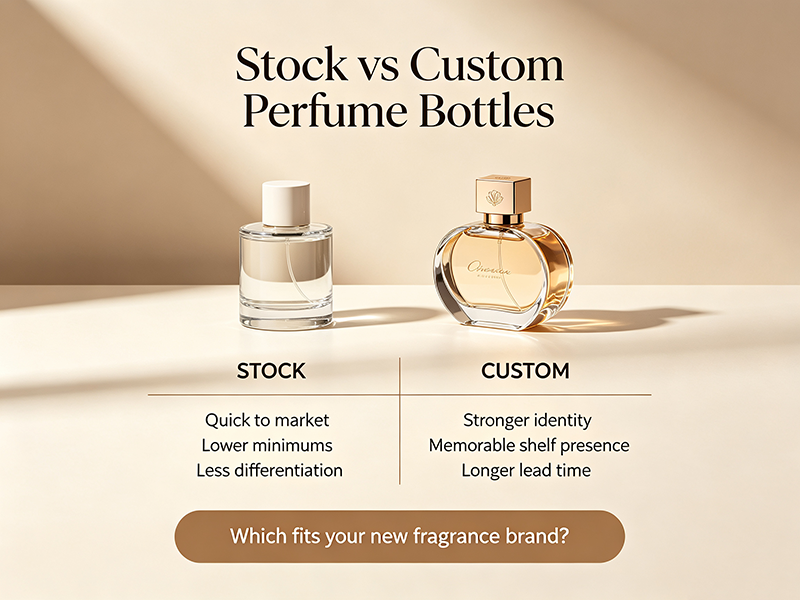
Краткий ответ: большинству новых брендов следует начинать с эффективной стратегии использования готовых бутылок
Для многих первых запусков парфюмерных линеек грамотно подобранный стандартный флакон является наиболее рациональной с коммерческой точки зрения отправной точкой. Это позволяет снизить риски, связанные с изготовлением пресс-форм, уменьшить минимальный объем заказа на стекло, упростить процедуру валидации и обеспечить бренду большую гибкость в случае изменений в продукте, позиционировании или прогнозе продаж.
Это не означает, что каждому новому бренду следует избегать использования индивидуальной формы. Создание фирменной бутылки может быть оправданным, если её форма играет ключевую роль в бизнес-концепции, прогнозируемые объёмы продаж выглядят убедительно, финансирование достаточное, а план запуска позволяет учесть более длительный процесс разработки.
Лучше задать не вопрос “Какой вариант выглядит более престижно?”, а следующий:
Какой вариант упаковки обеспечивает достаточную дифференциацию для поддержки бренда, при этом позволяя удержать объемы, финансовые риски, сроки и технические риски в пределах, приемлемых для бизнеса?
Для некоторых брендов решением становится использование серийного стекла в сочетании с индивидуальным декором. Для других — создание новой стеклянной формы. Для многих оптимальным решением является поэтапный подход, сочетающий эти два подхода.
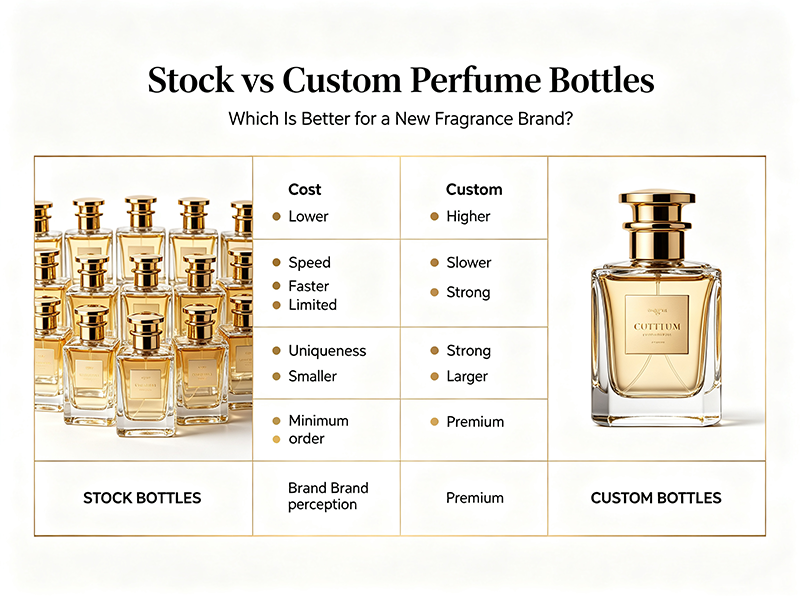
Краткое сравнение стандартных и индивидуальных флаконов для парфюмерии
| Фактор принятия решения | Флакон для духов из стоковых изображений | Флакон для духов на заказ |
|---|---|---|
| Стеклянная форма | Существующая форма | Новая форма, изготовленная специально для данного проекта |
| Рекомендации по минимальному объему заказа (MOQ) на стекло в компании DAXIN | три тысячи штук | 10 000 штук |
| Инвестиции в оборудование | Новая стеклянная форма не требуется | Требуются инвестиции в создание новой формы и разработку |
| Путь развития | Как правило, проще | Требуются чертежи, инженерные расчеты, испытания пресс-форм и валидация |
| Дифференциация бренда | Создано в основном с помощью декоративных элементов, крышки и коробки | Включает фирменный силуэт из стекла и размеры |
| Гибкость перед запуском | Выше | Снижение после начала изготовления инструментов и проведения испытаний |
| Технический риск | Опустить, когда бутылка окажется пустой | Более высокий уровень до тех пор, пока производство и сборка не пройдут валидацию |
| Риск, связанный с запасами | Снижение обязательств по поставкам стекла | Более значительные обязательства по поставкам стекла и увеличение запасов, предназначенных конкретно для проектов |
| Время для отбора пробы | Часто это быстрее, если есть образцы | Длится дольше, поскольку необходимо изготовить пробные образцы |
| Эксклюзивность | Ограничено на уровне формы стекла | Более широкие возможности управления при условии соблюдения соглашений об использовании оборудования и коммерческих соглашений |
| Оптимальный вариант | Тестирование, первый запуск, рост с минимальным риском | Проверенная концепция, увеличение объемов, высокий спрос на фирменную форму |
Эта таблица является отправной точкой, а не окончательным ответом. Минимальные объемы заказа (MOQ) на крышки, насосы, декоративные элементы и коробки могут отличаться от минимальных объемов заказа на стеклянные бутылки и могут повлиять на коммерческий результат.
1. Сравнить минимальные объемы заказа по всему комплекту
MOQ — это первый практический фильтр, поскольку он определяет, какой объем упаковки бренд должен закупить до того, как будут подтверждены объемы продаж.
В компании DAXIN минимальные объемы заказа (MOQ) при планировании проектов составляют:
| Компонент или процесс | Сведения о минимальном объеме заказа (MOQ) |
|---|---|
| Стандартная стеклянная бутылка | три тысячи штук |
| Стеклянная бутылка на заказ | 10 000 штук |
| Крышка | 10 000 штук |
| Насос | 10 000 штук |
| Бумажная коробка | три тысячи штук |
| Распыление | 3 000 штук каждого цвета |
| Шелкография | тысяча штук |
| Гальваника | 10 000 штук |
Данные приведены в качестве ориентира при планировании. Окончательный минимальный объем заказа (MOQ) необходимо подтвердить с учетом выбранных компонентов, цвета, материала, технологии изготовления и макета.
Минимальный объем заказа для бутылок не является минимальным объемом заказа для проекта
Новый бренд может исходить из того, что минимальный объем заказа (MOQ) для бутылок из складских запасов составляет 3 000 штук, и предположить, что полный комплект упаковки можно изготовить тиражом 3 000 единиц. Это предположение может оказаться ошибочным, если для выбранного насоса и крышки требуется по 10 000 штук.
В таком случае у бренда может возникнуть четыре варианта действий:
- Выберите доступные компоненты, которые поддерживают меньший стартовый тираж
- Закупить запасные колпачки и насосы для будущего производства
- Увеличьте объем первого заказа, если это оправдано прогнозом и состоянием денежного потока
- Переработать пакет с учетом более гибкой структуры минимального объема заказа (MOQ)
Именно поэтому для каждого проекта по поиску поставщиков необходима матрица минимальных объемов заказа (MOQ). Перечислите бутылку, дозатор, воротник, крышку, каждый процесс декорирования, коробку и вкладыш. Укажите минимальный объем для каждой позиции и определите, какие компоненты останутся после первой партии розлива. При оценке Минимальный объем заказа на флаконы для парфюмерии, всегда уточняйте, какую именно часть проекта обозначает данное число и какие дополнительные обязательства по инвентаризации оно влечет за собой.
Наличие нескольких ароматов может увеличить реальное минимальное значение
Если бренд выпускает три аромата в флаконах с распылителем, имеющих три разных цвета, минимальный объем заказа (MOQ) на распылители может применяться к каждому цвету в отдельности, а не к общему заказу. Кроме того, использование отдельных макетов может повлечь за собой необходимость отдельных настроек печати.
Коллекция, которая выглядит эффективной в таблице с общими объемами, может обернуться избыточными запасами, как только количества будут разбиты по размерам, ароматам, цветам и вариантам состава. Новым брендам следует рассчитывать минимальный объем заказа (MOQ) на уровне SKU и производственного процесса, а не только на уровне коллекции.
2. Сравнивайте первоначальные денежные затраты, а не только цену за единицу
Стандартное стекло, как правило, сопряжено с меньшими инвестициями в разработку, поскольку не требуется изготовление новой стеклянной формы. Изготовление стекла по индивидуальному заказу предполагает затраты на изготовление инструментов, пробное производство, доработку, а также более значительный минимальный объем заказа.
Однако сама по себе цена за единицу не отражает реальный финансовый риск.
Риск, связанный с наличными средствами в бутылках
Для организации маршрута перегона скота могут потребоваться денежные средства на следующие цели:
- Стеклянные бутылки из запасов
- Насосы и хомуты
- Кепки
- Настройка декораций и единицы измерения
- Коробки и вкладыши
- Образцы
- Упаковка и перевозка
Количество стекла может быть меньше, но изготовленная на заказ крышка или гальванический компонент все равно могут потребовать закупки в большем количестве. Бренды должны рассчитывать общую потребность в денежных средствах, включая избыточные компоненты, а не просто умножать цену бутылки на предполагаемый объем розлива.
Риск по наличным средствам в «Custom Bottle»
В маршрут с индивидуальной прокладкой можно добавить:
- Проектные разработки
- Стоимость стеклянной формы
- Требования к пробной или образцовой форме
- Модификация пресс-формы
- Пробное производство бутылок
- Минимальный объём заказа для больших стеклянных изделий
- Разработка индивидуальной упаковки
- Более длительный период до начала продаж может способствовать увеличению объема продаж
Кроме того, бренд берет на себя риск невозвратных затрат. Если после разработки формы произойдут изменения в ходе потребительских испытаний, по результатам обратной связи от розничных сетей, в направлении разработки рецептуры или в позиционировании продукта, часть инвестиций может оказаться невозвратной.
Рассчитать сумму наличных на одну единицу товара, готовую к продаже
Самое полезное сравнение — это не просто “стандартное решение стоит X, а индивидуальное — Y”. Рассчитайте:
Общая сумма денежных средств, необходимых для упаковки, ÷ количество единиц продукции, которые фактически можно расфасовать и реализовать в ходе первого тиража
Если компания закупает 10 000 крышек, но наполняет ими только 3 000 бутылок, неиспользованные крышки остаются активом в запасах, но при этом по-прежнему требуют затрат денежных средств. При принятии решения следует учитывать риски, связанные с хранением, повреждением, изменением дизайна и устареванием.
3. Сравнивайте общее время разработки, а не только время производства
A supplier may quote a normal mass-production period of 30–35 days after order confirmation and approval of details, with high-season production around 40 days. That production period is only one part of the launch schedule.
Typical Stock-Bottle Development Stages
A stock-bottle project may still require:
- Bottle and component selection
- Plain sample review
- Pump and cap compatibility testing
- Color sampling
- Artwork preparation
- Decorated sample approval
- Box structure development
- Complete assembly approval
- Mass production
- Inspection and shipping
An existing bottle mold removes one major development stage, but it does not eliminate the need to approve the full package.
Additional Custom-Mold Stages
A custom bottle can add:
- Concept feasibility review
- Technical bottle drawings
- Capacity and glass-distribution engineering
- Mold design and manufacture
- Пробное производство бутылок
- Dimensional inspection
- Stability and neck evaluation
- Mold correction where required
- Decoration trials on the approved glass
- Custom packing validation
Each approval can generate a new revision loop. The brand should not schedule a custom bottle as if it were simply a stock bottle with a longer factory production period.
Consider the Cost of a Late Launch
Custom glass may be worth the additional time when it creates a durable brand asset. But if a missed retailer window, seasonal launch, or funding milestone carries significant commercial cost, schedule risk may outweigh the value of the proprietary shape.
The brand should decide which date is fixed and which specification can move. If both the design and the launch date are treated as non-negotiable, risk will often reappear as air freight, rushed approvals, or compromised quality.
4. Compare Brand Differentiation Honestly
The strongest argument for a custom bottle is differentiation. A proprietary silhouette can improve recognition in product photography, on a retail shelf, and in the customer’s hand. It may become a long-term brand asset that carries across multiple fragrances.
However, new brands often overestimate how much differentiation comes from glass shape alone.
A Stock Bottle Can Still Build a Recognizable Identity
Consumers experience the complete system. A stock bottle can become distinctive through:
- A proprietary color palette
- A disciplined print layout
- A recognizable cap proportion
- A consistent collar finish
- A signature label or plaque
- A strong box-opening sequence
- Repeated visual codes across a fragrance collection
If the brand has not yet established its name, typography, color, or product architecture, a custom glass silhouette cannot solve the underlying identity problem.
A Custom Bottle Should Have a Strategic Reason
A new mold is more justified when the bottle shape performs a specific brand job, such as:
- Expressing a recognizable symbol or architectural idea
- Creating a distinctive grip or ritual
- Supporting a refill or special closure system
- Establishing a family shape for future fragrances
- Delivering proportions unavailable in the stock market
- Integrating logo relief into the glass
“We want something unique” is a starting desire, not a complete design brief. The brand should be able to explain what customers should recognize and why that recognition matters commercially.
5. Compare Design Flexibility and the Cost of Changing Direction
New brands learn during development. Retailers may prefer another capacity. Testing may show that the cap feels too heavy. The filling partner may require a different neck specification. The price structure may need to change.
Stock Bottles Preserve More Optionality
With an existing mold, the brand can often change color, artwork, cap selection, or box structure without abandoning the underlying bottle. This flexibility is valuable before demand and positioning are fully proven.
The bottle may also support future fragrances through new decoration. Sharing the same glass across several SKUs can simplify purchasing, filling, quality control, and inventory.
Custom Molds Increase Commitment
Once a custom mold is made and trials begin, changing height, width, base geometry, neck position, or major relief details may require mold modification or new tooling. Changes can affect the cap, box, insert, carton count, and filling setup.
This does not make custom development a bad choice. It means the brand should enter it with a more stable concept and a formal change-control process.
6. Compare Technical and Manufacturing Risk
An existing bottle that has already been produced offers useful manufacturing knowledge. The supplier may have established expectations for glass formation, decoration areas, packing, and compatible components.
A new bottle has no mass-production history until it is developed and validated.
Custom Shapes Create New Questions
Features that require careful engineering include:
- Very thick or uneven bases
- Sharp transitions in glass distribution
- Narrow feet or small contact areas
- Highly asymmetric shapes
- Deep recesses
- Thin projecting features
- Broad flat panels sensitive to deformation
- Unusual shoulder geometry
- Off-center neck positions
A concept may look compelling in a rendering but create instability, decoration difficulty, glass stress, or inefficient packing.
Stock Does Not Mean Risk-Free
A stock bottle still needs inspection and assembly testing. A bottle from an existing mold may have:
- A neck finish that does not match the preferred pump
- Limited cap options
- A decoration area smaller than expected
- Variable availability
- A weight that conflicts with freight targets
- A shape shared too widely within the market
The difference is that stock-bottle risk is usually easier to evaluate using samples before the brand commits to glass tooling.
7. Compare Pump, Collar, and Cap Compatibility
The glass bottle cannot be evaluated independently from the closure system.
Stock Bottle Compatibility
A stock bottle with a standard, proven neck may offer a wider choice of pumps and available caps. This can shorten compatibility testing and reduce the need for custom internal structures.
However, “compatible” should still be demonstrated with an assembled sample. Check:
- Pump-to-neck fit
- Crimp or assembly quality
- Dip-tube length
- Spray pattern
- Leakage resistance
- Collar coverage
- Cap retention
- Cap alignment
- Clearance around the actuator
Custom Bottle Compatibility
A custom bottle gives more control over the relationship between the glass and closure, but it also requires more coordination. If the bottle neck or shoulders are modified late, the pump, collar, cap, and box may all need to be rechecked.
The supplier should freeze key interface dimensions before related tooling is approved. The glass mold, pump specification, collar drawing, cap internal structure, and assembled height should be managed as connected documents.
Custom Caps Can Remove the MOQ Advantage of Stock Glass
A brand may choose stock glass to launch 3,000 units, then design a proprietary cap with a 10,000-piece MOQ. The cap—not the bottle—becomes the controlling commitment.
For a first launch, it may be more efficient to select an available cap structure and customize the visible finish. A fully custom cap can be introduced later when volume supports it.
8. Compare Decoration Potential
Decoration is the main tool for turning stock glass into brand-specific packaging, but bottle geometry determines what can be executed reliably.
Decoration on Stock Bottles
Before choosing a stock model, examine:
- Size and flatness of the print area
- Shoulder and base transitions
- Ability to rotate the bottle during decoration
- Areas that may collect excess coating
- Visibility of seams or mold marks
- How liquid color changes the visual result
Spray coating can dramatically change the character of existing glass. Screen printing and hot stamping can establish the logo hierarchy. Frosting can soften the surface, while UV printing and decals can support more complex artwork.
At DAXIN, spraying uses a 3,000-piece-per-color MOQ reference, silk printing uses a 1,000-piece reference, and electroplating uses a 10,000-piece reference.
Decoration on Custom Bottles
A custom bottle allows the decoration area to be considered during glass design. The brand can create a dedicated logo panel, relief detail, label recess, or geometry designed around a gradient.
But a custom shape can also make decoration harder. Deep curves, tight corners, and irregular surfaces may reduce color consistency or print accuracy. Decoration feasibility should be reviewed before the mold is finalized, not after the glass shape has already been approved.
9. Compare Quality-Control Complexity
Quality control should be defined before mass production regardless of the bottle route.
Stock Bottle Quality Control
For an existing bottle, the brand can often inspect representative samples and define expectations using known production characteristics. Relevant checks include:
- Capacity and dimensions
- Bottle stability
- Neck quality
- Распределение стекла
- Bubbles, stones, cracks, and deformation
- Surface cleanliness
- Decoration adhesion and position
- Pump and cap fit
Custom Bottle Quality Control
A custom project needs additional validation between concept and mass-production standard. Trial samples may be used to confirm:
- Whether the drawing can be manufactured consistently
- Whether capacity and dimensions match the specification
- Whether the bottle stands securely
- Whether the glass distribution is acceptable
- Whether the neck works with the intended pump
- Whether decoration can be applied consistently
- Whether the bottle survives the planned packing and transport method
The approved trial sample should not remain an informal visual reference. Create a controlled approval set including drawings, color standards, artwork position, closure components, box structure, and agreed inspection criteria.
10. Compare Inventory and Obsolescence Risk
Inventory risk is particularly important for new fragrance brands because demand is still uncertain.
Stock Components May Be More Reusable
Undecorated stock glass, standard pumps, and common caps may be usable across more than one fragrance if the design architecture is planned carefully. The brand can create differentiation later through decoration and boxes.
This does not guarantee that every component can be reused, but a modular package can reduce the financial impact of changing a fragrance name, color, or launch plan.
Custom Components Are More Brand-Specific
A bottle with a molded logo, unique capacity, or proprietary silhouette may have little alternative use. If the brand changes its identity or discontinues the product, remaining glass and matching components may become obsolete.
Before committing to a custom mold, calculate:
- Expected first-year sell-through
- Reorder probability
- Storage cost
- Risk of artwork or formula changes
- Whether the bottle will support future fragrances
- Whether the cap and pump can be shared
- What happens to unused packaging if the launch underperforms
A custom bottle becomes more financially defensible when it is designed as a long-term platform, not a single short-lived novelty.
11. Compare Shipping and E-Commerce Performance
Bottle shape and weight affect logistics whether the glass is stock or custom.
Efficient Stock Shapes
Rectangular and compact stock bottles may support efficient dividers, cartons, and shelf arrangements. The brand can compare several proven shapes and choose one that balances presence with pack density.
Custom Shape Opportunities and Tradeoffs
A custom bottle can be engineered for efficient packing, but creative concepts sometimes prioritize width, projection, or weight without calculating the logistics impact.
Confirm:
- Assembled bottle dimensions
- Net and gross unit weight
- Units per inner and master carton
- Carton dimensions and gross weight
- Protection between decorated surfaces
- Pallet configuration where applicable
- E-commerce parcel requirements
A heavy or irregular package may look impressive but increase freight and breakage exposure. The cost should be evaluated per delivered sellable unit, not only at the factory gate.
12. Compare Exclusivity and Brand Ownership
Stock glass generally offers limited exclusivity because the underlying mold may be used for other customers. Brands should not assume a catalog bottle becomes exclusive simply because they customize it.
Differentiation can still be protected through proprietary artwork, brand elements, a unique color system, custom box design, or a cap developed under a clear commercial agreement.
For a custom mold, clarify:
- Who pays for the mold
- Who owns or controls its use
- Whether the shape is exclusive
- Which regions, products, or time periods are covered
- Who stores and maintains the tooling
- What happens if the relationship ends
- Whether replacement or repair costs are defined
- How technical drawings and revisions are recorded
Intellectual-property protection depends on jurisdiction, originality, agreements, and registration strategy. A packaging supplier can clarify manufacturing and tooling arrangements, but the brand should obtain appropriate legal advice for design rights, trademarks, and contractual protection.
13. Compare Scalability Across Future Fragrances
The first bottle decision should consider what happens after a successful launch.
Stock-Bottle Family Strategy
A stock bottle can become the base of a collection. Different fragrances may share the same glass, pump, cap structure, and box dimensions while using separate colors and artwork.
Benefits can include:
- Consolidated glass purchasing
- Shared closure inventory
- Simpler filling-line setup
- Easier quality standards
- More efficient box engineering
- Faster introduction of new fragrances
The risk is that the collection may rely too heavily on decoration for differentiation. Strong art direction and consistent brand codes become essential.
Custom-Bottle Platform Strategy
A proprietary bottle can create a powerful family asset if the brand plans to use it across several fragrances and years. Tooling investment and development effort are spread over a larger commercial base.
Before developing it, ask:
- Can the bottle support several fragrance identities?
- Will one cap system work across the range?
- Can future sizes use related proportions?
- Is the silhouette connected to the brand rather than a short-term trend?
- Can the package be produced profitably at forecast reorder volumes?
The custom route is strongest when it supports a repeatable platform rather than a one-time object.
When a Stock Perfume Bottle Is the Better Choice
A stock bottle is usually the better option when several of the following conditions are true:
- The brand is preparing its first launch
- Demand has not yet been validated
- The first order needs to remain near 3,000 glass bottles
- The launch date is commercially important
- Funding should be preserved for formula, marketing, filling, or distribution
- The brand identity can be expressed through color, print, cap, and box
- The team expects to learn from the first production run
- Multiple fragrances need to share components
- A suitable existing shape and neck specification are available
- The business prefers lower sunk-cost exposure
The stock route is not a lack of ambition. It can be a deliberate way to protect capital and learn faster.
When a Custom Perfume Bottle Is the Better Choice
A custom glass mold becomes more suitable when:
- The bottle silhouette is central to the brand proposition
- No existing bottle can deliver the required proportions or function
- The brand can support at least the custom-glass MOQ reference
- Projected demand is supported by credible sales channels or prior performance
- The business can fund tooling without weakening other launch activities
- The development schedule allows trials and revisions
- The design direction is stable
- The bottle will support several reorders or future fragrances
- The team can manage technical approvals and change control
- The commercial value of exclusivity exceeds the additional risk
Custom glass should be an investment in durable brand equity, not an attempt to compensate for an unclear product strategy.
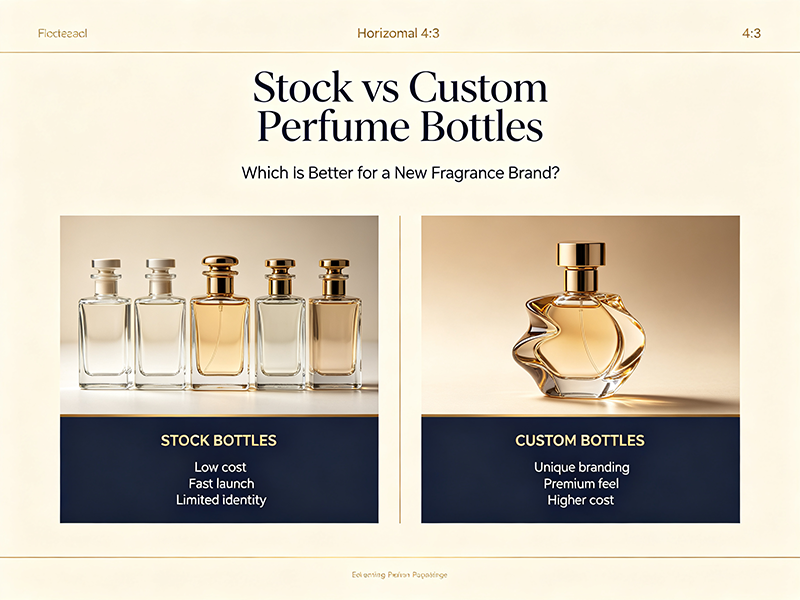
The Hybrid Route: Often the Best Answer for a New Brand
The most practical choice is not always fully stock or fully custom. A hybrid strategy uses proven elements where they reduce risk and selected custom details where they create the most brand value.
Examples include:
- Stock glass with a custom sprayed color
- Stock bottle and pump with a custom-finished cap
- Existing cap structure with a proprietary outer shell
- Stock bottle with a unique plaque or label system
- Shared bottle and cap across several fragrances with distinct decoration
- Stock glass for the first launch, followed by a custom mold after demand is validated
Why the Hybrid Model Works
It lets the brand concentrate investment on the touchpoints customers notice most. It also preserves proven bottle and pump geometry while creating a more ownable visual identity.
For example, if a new glass mold and fully custom cap would strain the budget, the brand might use a stock bottle and invest in a memorable cap finish, controlled gradient, and strong box. The result can appear deliberate without taking on every category of tooling and inventory risk at once.
A Three-Stage Packaging Roadmap for New Fragrance Brands
Stage 1: Validate the Product
Use a proven stock bottle, compatible closure, limited decoration palette, and efficient box. Launch one hero capacity or a tightly controlled SKU range. The objective is to validate fragrance demand, positioning, and pricing.
Stage 2: Build Recognition
After repeat demand becomes visible, upgrade the element that creates the greatest brand value. This may be a proprietary cap shell, more distinctive decoration, better glass weight, or a more memorable box-opening experience.
Keep compatibility with existing pumps, filling processes, and carton structures where practical.
Stage 3: Invest in a Signature Bottle
Once the brand has a stable customer base, repeat forecast, and mature visual identity, evaluate a custom glass mold. Use sales data and customer feedback to decide which size, hand feel, silhouette, and functional details deserve long-term investment.
This roadmap turns custom packaging into a response to validated business needs rather than a speculative first expense.
A Weighted Decision Scorecard
New brands can use a simple scorecard to make the decision more objective. Assign an importance weight from 1 to 5 to each factor. Then score stock and custom from 1 to 5 based on the actual supplier proposals.
| Criterion | Suggested question |
|---|---|
| Launch speed | How costly would a delay be? |
| Available cash | Can the business support tooling and higher component commitments? |
| Demand confidence | Is the forecast supported by orders, distribution, or proven sales? |
| Need for a unique shape | Is glass geometry essential to brand recognition or function? |
| Design stability | Is the concept mature enough to freeze dimensions? |
| Quantity fit | Do planned volumes support every component MOQ? |
| Technical capacity | Can the team manage drawings, trials, tolerances, and changes? |
| Inventory tolerance | What is the financial impact of unused custom packaging? |
| Future platform value | Will the bottle support several reorders or fragrances? |
| Logistics efficiency | Does the proposed shape meet freight and breakage targets? |
Multiply importance by each option’s score. The result does not replace management judgment, but it exposes where enthusiasm for a custom shape may be overriding the business constraints—or where excessive caution may be preventing a valuable long-term asset.
Example Scenarios
Scenario A: Self-Funded Niche Fragrance Startup
The brand plans one 50ml fragrance, expects modest direct-to-consumer sales, and has no prior sell-through data. Packaging must look premium, but funding is also needed for formulation, filling, photography, samples, and advertising.
Better route: Stock bottle customization.
Select a strong existing shape, use one controlled spray color, apply clean screen printing, choose an available cap structure, and invest in a well-fitted box. Preserve cash and learn from the first launch.
Scenario B: Influencer-Led Brand With Confirmed Preorders
The brand has a recognizable symbol, a large launch audience, confirmed preorder demand, and enough capital for tooling. The bottle shape is central to the story and will be used across several planned fragrances.
Potentially better route: Custom glass mold, subject to a realistic schedule and technical feasibility.
The brand should still build contingency into the timeline and validate the closure, decoration, and box using complete assembly samples.
Scenario C: Private-Label Brand Launching Five Fragrances
The company wants five scents in different colors but with a unified collection identity. The total order is meaningful, while the quantity of each fragrance is limited.
Better route: Shared stock bottle and closure platform.
Use the same glass, pump, cap, and box dimensions across the range. Differentiate through coating and artwork while checking the spraying MOQ per color.
Scenario D: Established Regional Brand Replacing a Generic Bottle
The brand already has repeat sales and distributor demand. Its current stock bottle no longer supports price positioning, and competitors use similar silhouettes.
Potentially better route: Custom bottle platform.
Use sales history to set volume, develop a recognizable shape, and plan the bottle for several fragrances and reorders rather than one limited release.
Questions to Ask a Perfume Bottle Manufacturer Before Deciding
Before approving either route, ask:
- Does the proposed stock bottle physically exist, or does only the mold exist?
- What quantity is currently available?
- Which pumps, collars, and caps have been tested with the bottle?
- What is the MOQ for every component and decoration process?
- Which costs are one-time tooling costs and which are recurring?
- What samples will be provided before production?
- What are the main technical risks of the custom design?
- Which dimensions must be frozen before cap and box development?
- What decoration areas and tolerances are realistic?
- How will color, print position, and cap fit be approved?
- How will the bottle be packed to protect decorated surfaces?
- What is the normal production period after final approval?
- What inventory remains if the first filling quantity is below a component MOQ?
- Who controls the custom mold, drawings, and future use?
- Which change would have the greatest impact on price or timing?
Whether a brand is speaking with a производитель флаконов для парфюмерии на заказ, a stock perfume bottle supplier, or an integrated поставщик упаковки для парфюмерии, the supplier should make the tradeoffs clearer, state assumptions, and recommend a route based on the whole project rather than pushing the most customized option.
Common Mistakes to Avoid
Assuming Stock Means Immediate Delivery
Confirm physical inventory, compatible components, and decoration capacity. An existing mold may still require production.
Choosing a Custom Bottle Before Confirming Sales Volume
Visual enthusiasm should not replace a credible quantity plan. Calculate cash exposure and expected sell-through first.
Comparing Bottle Prices Instead of Complete Packaging Costs
Include the pump, cap, decoration, box, insert, excess components, packing, freight, and inspection requirements.
Using a Custom Cap That Defeats the Stock-Bottle Strategy
A high-MOQ cap can become the largest inventory commitment. Review every component before claiming the project is a low-MOQ launch.
Finalizing the Box Before the Assembly
The approved bottle, pump, collar, and cap determine the final height, weight, and insert clearance.
Approving Only From Renderings
Renderings communicate design intent but do not prove glass quality, hand feel, stability, cap fit, spray performance, or decoration consistency.
Treating Heavier Glass as the Only Luxury Signal
Premium quality also comes from proportions, clarity, balance, fitting precision, finish consistency, and a coherent unboxing experience.
Starting Custom Tooling With an Unstable Brand Identity
If the name, logo, capacity, price point, or target customer may change, keep more options open until the strategy is mature.
Final Decision Checklist
Choose a stock perfume bottle when you need to:
- Protect cash
- Reduce glass MOQ
- Launch with less tooling risk
- Preserve design flexibility
- Test market demand
- Share components across fragrances
- Use decoration and accessories for differentiation
Choose a custom perfume bottle when you have:
- A stable and meaningful shape concept
- Sufficient funding
- Quantity that supports the glass MOQ
- Credible demand or distribution
- A realistic development schedule
- Technical approval capability
- A plan to use the design across multiple reorders or products
Choose a hybrid strategy when:
- You need a recognizable package but cannot justify full custom glass
- One touchpoint creates more value than changing every component
- You want to validate demand before investing in a proprietary mold
- You can share proven bottle and pump geometry while customizing visible details
Заключительные мысли
For most new fragrance brands, the best first bottle is not the most technically ambitious option. It is the package that expresses the brand clearly, works reliably, meets the launch quantity, protects cash, and leaves enough flexibility to respond to real market feedback.
A stock perfume bottle can deliver a premium and recognizable result when color, decoration, cap, pump, and box are developed as one system. A custom glass mold becomes more valuable when demand is proven, the brand identity is stable, and the proprietary shape can support multiple production runs. The right perfume bottle mold decision should therefore follow the commercial case, not precede it.
The decision between Стандартные флаконы для духов и флаконы, изготовленные на заказ should therefore be made with a complete commercial model—not only a mood board. Compare component-level MOQs, total cash exposure, development time, technical risk, inventory, logistics, and long-term brand value.
If you are evaluating stock or custom bottles for a new fragrance line, share your capacity, quantity, design references, decoration direction, cap and pump requirements, box concept, target market, and launch schedule. An experienced perfume packaging supplier can then compare practical routes and coordinate the glass bottle, pump, collar, cap, decoration, and outer packaging as one compatible custom perfume packaging system.
FAQs:
1. Are stock perfume bottles suitable for a luxury fragrance brand?
Yes. Luxury positioning depends on the complete experience, not only on whether the glass mold is proprietary. A well-proportioned stock bottle can support a luxury fragrance when it is combined with controlled decoration, a precise cap and pump system, a strong box, and consistent quality. The brand should choose a bottle that fits its price position rather than assuming every luxury launch requires custom glass.
2. What is the MOQ for stock and custom perfume bottles?
At DAXIN, the stock glass bottle MOQ reference is 3,000 pieces, while custom glass bottles use a 10,000-piece reference. Pumps and caps use a 10,000-piece reference, paper boxes 3,000 pieces, spraying 3,000 pieces per color, silk printing 1,000 pieces, and electroplating 10,000 pieces. Final MOQs depend on the selected components and processes.
3. Is a stock bottle the same as an in-stock bottle?
Not always. “Stock bottle” often means that an existing mold is available. Finished glass may or may not be physically in warehouse inventory. Brands should confirm current quantity, capacity, neck specification, compatible components, and whether a new production run is required.
4. Can a stock perfume bottle be customized?
Yes. Stock glass can be customized through spray coating, screen printing, hot stamping, frosting, UV printing, decals, metallization, selected caps, custom finishes, and branded boxes. The glass silhouette may remain available to other buyers, but the complete package can still develop a distinctive identity.
5. How much more does a custom perfume bottle cost?
There is no universal percentage. The difference depends on mold complexity, glass weight, order quantity, trial requirements, revisions, cap and pump development, decoration, packing, and freight. Brands should compare total project cash and cost per sellable unit rather than only the bottle unit price.
6. How long does it take to develop a custom perfume bottle?
Custom development is longer than a comparable stock-bottle project because it requires technical drawings, mold production, glass trials, inspection, possible correction, decoration samples, and complete assembly approval. Mass production is scheduled only after the necessary details are approved. The exact timeline depends on design complexity and revision cycles.
7. When should a new fragrance brand invest in a custom bottle mold?
A custom mold is more appropriate when the brand has a stable design direction, sufficient funding, credible demand, quantity that supports the MOQ, and a plan to use the shape across multiple reorders or fragrances. It should create commercial value that justifies the added cost and risk.
8. What is the best compromise between stock and custom packaging?
A hybrid package often provides the best balance. The brand can use proven stock glass and a compatible pump while customizing the color, print, cap finish, plaque, label, or box. This concentrates investment on visible brand touchpoints while reducing glass tooling and development risk.
 English
  Spanish
  French
  German
  Arabic
  Italian
  Dutch
Dutch  Portuguese
  Russian
  Korean
  Japanese