
Beschichtung von Glasflaschen: Ein Leitfaden für Parfümmarken zu Oberflächenbeschaffenheit und Haltbarkeit
Mattschwarz, tiefes Smaragdgrün, ein Ombré-Verlauf von Tintenblau zu Glas: Die beschichtete Flasche ist das untrügliche Zeichen für die Einführung eines ernstzunehmenden Parfüms. Sie ist aber auch das Dekorelement, nach dem Marken ein Jahr später am besorgtesten fragen, wenn die Flaschen mit abgenutzten Kanten oder zerkratzten Halsrändern zurückkommen. Bevor Sie sich für eine Oberflächenbeschichtung entscheiden, sollten Sie wissen, was eine Beschichtung ist, welchen Belastungen sie standhält und welche Fragen aus einem hübschen Muster eine verlässliche Produktionsentscheidung machen.
Was "Glasflaschenbeschichtung" eigentlich bedeutet: Zwei verschiedene Welten
Wenn Sie nach "Glasflaschenbeschichtung" suchen, werden Sie feststellen, dass sich zwei Branchen unter diesem Begriff aneinander vorbeiredet.
Die erste Welt ist unsichtbar. Glasbehälterfabriken tragen im Bereich der Formungslinie Funktionsbeschichtungen auf – eine Behandlung am „heißen Ende“ vor dem Tempern und eine Schicht am „kalten Ende“ danach –, damit sich die Flaschen auf den Förderbändern nicht gegenseitig zerkratzen, die Abfüllanlagen nicht blockieren oder beim Transport nicht aneinanderkleben. Typische Materialien für die Kaltendbehandlung sind wasserlösliche Stearat-Sprays (üblich in der Pharmaindustrie, werden vor dem Abfüllen abgewaschen), Ölsäure-Dampf zur allgemeinen Schmierung sowie Polyethylen-Sprays, wenn maximaler Schutz gewünscht ist (Oberk-Verpackungen – Crashkurs). Technik, nicht Design.
Die zweite Welt ist das Thema dieses Artikels. Bei Verpackungen für Parfüms, Kosmetika und Spirituosen bezeichnet "Beschichtung" eine dekorative Schicht – Farbe, Lack, Emaille oder einen UV-gehärteten Film –, die der Außenseite einer Flasche Farbe und Struktur verleiht. Achten Sie in Produktlisten auf zwei ähnlich aussehende Begriffe: "sicherheitsbeschichtete Glasflaschen" aus dem Labor (mit Plastisol ummantelt, für gefährliche Chemikalien) und silikonbeschichtete Babyflaschen gehören zur Kategorie der Trinkgefäße und nicht zu den Dekorationsmöglichkeiten für Parfüms.
Welche "Beschichtung" haben Sie im Blick?
Warum ein industrielles Verfahren, wenn ein Hobbybastler einfach Sprühfarbe kaufen kann? Glas ist glatt, dicht und porenfrei: die schlechteste Oberfläche für die Haftung. Farbe auf Glas gibt es nur auf zwei Arten: entweder während der Herstellung in das Glas eingeschmolzen oder durch Vorbehandlung und Aushärtung an die Oberfläche gebunden, wobei ein Einbrennvorgang oder eine UV-Bestrahlung den feuchten Film in einen vernetzten Feststoff verwandelt. Dieser zweite Weg ist die Beschichtung. Selbst aufgetragene Farbe auf einem Glasgefäß blättert innerhalb weniger Wochen ab, weil beide Schritte übersprungen werden: keine Oberfläche, mit der eine Reaktion stattfinden kann, keine Aushärtung. Professionelle Beschichtungen lösen beide Probleme mithilfe von Chemie und Öfen. Der Vorteil ist eine Haltbarkeit, die Sie festlegen, prüfen und vom Lieferanten einfordern können.
Wenn Sie Kerzen oder Dekorationsartikel für Regale herstellen und nur die Antwort auf die Frage "Warum blättert meine Farbe ab?" gesucht haben, dann haben Sie sie jetzt. Der Rest richtet sich an diejenigen, die eine beschichtete Flasche vor einem Kunden ausstellen.
Woher die Flaschenfarbe stammt: Vier Wege, einer davon bleibt für immer bestehen
In Parfümforen taucht immer wieder dieselbe Beschwerde auf: Die Farbe eines Flakons blättert ab, und jemand erklärt, dass die Marke "das Glas bemalt hat, anstatt farbiges Glas zu verwenden". Das ist zur Hälfte richtig, und gerade die Hälfte, die falsch ist, ist der entscheidende Punkt. Bei der Flakonfarbe gibt es vier unterschiedliche Herstellungsverfahren, und jedes bietet unterschiedliche Eigenschaften zu unterschiedlichen Preisen.
Farbe im Glas: Einfärbung im Glas (Körper)
Bei der Einfärbung im Glas werden der Glasmasse vor dem Schmelzen anorganische Farbstoffe wie Kobaltblau, Smaragdgrün, Bernstein, Teebraun und Opalweiß beigemischt. Die Farbe wird Teil des Glases: Sie kann sich nicht ablösen, abkratzen oder durch Parfüm aufgelöst werden, da es keinen Film gibt, der beschädigt werden könnte. Dies ist die ideale Lösung für Marken, die eine stabile, lichtschützende Flasche in einem klassischen Farbton benötigen.
Die Kompromisse sind struktureller Natur. Die Farbpalette beschränkt sich auf Farbtöne, die mit der jeweiligen Chargenchemie hergestellt werden können: keine Pantone-Farbanpassung, kein echtes, fast schwarzes Schwarz, keine Farbverläufe. Die Produktionsmengen sind groß, da im Schmelzofen tonnenweise geschmolzen wird und jeder neue Farbton eine neue Chargenrezeptur erfordert. Wenn Ihre Markenidentität "Kobaltblau" lautet, ist dieser Weg die richtige Wahl für Sie. Handelt es sich hingegen um eine Sonderfarbe mit einem Namen im Briefing, ist dies nicht der Fall.
Farbe auf der Oberfläche: dekorative Beschichtung
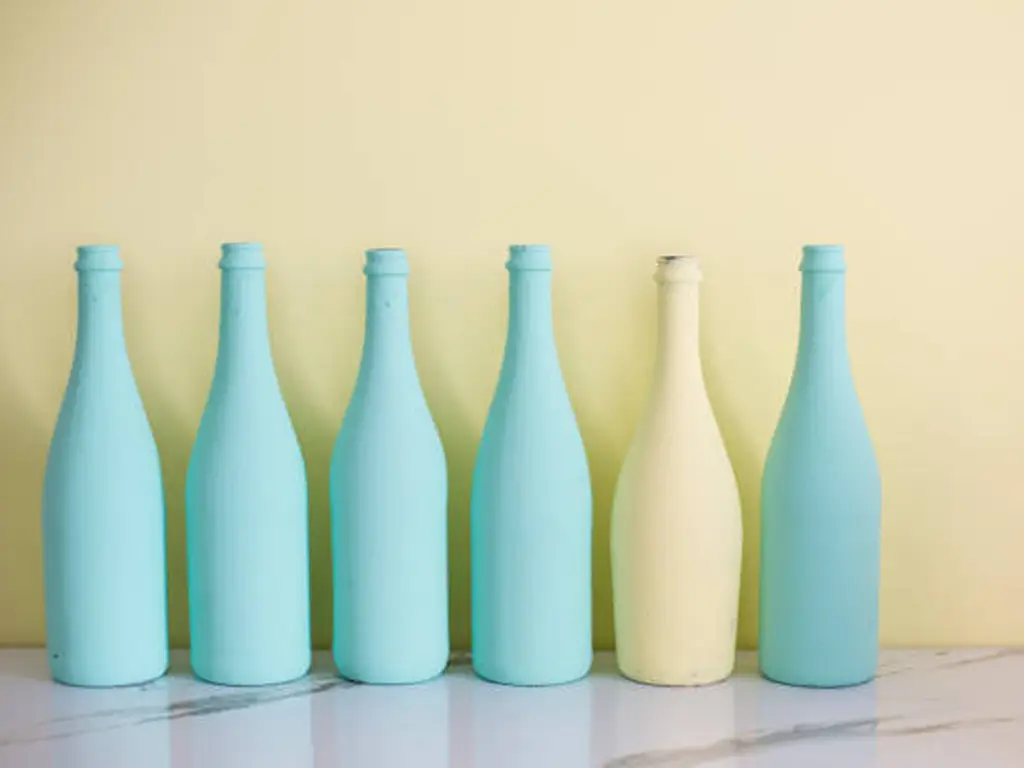
Bei der dekorativen Beschichtung ist es genau umgekehrt. Da die Beschichtung auf eine fertige Flasche aufgebracht wird – sei es durch Sprühen, Tauchen oder in einer automatisierten Produktionslinie –, sind die Möglichkeiten praktisch unbegrenzt: jede Markenfarbe, jede Deckkraft von transparent bis vollständig deckend, jede Oberflächenbeschaffenheit von glänzend über matt bis hin zu Soft-Touch, Farbverläufe, Perlglanz sowie partielle Beschichtung, bei der das klare Glas durchscheint. Entscheidend für eine neue Marke ist, dass die Beschichtung auf einer Serienflasche aufgebracht werden kann: Ein und dieselbe Form kann zehn Kunden in zehn verschiedenen Farben bedienen. Deshalb ist die Beschichtung der Standardweg für Markteinführungen, limitierte Auflagen und regionale Varianten.
Der Preis für diese Freiheit ist der Film selbst. Eine Beschichtung ist wie eine Haut, kein Knochen: Sie hat unter chemischen Einflüssen und durch Abrieb eine begrenzte Lebensdauer, und bei allem, was nach diesem Abschnitt folgt, geht es darum, diese Lebensdauer vorhersehbar zu machen.
Strukturverfahren: Mattätzung und Metallbeschichtung
Zwei weitere Verfahren vervollständigen das Spektrum. Durch Frosting (Säureätzung) wird die Glasoberfläche zu einer matten Struktur aufgelöst: farblos, durchgehend, nicht ablösbar, oft kombiniert mit partieller Politur oder Überdruck. Bei der Vakuummetallisierung wird eine echte Metallschicht – Gold, Silber, Gunmetal, Roségold – aufgebracht, um Oberflächen zu erzielen, die mit Farbe nicht reproduzierbar sind. Keines der beiden Verfahren ersetzt die Beschichtung; beide ergänzen sie, und alle vier Verfahren können auf einer Flasche übereinandergeschichtet werden.
Die Wahl zwischen den Wegen
| Pfad | Wo die Farbe lebt | Schalen? | Effekte, die dadurch freigeschaltet werden | Typische Wirtschaftswissenschaften |
|---|---|---|---|---|
| Färbung im Glas | Im Inneren des Glases | Niemals | Klassische Farbtöne, Lichtschutz | Große Auflagen; Verpflichtung auf Chargenebene |
| Dekorative Beschichtung | Gebundener Oberflächenfilm | Nur wenn sie schlecht formuliert, ausgehärtet oder behandelt sind | Vollständige Farbpalette, matt/glänzend/Soft-Touch, Farbverläufe, partielle Deckkraft | Beliebige Stückzahl; Standardflaschen sind zulässig |
| Mattierung (Ätzung) | In Glas eingravierte Struktur | Niemals (es ist das Glas) | Matte Textur, Kontrastschichten | Mittlere Stückzahlen; die Formgeometrie spielt eine Rolle |
| Vakuummetallisierung | Metal film on surface | Can wear | Metallic mirror effects | Premium runs; costliest per unit |
Rough rule of thumb: want twenty years of color with no maintenance, color the glass. Want your exact brand color, a gradient, or a matte touch, coat it. Want ceramic-like matte, etch it. Want metal, plate it. The mistake is treating these as "versions of painting": they are different materials with different failure modes, and your choice of path sets every durability question you will ask later.
Choosing a Coating Finish: What Fragrance Brands Actually Pick
Within the coating path, the next decision is the finish: brand-language first, engineering second.
| Oberfläche | Look and feel | Verhalten von Fingerabdrücken | Typical user |
|---|---|---|---|
| Opaque full cover | Bold, total color; the bottle becomes a block of brand color | Matte hides prints; gloss shows them | Mass and masstige launches |
| Glossy lacquer | Deep, reflective, "wet" color | Shows every print | Retail shelves with strong light |
| Matte | Soft light absorption, modern, premium-coded | Hides prints well | Niche and premium lines |
| Soft-touch | Velvet feel, warmth in the hand | Hides prints | Luxury-positioned cosmetics |
| Pearl / shimmer | Light-shifting depth | Mäßig | Festive and prestige editions |
| Gradient (ombre) | Color dissolving into clear glass | Same as its base finish | Premium launches; flagship visual |
| Partial cover / bare zones | Coat meets clear glass at a deliberate line | Same as its base finish | Design-led lines, layered printing |
Two corrections before you pick. First, matte is not "more durable" because it looks robust: matte and soft-touch films are typically softer than gloss and show rub marks sooner. Their fingerprint resistance is a perception benefit, not an abrasion rating. Second, the finish is rarely the last decoration. Coating is the base layer of a stack; silk-screen your logo, hot-stamp foil, or emboss onto or through it, and the coating's surface chemistry decides how well those inks and foils hold. "Coating first, print on top" gives you effects, a matte bottle with a foil logo, a gradient bottle with a silk-screened name, that no single process produces alone. One warning from the indie side: a printed sticker on a coated bottle reads as a sticker. If the finish is the investment, print into it, not onto it.
The economics deserve equal weight. Coating is the only way to make a stock bottle exclusive without a new mold. That "change the skin, keep the skeleton" logic lets a brand test a channel, a season, or a regional scent without tooling commitment. For new fragrance lines, it is the default entry route.
One trend matters if you export. European regulation on coating VOCs is tightening: under Directive 2004/42/EC the applicable limit depends on the product category, and compliance is verified by measurement per ISO 11890. The decorating industry is shifting toward water-based systems, and the direction is right. But as the next section shows, "water-based" and "durable against perfume" do not automatically mean the same thing.
Why Coated Perfume Bottles Fail — and the Specs That Prevent It
Perfume is one of the harshest environments a decorative coating can live in. Fragrance communities document the failures constantly: coatings peeling within months, paint eroded where atomizer leakage ran down the collar, finishes flaking on a store shelf untouched. They fall into three mechanisms. Knowing which one you are looking at tells you where the fix belongs.
Failure mechanism 1: chemical attack by the product itself
Perfume is 80–95% ethanol with aromatic compounds, effectively a solvent that the bottle carries against its own decoration. Every drop that touches the coating matters: leakage from a faulty atomizer, drips down the collar during spraying, juice trapped under an overhang. The same "alcohol eats paint" behavior shows up on air-freshener bottles and painted cabinets; on a fragrance bottle, the collar and shoulder go first. No coating is immune to prolonged solvent contact. The question is how many exposures a film survives before it softens, blooms, or lifts.
Failure mechanism 2: mechanical wear
Coated bottles are handled, stacked, packed, and carried. Soft finishes, matte and soft-touch above all, abrade sooner than hard gloss, and every surface has weak zones: sharp bottom edges, embossed logos, the rim under the cap. Store display adds heat from lighting, temperature swings, and repeated handling. A coating that survives your QA bench can still fail on a warm shelf after a month of being picked up and put down.
Failure mechanism 3: coating system defects
The third mechanism hurts most because it is invisible at delivery. A film needs the full system: clean, correctly prepared glass; a primer where the chemistry demands one (matte finishes are the classic case); adequate film build; correct curing, because under-baked film looks perfect on day one and fails at month three; and, for many systems, a clear topcoat that carries the real alcohol and abrasion resistance. When a batch passes sampling but fails in the market, the cause is almost always a system step shortened for cost or speed. Not the color, not the perfume.
Diagnose before you blame
See a peeling coated bottle? Diagnose before you blame. Ask which mechanism it is: chemical attack (location: collar, shoulder, drip paths), mechanical wear (location: edges, emboss, handling zones), or system defect (widespread flaking, failing months after production). Three mechanisms, three fixes, and only one of them is the supplier's formulation.
What determines how long a coating lasts
Three variables, in order of leverage.
Resin system. Solvent-borne (oil-based) lacquers cross-link into dense films that alcohol struggles to penetrate, historically the default for alcohol resistance, at the cost of higher VOC. Water-based systems start with far lower VOC, but a conventional water-based lacquer has poor alcohol resistance. The ones that pass perfume-grade testing are built differently: an alcohol-resistant waterborne polyurethane, cross-linked with a curing agent, finished with a clear waterborne topcoat. "Water-based" says nothing about alcohol resistance until you see the formulation and the test.
Aushärten. Coating films gain their durability in the oven or under UV. Typical decorative lacquers cure at low bake temperatures; ceramic-type enamels fuse at much higher temperatures, hundreds of degrees, where the pigment melts into the glass surface. Under-curing is the quiet killer: the film looks identical, but its solvent resistance is a fraction of spec.
Layer structure. Primer, color layer, topcoat, each exists for a reason. If a supplier's answer to "do you use a primer under matte?" or "is there a topcoat?" is vague, you are looking at a film that will fail on contact with your own product.
Turning durability into a spec
This is the part you can take to any supplier, and should:
- Alcohol-rub test. Ask how many ethanol wipe cycles the coating survives, at what alcohol concentration, and get the number and method in writing. In perfumery, acceptance specs commonly run into the hundreds of cycles; the point is that a number exists on paper.
- Adhesion. A cross-hatch (grid) test per ISO 2409, rated 0–5 where 0 means no flaking, or its ASTM equivalent (D3359, rated 5B best; a common acceptance is ≥4B, under 5% removed).
- VOC compliance documentation. For EU export, measured VOC data per ISO 11890 under the applicable 2004/42/EC category. Reject "eco-friendly" as a claim; require the measurement.
- Color consistency. A sealed master sample, a stated tolerance method (ΔE), and a batch-inspection plan. Coatings are notorious for batch-to-batch drift on custom colors.
- Process lock. A sample-approval → parameter-lock → batch-reproduction protocol, so the approved sample and the shipping batch are made under identical settings.
The specs to demand in writing
Ask any supplier for that list in writing, and be wary of the ones who cannot produce test documentation. At Daxin Glass Bottles, decorated orders run through a sample-approval, parameter-lock, and batch-reproduction protocol, with hourly finish sampling during coating and printing. Final inspection is three-tier: appearance; function, including seal integrity and resistance to alcohol and fragrance oils; and packaging. Test documentation is filed with every order, and the full check sequence is on our quality-management page. That documentation is what turns a coating from a promise into an audited property.
Who Should Coat Your Bottles: Glassmaker, Decorator, or Both
Once the finish and the specs are set, the supply question remains: who applies the coating?
| Route | What it is | Where it shines | Where it strains |
|---|---|---|---|
| Integrated glassmaker | Bottle forming and decoration under one roof | Glass surface and film controlled as one system; single responsible party | Smaller pool of suppliers; not every glass plant runs a serious decorating line |
| Contract decorator | A decoration specialist coating bottles you supply (or stock bottles they supply) | Deep finish expertise; decorates any glass source | Two vendors for one surface; coordination and blame-splitting between glass and film |
| Split sourcing | Glass from vendor A, decoration from vendor B | Maximum price competition per stage | Most handoffs, most ambiguity on color, adhesion, and transit damage |
The honest version has no universal winner. A specialist decorator may have finish techniques, gradient control, soft-touch systems, plating, that a glassmaker's line does not match; if your glass source is locked in and excellent, sending bottles out for coating is perfectly rational. An integrated supplier, for its part, controls the thing coating cannot fix later: the surface it is applied to. Bottles that reach a decorator with transit scratches, inconsistent surface state, or a spec that was never written down are where "coating defects" actually begin.
Choose by your starting point. If you already have a trusted glass supplier and only the coating is missing, a contract decorator is the natural fit. If you are starting from zero, with a new mold, a new finish, and new packaging, one vendor who forms the glass and decorates it in the same controlled chain removes an entire class of "whose fault is the color" arguments. For a market test, either works as long as the stock bottle and the finish MOQ fit your volume.
Put the two routes to the test: ask for a coated sample on a stock bottle and a custom-finish quote on your own shape at the same time.
Compare stock vs. custom finishingThe Business Case: Buy a Finish, Contract a Chain
Step back from the chemistry and the coating looks like a small purchase: a color on a bottle. The economics say otherwise. A coating's quality is decided across at least four handoffs, glass surface, film formulation, curing, and testing, and when those handoffs sit with different companies, the risk does not disappear. It turns into negotiation. Every hour your team spends arbitrating color drift between a glass factory and a decorator, or chasing a test report after a market complaint, is a cost that never appears on the coating quote. Brands that treat a finish as "buy the paint, hire a painter" pay that tax quietly. Brands that treat it as one responsible chain, with acceptance specs written into the order, pay it once, up front, in the specification work.
That is the model we run at Daxin Glass Bottles: bottles, decoration, printing, closures, and packaging approved and produced as one chain, with the quality plan, not a sales story, in front of you from the first sample. Start with an in-stock shape from our Lagerprogramm (stock MOQ is 1,000 pieces) and validate the market with a coated, printed prototype before any tooling commitment. When a design earns its mold, custom decoration runs from 5,000 pieces and a new glass mold from 10,000, with the mold-tooling fee charged once and rebated once cumulative volume reaches the agreed threshold. From approved artwork to physical sample is typically 15–20 days; standard production runs 30–35 days, and that window is your last chance to correct course before the first fill. Our custom-bottle capabilities page walks through the same chain we would put on your desk.
Contract the chain, and "whose problem is it?" stops being a negotiation. The coating is a skin; the chain is what keeps it on.
Send a finish spec. Get a coating that survives your product.
We run the whole chain — bottles, coating, printing — and put the acceptance tests (alcohol rub, adhesion, VOC data) into the order file. Send your finish idea and target volume; you get sample timing, MOQ, and test documentation back.
Start with your finish specReferenzen
- ISO. “ISO 2409:2020 — Paints and Varnishes: Cross-Cut Test.” 2020. https://www.iso.org/standard/72056.html
- European Parliament and Council. “Directive 2004/42/EC on the Limitation of Emissions of Volatile Organic Compounds Due to the Use of Organic Solvents in Certain Paints, Varnishes and Vehicle Refinishing Products.” 2004. https://eur-lex.europa.eu/eli/dir/2004/42/oj
- O.Berk Company. “Quick Question Monday: What Are Cold End Glass Coatings For?” https://www.oberk.com/packaging-crash-course/cold-end-glass-bottle-coatings
- Daxin Glass Bottles. “Quality Management.” https://www.daxinglassbottles.com/quality-management/
- Daxin Glass Bottles. “In-Stock Bottles & Jars.” https://www.daxinglassbottles.com/in-stock/
- Daxin Glass Bottles. “Custom Glass Bottles & Jars.” https://www.daxinglassbottles.com/custom-glass-bottles-jars/
- Daxin Glass Bottles. “Decorating & Finishing.” https://www.daxinglassbottles.com/decorating-finishing/
- Daxin Glasflaschen. Startseite. https://www.daxinglassbottles.com/
 English
  Spanish
  French
  German
  Arabic
  Italian
  Dutch
Dutch  Portuguese
  Russian
  Korean
  Japanese