Distinguer les risques fonctionnels — rétention, étanchéité, actionnement, stabilité structurelle — des risques esthétiques tels que l'écart, le centrage, la couleur et le positionnement des motifs décoratifs.

À l'écran, le packaging semblait abouti. La bouteille présentait des proportions rectangulaires élégantes, le bouchon était parfaitement aligné sur l'axe central, les surfaces aux reflets champagne s'harmonisaient entre elles et le décor occupait un espace parfaitement équilibré. Le rendu donnait l'image d'un objet de parfumerie haut de gamme, sans aucune incohérence visible. L'échantillon physique, quant à lui, racontait une toute autre histoire.
La transition entre le bouchon et la bouteille ne semblait pas aboutie. Un col qui avait presque disparu à l'écran devenait très visible sous la lumière réelle. La bouteille, la pompe et le bouchon pouvaient être assemblés, mais la silhouette finale semblait moins aboutie que le concept. La couleur changeait lorsque la même cible passait d'un verre transparent à un plastique opaque et à un métal réfléchissant. Le graphisme, qui était équilibré sur un écran plat, se comportait différemment près d'un épaulement incurvé et du bord d'une vraie bouteille. Ces symptômes constituent le scénario de sauvetage anonymisé utilisé dans cette ébauche ; la séquence exacte du projet et les composants observés sont les suivants.
Le changement important ne résidait pas dans une nouvelle orientation esthétique. Le client avait déjà une ligne directrice très claire en matière de design. La mission consistait à déterminer pourquoi le système physique ne parvenait pas à l’exprimer — et à réduire le risque qu’un échantillon de présentation corrigé ne masque ce même problème jusqu’à la phase de production. La question est ainsi passée de “ À quoi devrait ressembler cette bouteille ? ” à “ Quelle interaction empêche l’emballage assemblé d’avoir l’aspect et le comportement escomptés ? ”
Cette distinction est importante dans Conception de flacons de parfum sur mesure. Une représentation graphique permet de rendre compte des proportions, du rendu final souhaité et de l’identité de la marque. Elle ne permet toutefois pas de valider la répartition du verre, la hauteur d’installation de la pompe, la tenue du capuchon, l’épaisseur du revêtement, le transfert de la décoration, la répétabilité de l’assemblage ou la protection pendant le transport. Il s’agit là de relations physiques qui ne deviennent visibles que lorsque les matériaux, les procédés et les tolérances sont réunis.
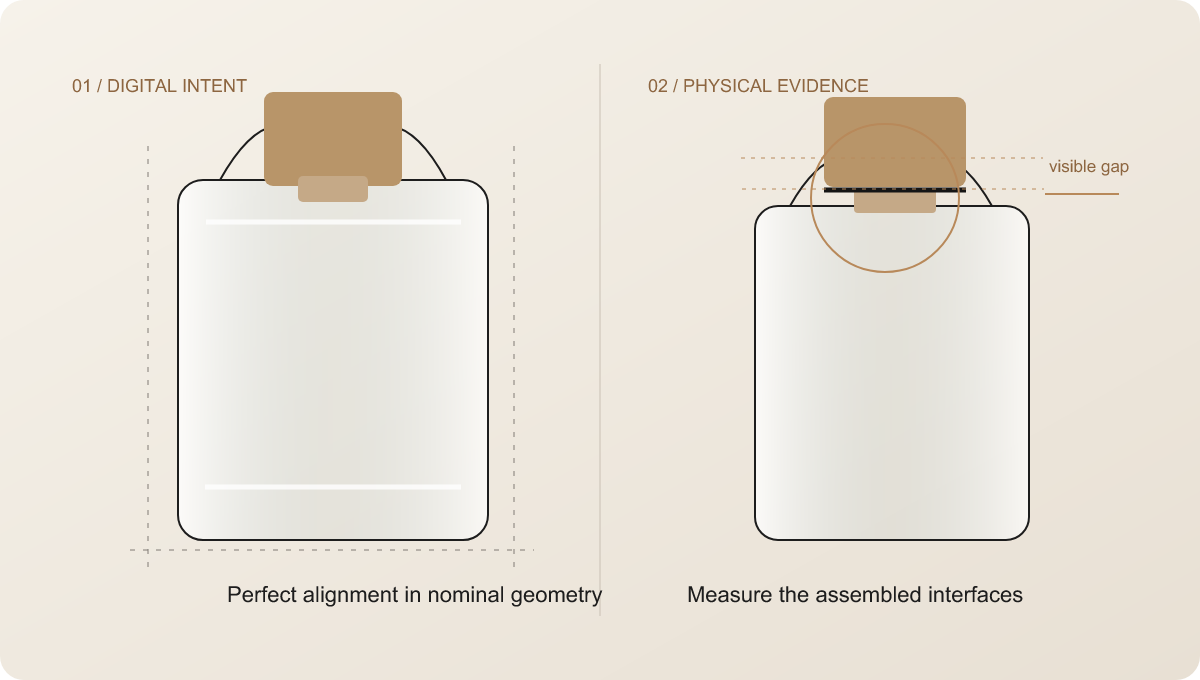
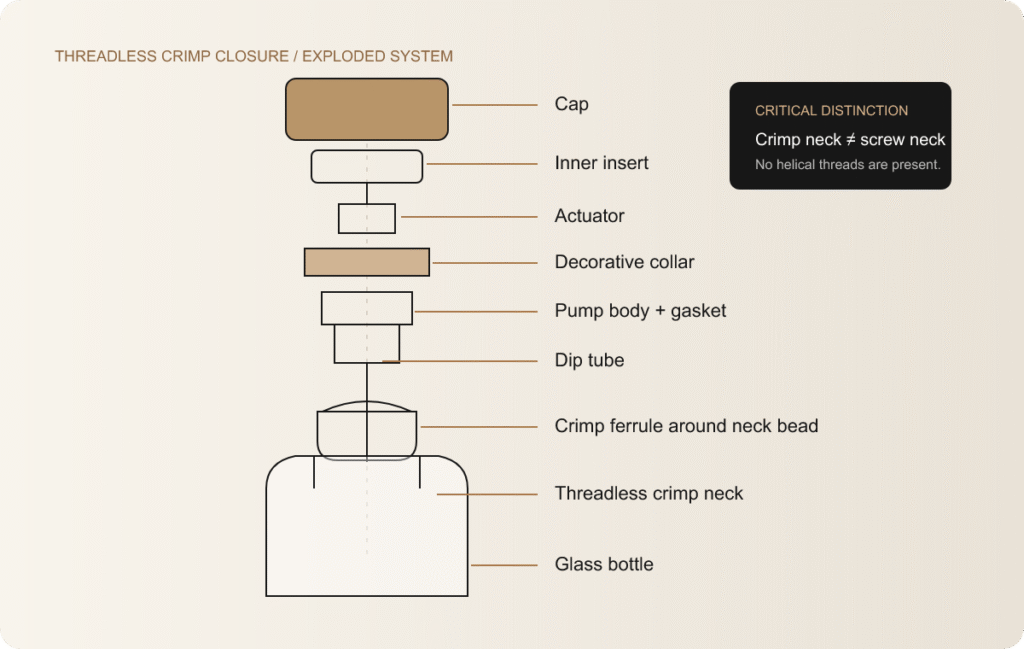
Le système une fois assemblé. Chaque flèche représente une interface ; une illustration correcte d'un col serti comporte une bague et une virole, et non un filetage.
Un emballage de parfum n'est pas un objet unique. Il s'agit d'une succession d'éléments liés entre eux : flacon en verre, embout, joint et bague de la pompe, actionneur, collier, bouchon ou insert de bouchon, décoration et emballage d'expédition. Chaque élément peut être conçu par une équipe différente, fabriqué à partir d'un matériau différent et produit selon un procédé différent. La CAO représente souvent chaque interface à une valeur nominale précise. La fabrication génère une dispersion autour de cette valeur.
Le verre ajoute une complexité particulière. Il est moulé à partir d’un matériau chaud et en mouvement, et n’est pas usiné à partir d’un bloc fini. La géométrie du col, la transition au niveau de l’épaulement, la répartition de l’épaisseur des parois, la masse de la base et les conditions de refroidissement sont toutes liées. Une virole de pompe se forme ensuite autour de l’extrémité serti sans filetage de la bouteille lors de l’installation. Une collerette sert de repère pour la pompe ou la bouteille installée. Un insert de bouchon peut servir de repère pour la collerette, l’actionneur ou un autre élément de retenue. Enfin, un opérateur ou une machine d’assemblage assemble la pile selon ses propres conditions de positionnement et en appliquant sa propre force.
Des problèmes apparaissent également à un stade tardif lorsque les composants sont validés séparément. Un fournisseur de flacons vérifie le col par rapport à son plan. Un fournisseur de pompes vérifie sa virole. Un fournisseur de bouchons vérifie le diamètre extérieur et la profondeur d’insertion. Chaque rapport peut être correct. Pourtant, aucun rapport ne répond à la question décisive du client : l’ensemble du système d’emballage du parfum reste-t-il acceptable sur le plan visuel et mécanique malgré des variations réalistes ? Un emballage doit être inspecté verticalement, à travers chaque composant, et horizontalement, sur plusieurs assemblages répétés.
Lorsqu’un flacon de parfum assemblé ne semble pas au point, la solution la plus évidente consiste souvent à modifier la partie la plus visible. Ce n’est pas nécessairement le moyen le plus rapide d’obtenir un résultat stable. Un bouchon qui dépasse trop peut être lié au goulot du flacon, à la pompe installée, au collet, à l’insert interne du bouchon ou à la séquence d’assemblage. Modifier le moule externe du bouchon avant d’isoler ces variables peut persister le problème, alourdir le travail d’outillage et rendre l’interprétation de l’échantillon suivant plus difficile.
La méthode de diagnostic commence par décrire le symptôme sans désigner de coupable. “ Le fournisseur de bouchons a failli à ses obligations ” est une conclusion. “ L'écart circonférentiel visible est plus important d'un côté et varie d'un assemblage à l'autre ” est un indice. Cette deuxième affirmation peut être mesurée, photographiée sous un éclairage constant et comparée aux dimensions de l'interface. Elle ouvre la voie à plusieurs hypothèses vérifiables au lieu de clore l'enquête prématurément.
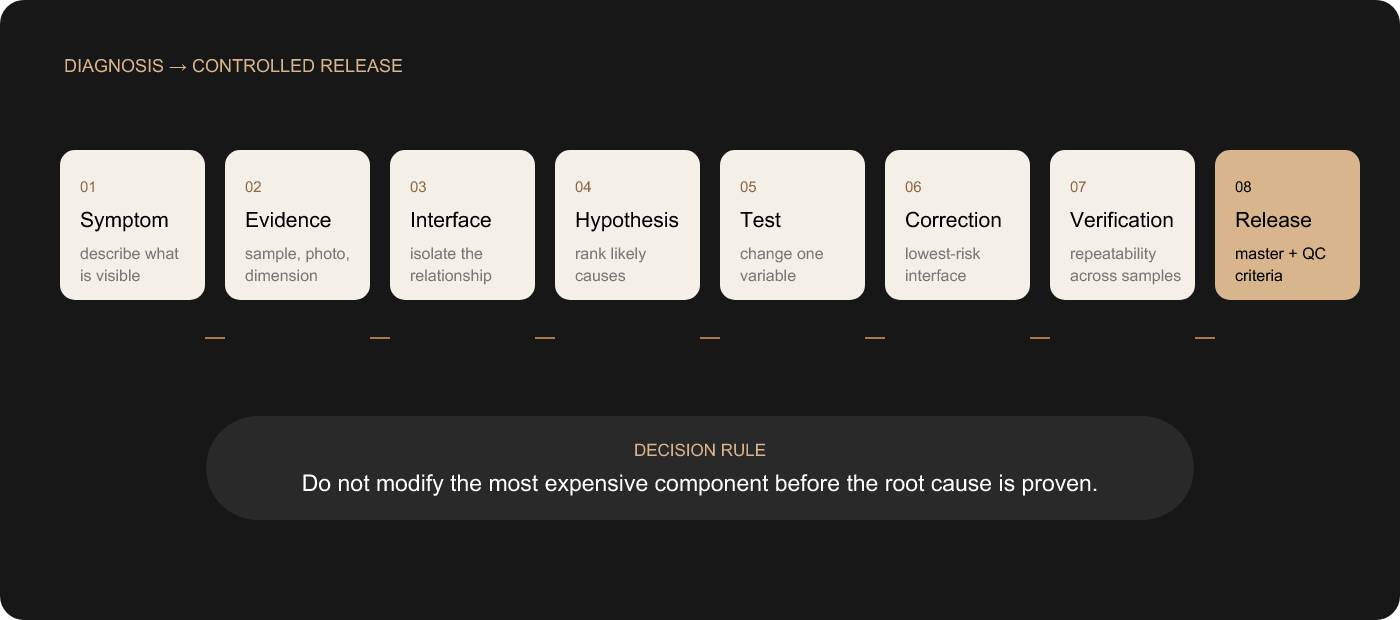
Diagnostic contrôlé. Une mesure corrective est justifiée par des preuves et n'est mise en œuvre qu'une fois sa reproductibilité démontrée.
Problème visible | Causes possibles | Que faut-il vérifier en premier lieu ? |
La casquette est trop haute | Hauteur du col, hauteur de la pompe installée, contact du collier, insert peu profond, position d'arrêt interne | Chaîne de dimensions verticales assemblée et variation d'un échantillon à l'autre |
L'écart est irrégulier | Insert décentré, pompe inclinée, planéité du col, maintien du bouchon, variation du plan supérieur de la bouteille | Motif de rotation, perpendicularité et préservation de l'écart lors du permutation d'un composant |
La pompe semble lâche | Incompatibilité entre le col et la virole, réglage du sertissage, joint d'étanchéité ou conditions d'installation | Profil exact du col, caractéristiques de la virole et échantillon monté — et pas seulement le diamètre nominal |
Les pièces en or ne concordent pas | Substrat, procédé de placage, anodisation, métallisation, peinture, brillance ou divergence de référence | Pièces observées ensemble par rapport à un modèle physique de référence, sous un éclairage constant |
Le logo semble déformé | Surface courbe, échelle de l'illustration, épaisseur du trait, fixation, revêtement ou proximité des bords | Le motif de décoration réel et l'échantillon physique validé, et pas seulement le fichier vectoriel |
La bouteille est en verre ou semble asymétrique | Géométrie du fond, répartition du verre, état du moule, refroidissement ou repère d'inspection | Contact avec la base, verticalité et géométrie pertinente sur plusieurs échantillons non décorés |
Distinguer les risques fonctionnels — rétention, étanchéité, actionnement, stabilité structurelle — des risques esthétiques tels que l'écart, le centrage, la couleur et le positionnement des motifs décoratifs.
Précisez les échantillons exacts, les conditions de montage, l'orientation et l'éclairage. Évitez de mélanger des échantillons issus de révisions différentes.
Comparez les positions réelles du col, de la pompe installée, du collier et de l'insert avec les plans nominaux et le repère de référence de l'assemblage final.
Déterminez quelles variations peuvent s'additionner dans le même sens et quels jeux ou contraintes les absorbent.
Passez en revue le sertissage, le positionnement du collet, l'insertion du capuchon, la décoration et la manipulation, plutôt que de considérer l'assemblage comme une étape invisible.
Utilisez des remplacements contrôlés, des insertions temporaires, des dispositifs de fixation ou des échantillons de référence pour modifier une seule variable significative à la fois.
Optez pour la correction la moins risquée qui préserve l'aspect esthétique, puis vérifiez la reproductibilité plutôt que de vous réjouir d'un seul exemplaire réussi.
Les emballages de parfums de luxe sont particulièrement sensibles aux variations. L’œil ne perçoit pas le bouchon, le col et l’épaule comme des éléments distincts. Il en perçoit une silhouette d’ensemble. Un léger changement de position verticale peut faire ressortir davantage le col, affaiblir la liaison entre le bouchon et le flacon ou donner l’impression que le bouchon est trop petit. Un espace peut être régulier tout en étant trop visible. Il peut également être théoriquement étroit mais peu esthétique, car un côté se referme tandis que l’autre s’ouvre.
C'est là que la tolérance technique et la tolérance visuelle divergent. La tolérance technique consiste à vérifier si un composant se situe dans une plage dimensionnelle convenue et s'il continue à remplir la fonction pour laquelle il a été conçu. La tolérance visuelle consiste à vérifier si le résultat de l'assemblage reste conforme à un langage de conception haut de gamme. Une dimension peut satisfaire au premier critère et échouer au second. À l'inverse, un objectif visuel extrêmement strict, ne laissant aucune marge pour les variations réelles de fabrication, peut aboutir à une spécification impossible à mettre en œuvre.
La solution ne consiste pas à exiger une “ tolérance zéro ”. Elle consiste à définir la relation avec le consommateur, à identifier les repères qui la déterminent et à mettre en place des contrôles réalistes tout au long de la chaîne de production. L’objectif peut être une ligne d’ombre fine et uniforme, délibérément recherchée, plutôt qu’une absence totale d’espace. Le col peut être conçu comme un élément visible intentionnel plutôt que comme une fine fente accidentelle. L’insert du bouchon peut absorber les variations tandis que le bouchon extérieur préserve la silhouette essentielle. Il s’agit là de choix architecturaux, et non d’une inspection esthétique de dernière minute.
Dans le cadre de ce projet, la position du capuchon a été considérée comme une sortie du système. Le symptôme précis de jeu, la conception du capuchon et la correction choisie restent [VÉRIFICATION DES FAITS / À CONFIRMER PAR DAXIN]. La leçon à publier est indépendante de ces éléments : ne modifiez ni le verre ni le capuchon externe tant que l'équipe n'a pas déterminé quelle référence détermine la transition finale visible.
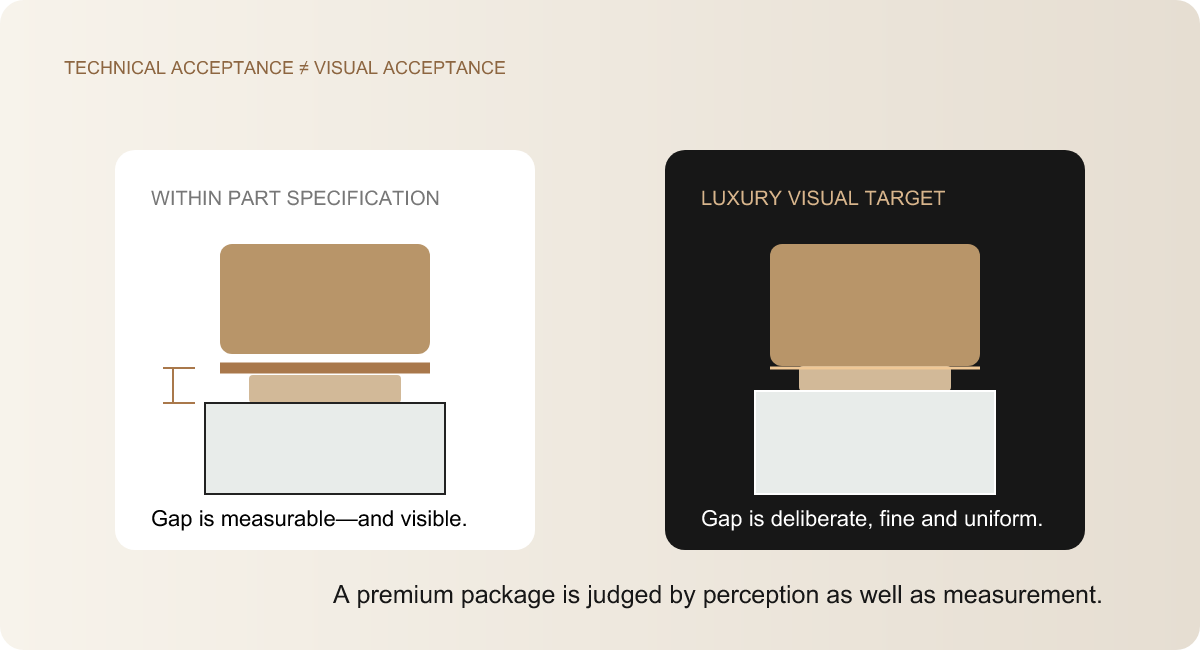
Deux systèmes d'acceptation. La cible idéale permet de trouver le juste équilibre entre une ligne d'ombre de haute qualité et la variation que peut supporter un assemblage reproductible.
Le cumul des tolérances désigne l'effet combiné des variations admissibles de plusieurs cotes sur une relation finale. Dans le cas d'un bouchon de parfum, la hauteur du goulot du flacon peut varier par rapport à sa valeur nominale. La position de la pompe une fois installée peut varier, car la virole s'adapte au goulot. Un collier possède sa propre profondeur et ses propres surfaces de contact. L'insert du bouchon a une position de retenue. L'assemblage entraîne des variations d'alignement et d'ajustement. L'écart final au niveau du bouchon reflète l'ensemble de ces variations.
Imaginons — non pas en tant que données de projet, mais en termes de logique — que le col se situe dans la partie haute de sa plage, que la pompe installée soit également en position haute et que l’insert du bouchon s’emboîte légèrement moins profondément dans le bouchon extérieur. Aucune pièce ne doit être défectueuse. Leurs orientations s’additionnent simplement. Un deuxième ensemble peut combiner un col bas, une position de pompe plus basse et un insert plus profond, produisant un jeu visiblement différent de celui obtenu avec des composants tout aussi conformes. Les certificats d’inspection des pièces individuelles ne révéleront pas ce comportement du système, à moins que la chaîne assemblée ne fasse partie du cahier des charges.
L’objectif technique évolue donc. La question “ Les pièces sont-elles conformes aux spécifications ? ” reste nécessaire, mais elle est insuffisante. La question la plus pertinente est : “ L’ensemble assemblé reste-t-il fonctionnel et visuellement acceptable dans toutes les combinaisons plausibles de variations des composants et des processus ? ” Y répondre peut nécessiter une analyse par couches, des échantillons mesurés, des remplacements contrôlés de composants et un assemblage pilote. Cela nécessite également une définition claire des paramètres de sortie qui importent : écart entre les électrodes, hauteur totale, visibilité du collier, jeu de l’actionneur, rétention ou une combinaison de ces éléments.
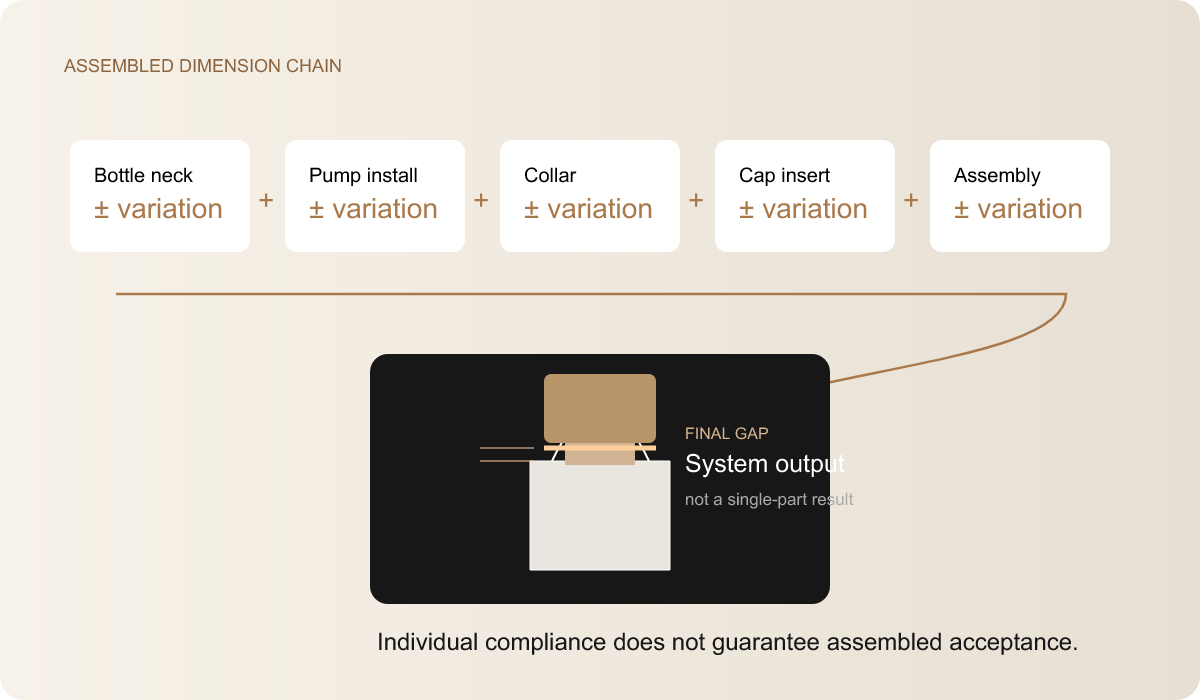
Le risque lié à la signature. Des variations acceptables prises individuellement peuvent, cumulées, entraîner une défaillance visible du système.
Interface | Relation cruciale | Risque typique | Vérification |
Flacon ↔ pompe | Profil du col, contact du joint, formage de la virole, hauteur de montage | Mauvais ajustement, position de montage variable ou problème d'étanchéité | Examen des plans et échantillons installés dans des conditions de montage définies |
Pompe ↔ collier | Jeu de l'actionneur, alésage du collier, hauteur et surface de contact | Fixation, virole apparente ou position du collier incorrecte | Contrôle dimensionnel et essais de fonctionnement répétés après le montage |
Cou ↔ tête | Dégagement, centrage, ligne d'ombre visuelle et trajectoire de retenue | Frottement, écart important, aspect décentré | Analyse des écarts de rotation sur plusieurs assemblages |
Bouteille ↔ bouchon | Silhouette générale, transition de largeur, position verticale | Proportion de déconnexions malgré la conformité des composants | Assemblage final et validation visuelle côte à côte |
Bouteille ↔ décoration | Zone de l'œuvre, courbure de la surface, revêtement et point de référence du dispositif de fixation | Distorsion, décalage ou contrôle insuffisant des contours | Échantillons physiques décorés et zones d'observation convenues |
Bouteille ↔ carton | Points de contact, jeu, déplacement, trajectoire d'abrasion et de compression | Éraflures, surcharge du capuchon ou déplacement pendant le transport | Vérification de l'emballage à l'aide des composants décorés définitifs |
Un flacon de parfum standard à col serti ne comporte pas de filetage. Le col du flacon présente un bourrelet non fileté et une géométrie spécifique. Lors de l’installation de la pompe, la virole métallique est formée autour du col tandis qu’un joint d’étanchéité assure l’étanchéité. Au-dessus de cette interface se trouvent le corps de la pompe, l'actionneur et la collerette décorative. Le bouchon peut être maintenu sur un insert, une partie de la collerette ou une autre surface prévue à cet effet. Confondre les architectures à col serti et à vis n'est pas une simple erreur de dessin ; cela modifie la manière dont l'emballage est assemblé et contrôlé.
Une désignation nominale telle que “ sertissage de 15 mm ” est utile, mais elle ne doit pas être considérée comme une garantie absolue qu’une pompe s’adaptera à n’importe quelle bouteille portant la même indication de taille. Le profil exact du goulot, la virole, le joint d’étanchéité, la coupelle de la pompe, l’outillage d’installation et la hauteur d’assemblage prévue sont tous des éléments importants. Le dosage et la qualité de la pulvérisation de la pompe ont une incidence sur la distribution du produit. La longueur et la coupe du tube plongeur dépendent de la capacité. La formule du parfum et la compatibilité du joint d’étanchéité peuvent avoir une incidence sur l’étanchéité et les performances du matériau. La ligne de remplissage doit être capable de manipuler et de sertir l’ensemble sélectionné de manière homogène.
Un mauvais ajustement peut se manifester de manière indirecte. Une pompe installée à une hauteur incorrecte peut pousser le collier et le bouchon vers le haut. Une virole qui ne se forme pas de manière homogène peut entraîner une position variable du bouchon, même si celui-ci ne touche jamais directement le goulot de la bouteille. L'alésage d'un collier peut se coincer contre un élément de la pompe. Un actionneur peut perdre de son jeu sous un bouchon. Le symptôme visible peut donc être un “ mauvais ajustement du bouchon ”, alors que la cause profonde se situe plus bas dans l'ensemble de fermeture.
Le public de DAXIN Options de vaporisateurs de parfum et Approvisionnement en bouchons et pompes sur mesure fournir le contexte du composant. Dans le cadre d’un projet de sauvetage, la disponibilité n’est qu’un premier pas. La pompe concernée doit être validée par rapport au flacon, au processus d’assemblage, au collier et au bouchon réels. Toute désignation de pompe, tout joint, tout dosage, tout réglage de sertissage ou tout résultat de compatibilité spécifique au projet doit être pris en compte dans le cas final.
Vérifiez que le profil est complet et que les données pertinentes sont bien présentes.
Effectuer l'évaluation après le formage effectif de la virole et la compression du joint.
Évaluez la position du col et de la casquette à partir de la pile assemblée.
La conception de parfums haut de gamme exige souvent que le verre exprime à la fois la masse et la précision : une base visuellement imposante, de larges faces planes, des angles nets, des épaulements bien définis et une cavité interne apparemment centrée. Ces caractéristiques sont séduisantes car elles créent une impression de poids, de profondeur optique et de lumière architecturale. Elles peuvent également rendre la répartition du verre plus exigeante.
Le verre en fusion doit pénétrer dans le moule et se mouler contre celui-ci tout en conservant une température de travail suffisante pour se répartir uniformément dans le corps de l'objet. Les transitions brusques, les angles serrés et les écarts importants entre les zones épaisses et fines influencent ce mouvement. Une base d'aspect très massif n'est pas simplement un bloc externe ajouté en CAO ; elle est liée à la géométrie interne du fond, au poids du verre, au moulage, au refroidissement et au résultat optique. Les grandes parois planes peuvent révéler plus facilement des ondulations ou des asymétries que les surfaces texturées. Les épaulements marqués peuvent concentrer la sensibilité visuelle et le risque de déformation au niveau de la transition vers le col.
Pour un acheteur B2B, l’important n’est pas de devenir un spécialiste du formage du verre, mais d’identifier très tôt les compromis à faire. Un rendu photoréaliste peut donner l’impression que chaque mur est parfaitement plat et que chaque angle est maîtrisé à l’infini. L’ingénierie de production doit déterminer quels rayons, transitions, contours internes et répartition des masses permettent d’obtenir un résultat physique reproductible tout en conservant un langage stylistique reconnaissable.
Lors d'un contrôle de production, plusieurs symptômes peuvent justifier une analyse du verre : un balancement sur une surface de référence, une hauteur totale variable, un aspect irrégulier des épaules, un aspect instable des parois, des difficultés de repérage des motifs décoratifs ou une fermeture assemblée qui varie en fonction des variations du col. Aucun de ces éléments ne prouve à lui seul que le verre est en cause. Des échantillons non décorés, des données dimensionnelles, l'analyse des sections et le comportement des autres composants permettent de déterminer si des modifications du moule ou du processus de formage sont justifiées.
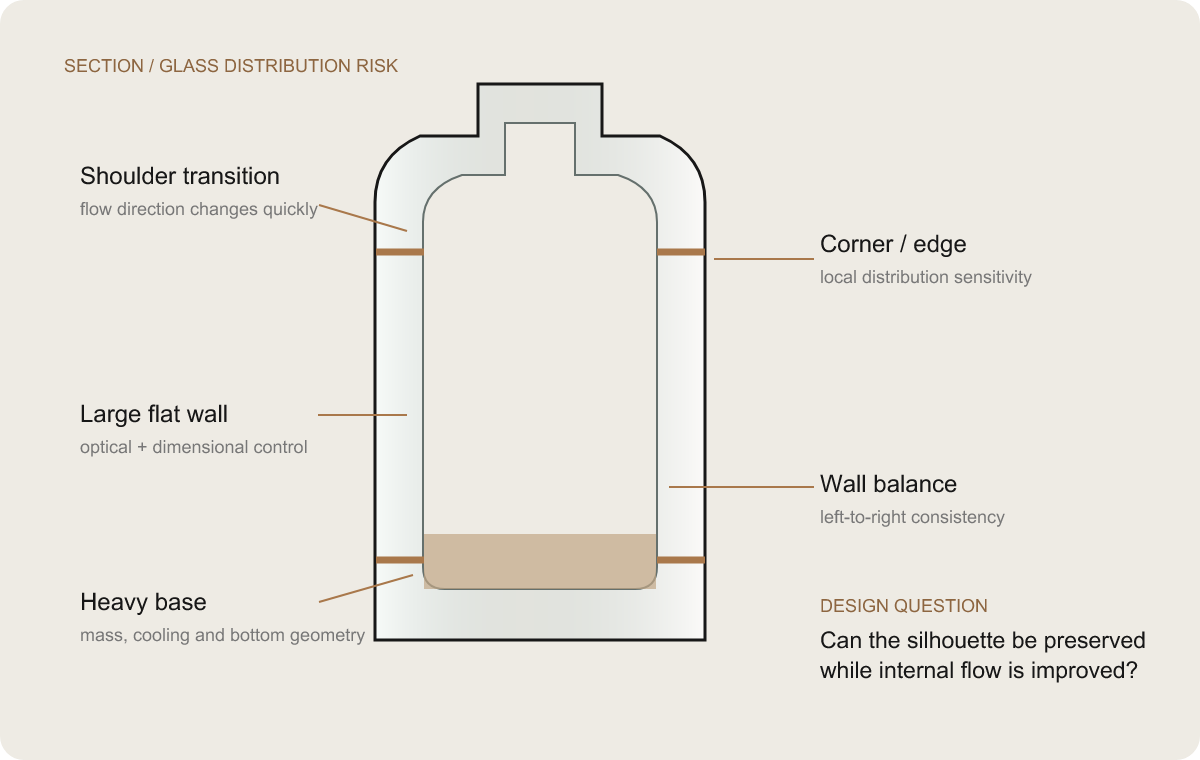
La géométrie du luxe rencontre la réalité du formage. La base massive, les parois larges, les transitions au niveau des épaulements et les angles s'influencent mutuellement.
Une conception technique médiocre simplifie un projet complexe jusqu’à ce que l’idée distinctive disparaisse. Une conception technique rigoureuse identifie les signaux visuels et tactiles qui confèrent de la valeur à l’objet, puis recherche des modifications moins visibles qui améliorent la fiabilité de la production. Le consommateur peut accorder de l’importance à la forme rectangulaire, à la large face avant, à la base optique massive, au rythme des épaulements et à l’alignement du capuchon. Il est en revanche moins susceptible de percevoir un rayon interne subtil, un contour inférieur raffiné ou une transition redistribuée qui préserve ces signaux.
La hiérarchie décisionnelle doit partir de l’intention de conception. Qu’est-ce qui doit rester reconnaissable ? Quelle vue véhicule l’image de marque ? Quelle surface doit accueillir la décoration ? Quel bord met en valeur le caractère haut de gamme du produit ? Une fois ces constantes clairement définies, l’équipe peut envisager d’affiner les rayons, la transition des épaulements, la répartition interne du verre, la structure de la base, l’équilibre des parois ou la transition du col. Toute modification géométrique précise apportée au projet réel est indiquée ; ce schéma explique le principe plutôt que de prétendre refléter une modification enregistrée.
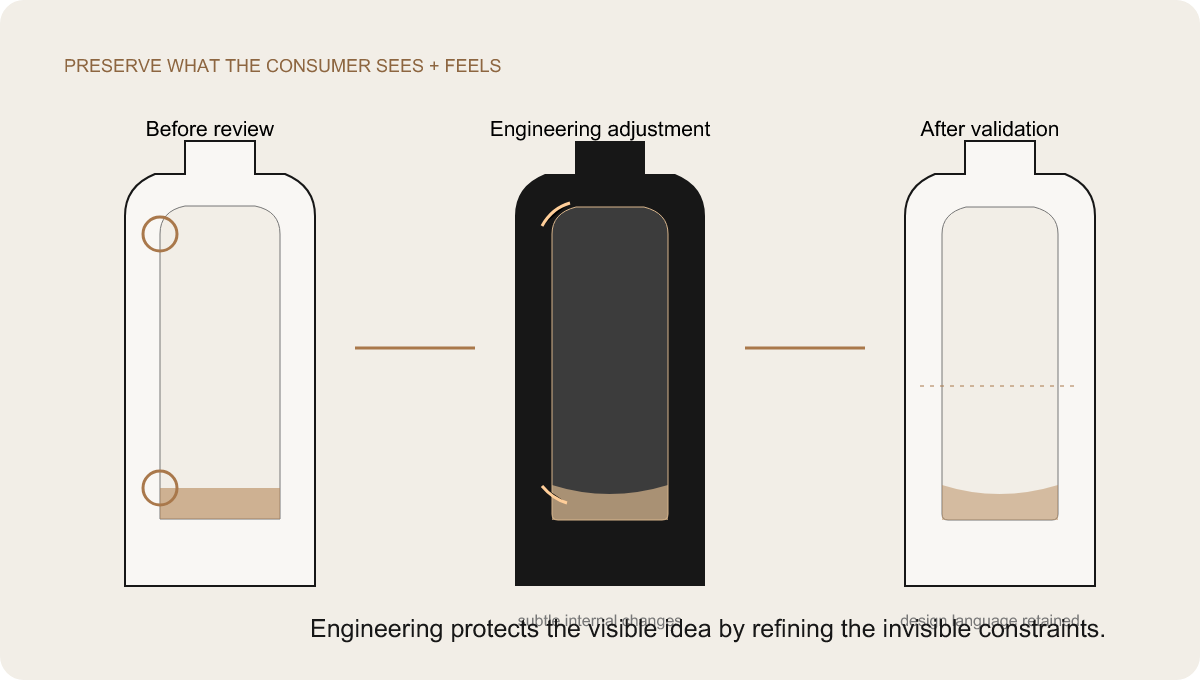
Une intervention discrète. Conserver la vision globale ; affiner les conditions internes qui favorisent la reproductibilité.
Une référence Pantone, un échantillon numérique ou un rendu validé constituent des éléments de communication essentiels, mais ils ne reflètent pas l'aspect physique final. Un revêtement transparent appliqué par pulvérisation sur du verre transparent est visible à travers les faces avant et arrière, en contre-jour avec le liquide, l'air ou tout autre élément se trouvant derrière la bouteille. Un revêtement opaque confère une couleur différente au corps de la bouteille. Le degré de matité modifie la taille des reflets. La brillance peut accentuer la saturation apparente. L'épaisseur du revêtement, la consistance de la pulvérisation et le durcissement ont une incidence sur l'opacité et l'aspect de la surface.
L'éclairage et la géométrie de visionnage accentuent ces différences. Un rendu de studio aux tons chauds peut faire harmoniser les nuances de champagne et de pierre. Un éclairage froid en magasin peut révéler des différences de nuances. Les particules métalliques tournent et scintillent selon l'angle. Une couleur qui semble équilibrée vue de face peut changer lorsqu'on la regarde de profil. Les photographies introduisent la balance des blancs de l'appareil photo, l'exposition, la compression et l'étalonnage de l'écran. L'envoi d'images prises avec un téléphone entre fournisseurs est utile pour la discussion, mais il s'agit d'un critère de validation insuffisant pour les couleurs haut de gamme subtiles.
La solution concrète consiste à définir à quoi s’applique la référence de couleur et à la valider physiquement. La référence correspond-elle à la bouteille vide enduite, à la bouteille remplie ou à l’emballage dans des conditions d’observation spécifiques ? Le niveau de matité fait-il partie du modèle de référence ? Une plage de tolérance est-elle définie par des échantillons limites ? Quel échantillon servira de référence pour la production et les commandes ultérieures ? Ces questions permettent de transformer la simple exigence “ respecter la référence Pantone ” en un plan de contrôle des couleurs applicable.
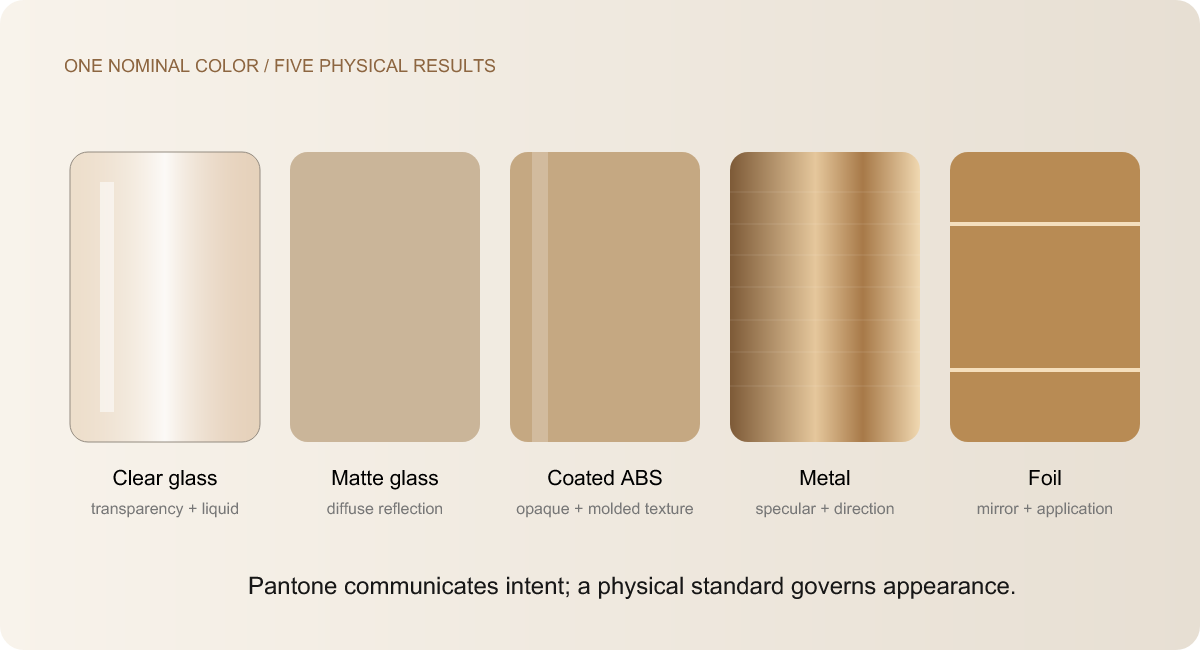
Le support s'exprime. Une même cible nominale produit des résultats optiques différents selon que les matériaux sont transparents, diffusants, opaques ou réfléchissants.
Un emballage de parfum peut utiliser le terme “ or ” pour désigner un bouchon en ABS métallisé, un collier en aluminium, un détail en zamac plaqué, une feuille d’estampage à chaud ou un motif imprimé. Leurs noms de couleur peuvent correspondre, alors que leur aspect ne le fait pas. Chaque support et chaque procédé génère une réflectivité différente. La métallisation consiste à déposer une couche réfléchissante sur du plastique. L’aluminium peut être anodisé, laqué ou brossé mécaniquement. Le zamac peut être plaqué sur une surface préparée. La feuille métallique permet de transférer une fine couche réfléchissante sous l’effet de la chaleur et de la pression. La peinture dépend du pigment, du liant, de l’épaisseur et de la brillance.
Une identité optique parfaite n'est peut-être ni réalisable ni souhaitable. Un collier en aluminium brossé ne reflétera jamais exactement comme une feuille miroir. L'objectif de conception peut plutôt consister à créer une gamme contrôlée : teinte et température cohérentes, avec des différences volontaires en termes de luminosité et de texture. Cette décision doit être prise en tenant compte de l'ensemble des pièces. Valider le bouchon seul sous une lampe et la feuille du carton plus tard à partir d'une photo risque de réserver des surprises lors de l'assemblage final.
Un échantillon de référence physique sert de point d'ancrage à la gamme. L'équipe peut choisir la teinte d'or la plus marquante visuellement — souvent le capuchon ou un autre élément de grande taille — comme référence, puis ajuster les matériaux adjacents en fonction de celle-ci. Les conditions d'observation, les écarts acceptables et la conservation de l'échantillon de référence doivent être consignés. Les valeurs numériques restent utiles pour le transfert de fichiers, mais c'est l'approbation physique des CMF qui fait autorité pour le produit fini.
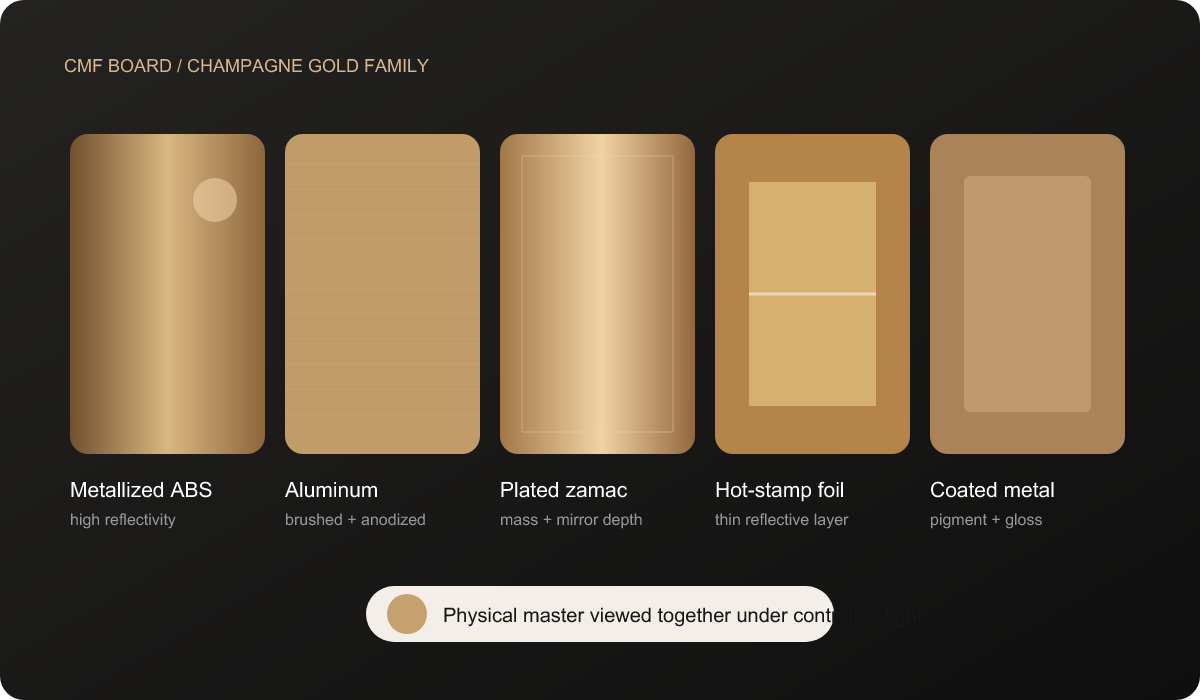
L'or est un système matériel. La teinte, la réflectivité, la texture et le procédé doivent être considérés comme formant une seule et même famille physique.
Adobe Illustrator affiche des vecteurs idéaux sur un plan idéal. Un flacon de parfum présente une surface tridimensionnelle, des variations liées à la fabrication et un procédé de décoration spécifique. La sérigraphie dépose l’encre à travers un tamis et dépend de l’épaisseur des traits, de l’opacité, de la préparation de la surface, du calage et du séchage. L’estampage à chaud transfère une feuille métallique par la chaleur, la pression et le contact. Le revêtement modifie la surface sous-jacente. La courbure modifie la façon dont l’illustration est perçue et dont un outil entre en contact avec la surface.
Les traits fins, qui paraissent élégants à l’écran, peuvent apparaître flous, irréguliers ou disparaître visuellement. Les textes très petits risquent de ne pas rester lisibles. Une grande surface de pelliculage peut mettre davantage en évidence les variations de transfert qu’un motif compact. Les illustrations proches d’un bord disposent d’une marge de repérage réduite. Un logo mathématiquement centré dans le fichier peut sembler décalé vers le bas en raison de l’épaulement, de la base ou de la calotte. L’alignement avant-arrière dépend d’un repère de bouteille et d’un dispositif de fixation fiables.
L’examen du motif décoratif doit donc passer de l’intention artistique à la faisabilité technique. Il convient d’identifier la zone de décoration utilisable, les caractéristiques minimales requises, le centre optique, le repère de repérage et la zone de visualisation. Réalisez un échantillon physique sur la finition de bouteille prévue. Comparez l’échelle, la position, la densité, l’aspect de la feuille métallique et la qualité des bords dans le cadre de l’emballage assemblé — et non sous la forme d’une épreuve de logo isolée. DAXIN’s décoration et finitions Cette page définit le contexte du processus disponible ; le parcours exact de la décoration, la modification du visuel et le résultat de la validation pour ce cas sont les suivants.
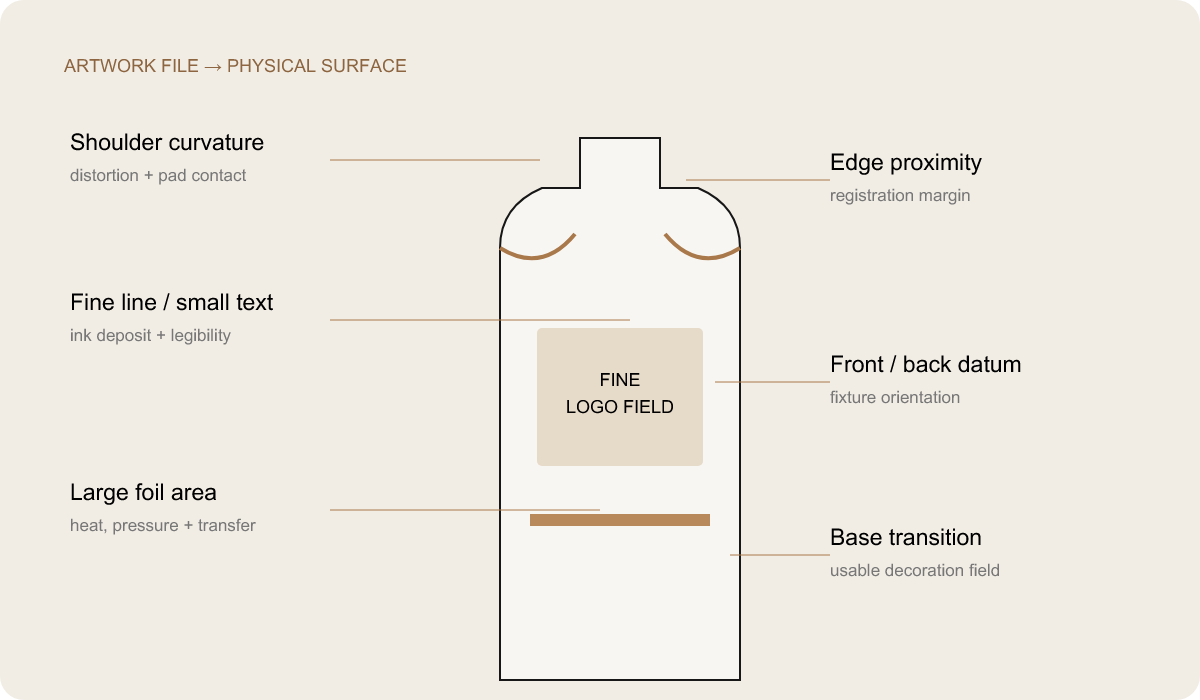
Traduction d'une œuvre d'art. Le fichier vectoriel définit l'intention ; la géométrie de la bouteille, le revêtement et le procédé déterminent le résultat physique.
La qualité fonctionnelle détermine si l'emballage peut être assemblé, actionné, manipulé et protégé comme prévu. La qualité esthétique détermine si l'objet destiné au consommateur présente la couleur, la brillance, la géométrie, l'alignement et la décoration approuvés. Les emballages de parfums de luxe doivent répondre à ces deux critères. Un bouchon esthétique qui gêne l'actionnement est inacceptable ; il en va de même pour un flacon parfaitement fonctionnel dont le bouchon de travers donne une image bon marché à la marque.
Ces catégories se recoupent. Une installation inégale de la pompe peut constituer un risque fonctionnel et être à l'origine d'un défaut esthétique. Un défaut de revêtement peut être visible, mais un revêtement appliqué sur une surface bien ajustée peut également altérer l'assemblage. Une bouteille qui vacille est suffisamment stable sur le plan structurel pour tenir debout, mais son aspect n'est pas satisfaisant. La distinction entre ces catégories aide l'équipe à définir les éléments probants et les responsabilités, tandis que l'évaluation du système final empêche cette distinction de devenir un angle mort.
Zone | Exigence esthétique | Exigence fonctionnelle | Pourquoi ces deux aspects sont importants |
Casquette et col | Transition centrée et régulière, finition validée | Maintien, dégagement et assemblage reproductible | On touche et on voit le bouchon avant d’utiliser le parfum |
Bouteille | Symétrie, qualité optique, stabilité des couleurs et de la surface | Capacité, intégrité structurelle, compatibilité avec le col et base stable | Le verre constitue à la fois la structure principale et l'élément visuel emblématique de la marque. |
Pompe | Alignement de l'actionneur et du collier, uniformité de la finition | Performances en matière de montage, d'actionnement et de distribution du produit | Un problème d'installation non détecté peut modifier la position visible du capuchon |
Décoration | Échelle, position, densité, contour et brillance | Adhérence et aptitude à la manutention et au conditionnement | Une première impression parfaite doit résister à toute la chaîne de distribution |
Kit de transport | Une présentation soignée dès l'arrivée | Contrôle des mouvements, de la compression et des contacts | La garantie protège tous les choix esthétiques déjà payés |
La fabrication d'un emballage de parfum implique généralement plusieurs acteurs : un fabricant de verre, un fournisseur de pompes, un fabricant de bouchons ou d'inserts, un décorateur, un transformateur de métaux, un fournisseur de cartons, un conditionneur et un assembleur. Lorsqu'un problème survient, chaque fournisseur peut démontrer que son composant est conforme à son plan. Cela permet de préserver le bon de commande, mais ne sauve pas le lancement du produit.
L'enquête doit déboucher sur une mesure corrective vérifiable et une condition de vérification, et non sur un compte-rendu de réunion indiquant simplement que “ le fournisseur doit apporter des améliorations ”. Toute amélioration doit avoir un objectif précis : modifier une butée d'insertion, ajuster la hauteur d'une collerette, contrôler l'installation d'une pompe, adapter une zone de décoration, modifier la géométrie du verre ou revoir le contact avec l'emballage. La mesure précise à prendre dépend des éléments probants. DAXIN’s compétences en gestion de projet C'est important car l'acheteur a besoin d'une vue d'ensemble du système assemblé, même lorsque la production fait appel à plusieurs fournisseurs.
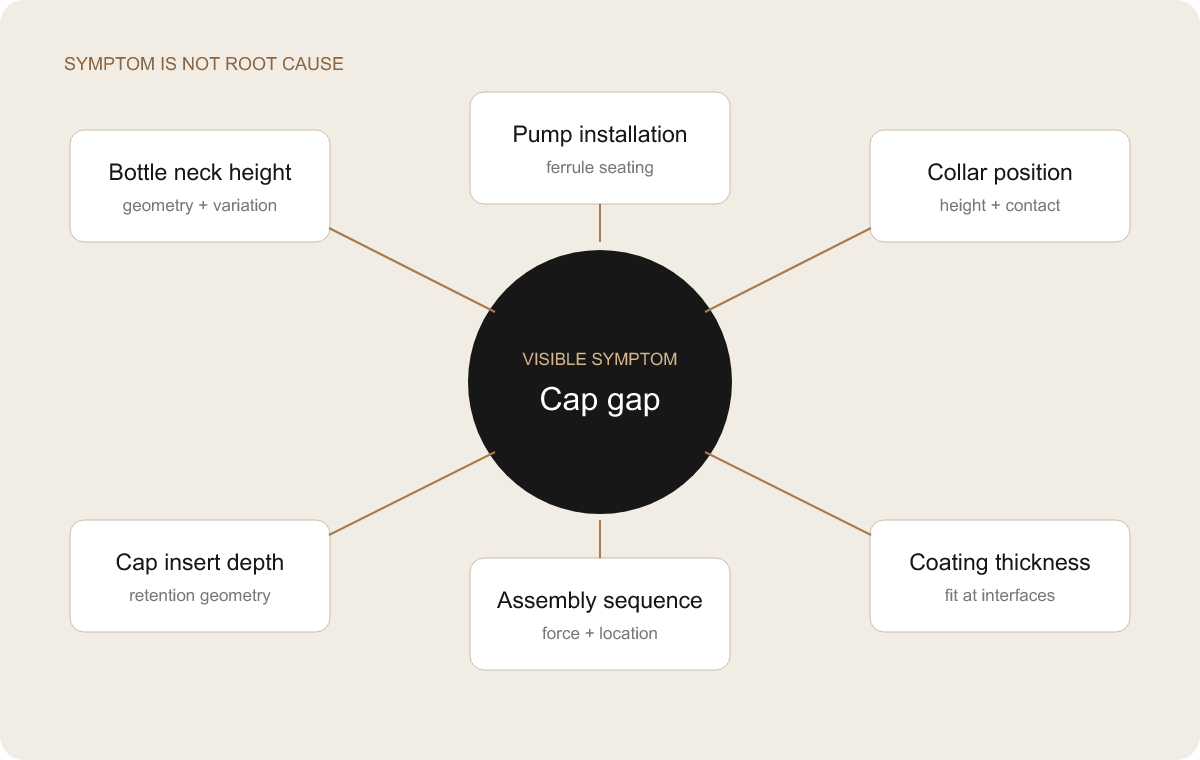
Un symptôme, plusieurs hypothèses. La composante visible n'est pas nécessairement la composante causale.
La meilleure correction n'est pas toujours celle qui se rapproche le plus du symptôme. La décision doit tenir compte de l'impact sur l'outillage, de l'impact sur le calendrier, des risques liés à la production, de l'impact visuel et de la réversibilité. Un insert en plastique peut être plus facile à ajuster qu'un moule en verre déjà fini. Une modification de la hauteur du col peut permettre de conserver la géométrie de la bouteille. Le remplacement d'une pompe peut résoudre un problème de hauteur d'installation, mais entraîner des modifications au niveau du dosage, de la finition ou de la ligne de remplissage. Il s'agit là d'exemples illustrant la logique décisionnelle, et non de règles universelles.
Les modifications apportées au verre doivent faire l'objet d'une prudence particulière, car elles peuvent influencer le formage, la capacité, la décoration et tous les éléments qui caractérisent la bouteille. Cela ne rend pas le moule intouchable ; cela rend simplement les justifications indispensables. Si la géométrie de la bouteille est la cause première et qu'une révision subtile améliore le système, le fait d'éviter cette modification ne fait que reporter le risque en aval. L'objectif n'est pas d'obtenir la pièce isolée la moins chère, mais la correction présentant le risque global le plus faible pour l'emballage.
Problème | Remplacement des vitres | Remplacement de la pompe | Remplacement du bouchon / de l'insert | Changement de décoration | Éléments à prendre en compte dans la prise de décision |
La casquette est portée haute | Uniquement si la géométrie ou la hauteur du cou s'avère être un facteur causal | Vérifiez si la position d'installation détermine l'empilement | Tenez compte de la profondeur de butée, de la retenue ou du jeu interne | Peu susceptible de résoudre des problèmes de géométrie | Commencez par mesurer la longueur totale de la chaîne verticale |
Ligne d'ombre irrégulière | Prendre en compte les indices de perpendicularité entre le plan supérieur et le manche | Vérifiez l'inclinaison après l'installation | Vérifier le centrage de l’insert et la planéité du capuchon | À n'utiliser que si le contraste accentue une ligne techniquement acceptable | Faites pivoter et échangez les composants pour voir quel symptôme apparaît ensuite |
Déformation du logo | À envisager uniquement si la géométrie du champ requis n'est pas adaptée | Sans rapport | Sans rapport | Généralement, premier chemin : échelle, ligne, référence, processus ou terrain | Préserver l'esprit de la marque tout en respectant la surface physique |
Décalage des cours de l'or | Pas géométrique en temps normal | L'itinéraire final est susceptible de changer | La finition, le support ou le fournisseur peuvent changer | Il est possible d'ajuster la feuille ou l'encre | Valider toutes les pièces par rapport à un seul modèle de référence physique |
Éraflure due au transport | La durabilité de la surface peut être réévaluée | Protéger l'actionneur exposé, le cas échéant | La durabilité de la finition et les points de contact ont leur importance | L'emplacement du revêtement et des illustrations a son importance | Commencez par rechercher des traces de contact avec la meute et des indices de déplacement |
Une matrice permet d'éviter que le plan de sauvetage ne se transforme en une succession de demandes d'échantillons sans lien entre elles. Chaque ligne relie un problème identifiable à ses causes possibles, aux risques associés, aux mesures de contrôle à mettre en œuvre et à la vérification. Les exemples ci-dessous sont de nature analytique ; ils ne prétendent pas refléter les résultats de tests spécifiques à un projet.
Problème | Cause possible | Composant concerné | Risque en cas de non-résolution | Mesures correctives envisageables | Méthode de vérification |
| Écart de plafond trop important | Position verticale cumulée | Encolure, pompe, col, empiècement | La silhouette haut de gamme semble décousue | Corrigez la référence validée au niveau de l'interface ayant le moins d'impact | Mesurer et comparer visuellement des échantillons assemblés à plusieurs reprises |
| Écart irrégulier | Inclinaison, planéité ou décentrage de la fixation | Pompe, collier, insert de bouchon, flacon | Aspect irrégulier et risque de frottement | Vérifier la perpendicularité, le centrage ou la surface de contact | Carte des écarts de rotation et étude sur l'inversion des composants |
| Compatibilité de la pompe incertaine | Incompatibilité entre le col, la virole et le joint | Goulot et pompe | Hauteur d'installation et de fermeture variable | Sélectionnez une spécification compatible ou adaptez l'installation homologuée | Échantillons installés et évaluation fonctionnelle correspondante |
| La famille Gold n'est pas d'accord | Différents supports et procédés de finition | Bouchon, col, logo, film d'emballage en carton | Expression fragmentée du CMF | Définir l'ancrage principal ; ajuster la teinte, la brillance et la texture en fonction du support | Visionnage côte à côte sous un éclairage convenu |
| Décoration peu visible ou déformée | Conflit entre l'œuvre d'art, le processus et la surface | Revêtement et décoration des bouteilles | Baisse de la lisibilité ou de la perception de qualité supérieure | Affiner le champ du dessin, l'épaisseur des traits, le procédé ou le point de référence du dispositif de fixation | Échantillons physiques décorés présentant la finition prévue |
| Bouteille instable | Géométrie du fond ou variation de la répartition | Bouteille en verre | Problème lié au balancement, au montage ou à la présentation | Vérifier la cause, puis affiner la géométrie ou le contrôle du formage | Plusieurs échantillons non décorés par rapport à un repère convenu |
| Usure due au transport | Faiblesse au niveau du contact, du mouvement ou de la cloison | Bouteille, bouchon, séparateur et boîte en carton | La valeur ajoutée apportée par la décoration se perd pendant le transport | Isoler les surfaces, contrôler les déplacements et renforcer le soutien | Validation de l'emballage et du transport en fonction de l'itinéraire |
Un échantillon corrigé peut être encourageant tout en restant trompeur. Il peut en effet combiner des pièces exceptionnellement favorables, faire l’objet d’un ajustement manuel supplémentaire ou ne pas respecter la séquence d’assemblage habituelle. La vérification consiste à s’assurer que la correction est valable pour plusieurs échantillons, pour les dimensions pertinentes et dans le cadre de variations réalistes. Le nombre de pièces et les tests précis à effectuer dépendent du niveau de risque ; fixer un nombre universel reviendrait à une fausse précision.
Le plan doit préciser ce qui a changé, ce qui est resté inchangé et ce qui constitue un indicateur de réussite. Pour la correction d'écart au niveau du bouchon, vérifiez plusieurs unités assemblées, l'uniformité de l'écart, la hauteur totale, la rétention, le jeu de l'actionneur et le comportement des échantillons provenant de différentes positions de composants. Pour la couleur, comparez-la au modèle physique de référence et aux repères de limite. Pour la décoration, vérifiez la position, la qualité des lignes et l'adhérence en fonction du procédé. Pour l'emballage, utilisez les surfaces décorées finales et le bouchon réel, et non des substituts non décorés qui masquent l'abrasion.
La vérification permet également d'éviter de déplacer le problème. Un insert plus profond peut réduire l'écart, mais gêner le fonctionnement de l'actionneur. Un capuchon plus serré peut améliorer l'alignement, mais endommager la finition d'une collerette. Une modification de la géométrie peut stabiliser le verre, mais réduire la surface de décoration utilisable. Une action corrective n'est considérée comme achevée que lorsque les exigences associées ont été examinées et que le résultat approuvé a été transposé sous forme de plan, d'échantillon de référence, de critère d'assemblage ou de point de contrôle qualité.
Un prototype répond à la question : “ Peut-on fabriquer cela ? ” Il prouve que le concept est réalisable. Un échantillon prêt pour la production soulève une question plus complexe : “ Les fournisseurs concernés sont-ils capables de fabriquer, de décorer et d’assembler cet emballage de manière répétée, dans une fourchette acceptable convenue ? ” Un produit parfait peut dépendre de composants triés sur le volet, d’ajustements manuels et de conditions idéales. La production entraîne des variations normales, un plus grand nombre d’opérateurs, davantage de moules, plus de lots de matériaux et davantage de manipulations.
Une homologation en vue de la production inclut donc le système de contrôle associé. Les plans identifient les interfaces critiques. Les modèles physiques définissent les caractéristiques que les écrans ne peuvent pas rendre. Les critères d'assemblage expliquent comment les composants s'assemblent. Des échantillons de référence homologués clarifient l'évaluation esthétique lorsque cela s'avère utile. Des contrôles qualité sont effectués avant les étapes à valeur ajoutée, qui rendraient toute correction plus difficile. L'emballage pour l'exportation est basé sur l'emballage décoré réel.
C’est pourquoi la mention “ échantillon validé ” peut constituer une étape ambiguë. L’échantillon a-t-il été validé uniquement au niveau de la silhouette, ou s’agissait-il du verre final ? Comportait-il l’installation prévue de la pompe ? La couleur correspondait-elle à un échantillon de peinture appliqué à la main ? Le bouchon a-t-il été fabriqué à l’aide des outillages de production ? La décoration a-t-elle été réalisée selon le procédé validé ? Une validation rigoureuse précise le statut et les limites des éléments présentés.
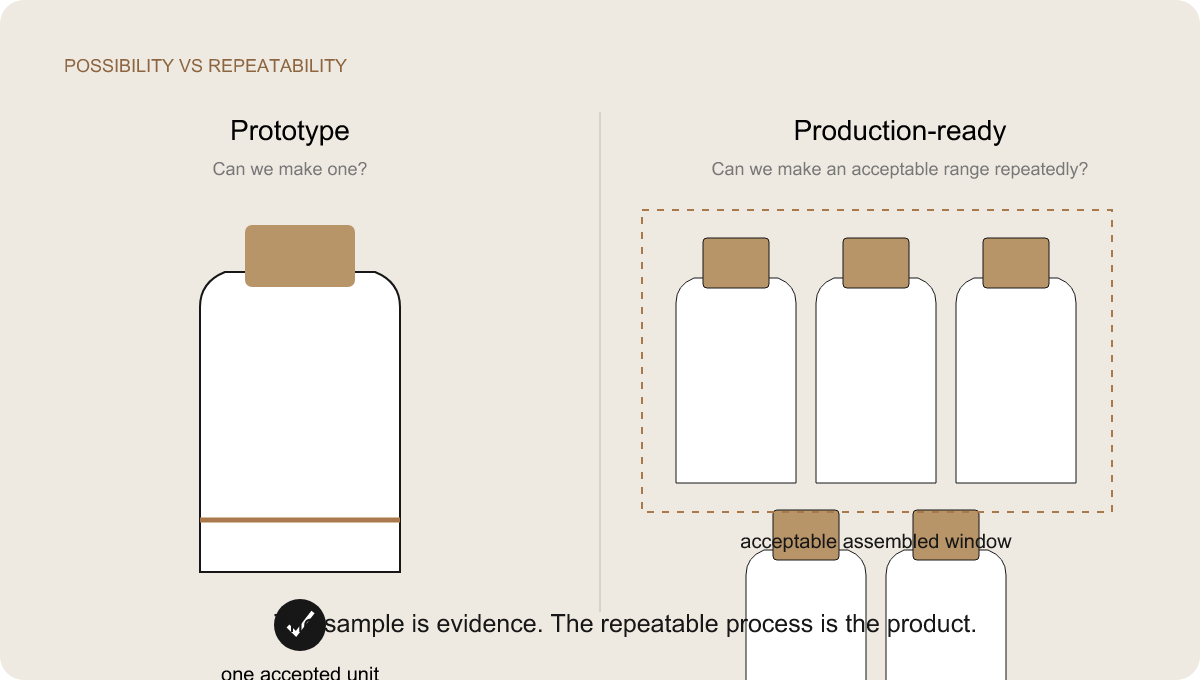
La possibilité n'est pas la reproductibilité. C'est la plage acceptable contrôlée — et non une bouteille choisie au hasard — qui constitue l'objectif de fabrication.
Un carton standard n'est donc pas automatiquement adapté à un flacon de parfum lourd ou très décoré. Un emballage sur mesure tient compte des points d'appui du flacon, des surfaces avec lesquelles il ne doit pas entrer en contact, de la manière dont ses mouvements sont limités, de l'espace libre nécessaire au bouchon en position verticale, du comportement des séparateurs sous compression et de la stabilité de la palette. L'emballage doit également être pratique à assembler de manière reproductible ; un concept de protection élégant que les opérateurs ne peuvent pas reproduire ne constitue pas un moyen de contrôle.
La procédure de validation dépend du produit, de la destination et des exigences convenues ; ce cas ne donne donc pas lieu à des résultats de tests de chute, de vibration ou de compression. DAXIN doit vérifier le carton, les séparateurs, la palette et le procès-verbal de vérification réels avant toute publication. Le principe est clair : l'emballage pour l'exportation fait partie intégrante de l'ingénierie de l'emballage des parfums, et non une étape postérieure à celle-ci. DAXIN’s livraison et entreposage Ce contenu constitue la prochaine ressource pertinente pour les acheteurs qui en sont à cette étape.
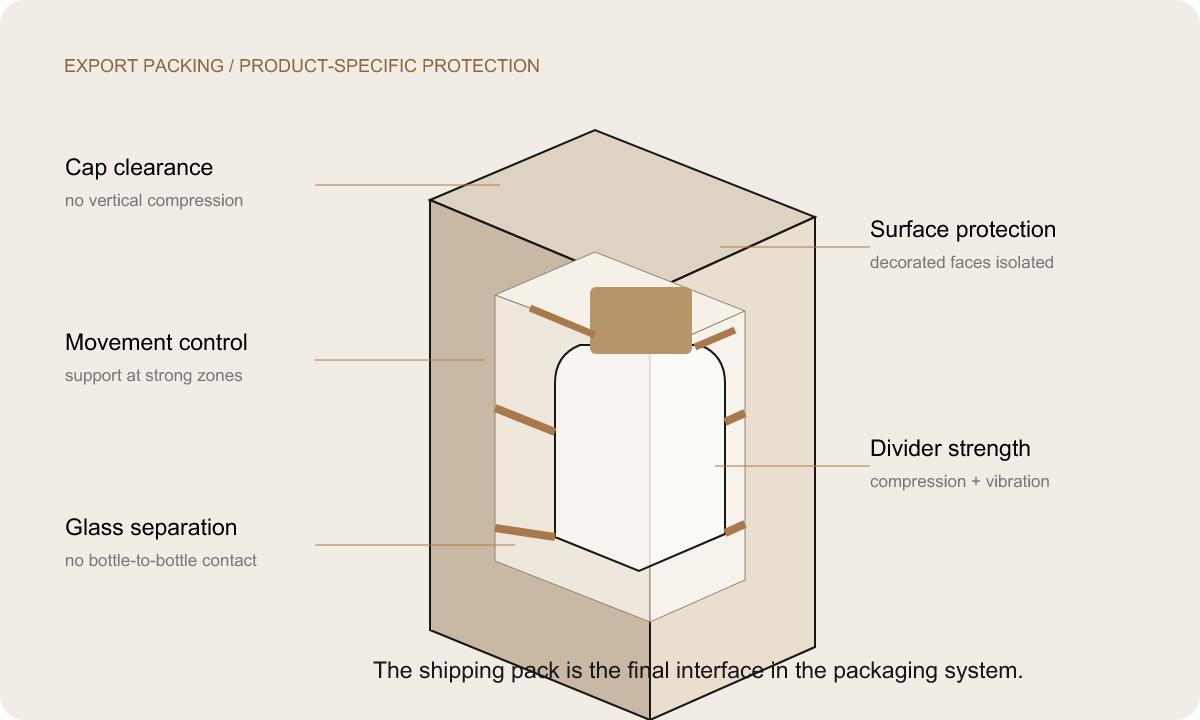
Protection par interface. Séparer le verre, isoler les faces décorées, contrôler les mouvements et éviter que la charge verticale n'agisse sur le capuchon.
Un problème d'interface détecté lors de la révision des plans peut nécessiter une modification des cotes et une nouvelle discussion technique. Le même problème détecté après la fabrication des outils peut nécessiter des retouches sur les outils et la réalisation de nouveaux échantillons. Après la production des composants, cela peut impliquer la gestion des stocks et la coordination avec les fournisseurs. Après la décoration, chaque pièce concernée a acquis une valeur ajoutée supplémentaire. Après le remplissage, le produit parfumé et l'opération de remplissage sont exposés. Après l'expédition internationale, la distance, les retards et le timing du marché entrent en ligne de compte dans la récupération.
Il n'est pas nécessaire d'avancer un chiffre fantaisiste pour comprendre cette courbe. Les corrections deviennent plus complexes à mesure que les engagements s'accumulent et que la réversibilité diminue. C'est pourquoi une analyse technique précoce peut apporter une valeur ajoutée considérable : elle permet de tester les interfaces à haut risque alors que le projet offre encore plusieurs options à faible impact.
Une vérification précoce ne garantit pas qu’aucun problème ne surviendra jamais. Elle permet toutefois de déterminer les points à examiner et le moment où des preuves sont requises. La compatibilité entre le col et la pompe, la position du bouchon une fois assemblé, la géométrie complexe du verre, ainsi que la faisabilité physique de la couleur et de la décoration peuvent être examinées avant que la production en série ne transforme une exigence floue en une réalité concrète de grande envergure.
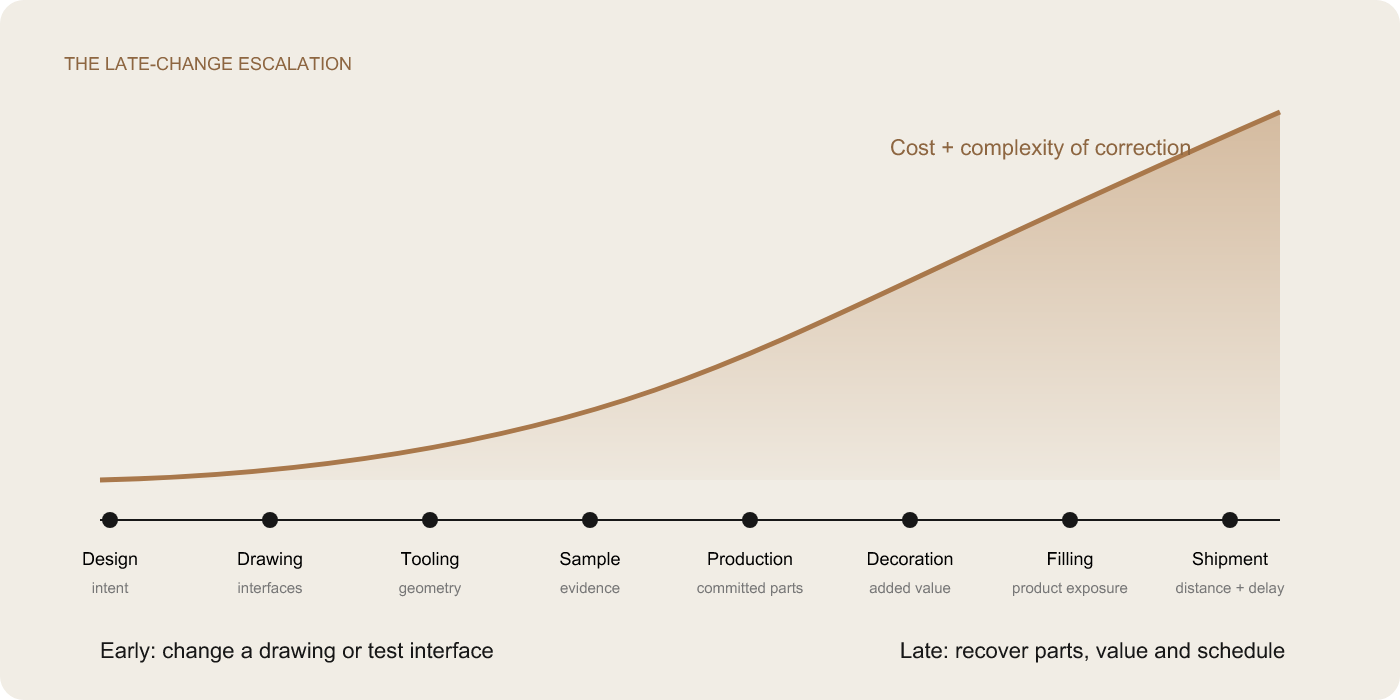
Escalade due à une modification de dernière minute. Cette courbe est conceptuelle et ne comporte délibérément aucune valeur numérique.

L'ingénierie garantit la qualité de la conception. Une image conceptuelle, et non une photographie du projet client en question.
Une intervention de sauvetage prête pour la production ne s'arrête pas à “ nous avons réparé le bouchon ”. Elle aboutit à un système maîtrisé : une géométrie de bouteille validée, un col bien défini et une pompe compatible, une relation bouchon-collier maîtrisée, une décoration approuvée, des échantillons physiques de référence pour la couleur et la finition, une séquence d'assemblage bien comprise, des critères d'inspection et un cahier des charges d'emballage pour l'exportation élaboré autour du produit décoré réel.
Ces contrôles ne prétendent pas que chaque unité future sera métaphysiquement parfaite. Ils définissent la fourchette acceptable, les éléments probants utilisés pour l’approbation et les points où le risque est détecté avant que la valeur ajoutée ne soit accrue. Les composants corrigés avec précision et le résultat du projet restent inchangés. L’affirmation responsable porte sur la réduction des risques grâce à un diagnostic, une correction et une vérification structurés — et non sur une promesse sans fondement selon laquelle l’échec serait devenu impossible.
Utilisez-le pour harmoniser la silhouette, l'esprit du produit et l'identité de la marque. Demandez des échantillons physiques pour vérifier la géométrie, l'assemblage, le comportement optique et la faisabilité technique.
Une bouteille, une pompe et un bouchon ne constituent pas un ensemble fonctionnel, car chacun de ces éléments passe séparément. C'est leur parcours de contact et le résultat final de leur assemblage qui déterminent le bon fonctionnement de l'ensemble.
Définissez la ligne d'ombre visible par le consommateur, le centrage et les proportions, au lieu de partir du principe que le dessin d'un composant les garantit automatiquement.
Commencez par mesurer le col, la pompe installée, le collier et l'insert du bouchon. Si le verre est en cause, remplacez-le de manière ciblée, et non par mesure de précaution.
Le verre transparent, la peinture, le plastique, le métal et le papier d'aluminium réfléchissent la lumière différemment. Les écrans communiquent ; des normes physiques bien établies s'imposent.
L'homologation doit couvrir une plage reproductible et préciser les conditions relatives à l'outillage, aux matériaux, aux procédés et à l'assemblage sur lesquelles reposent les données justificatives.
Les séparateurs, les jeux et les zones de contact permettent de préserver l'alignement du verre, de la finition et du bouchon obtenu lors du processus de fabrication.
Comparez la coordination, les interfaces, les échantillons, les implications en matière d'outillage, la décoration et l'emballage — et pas seulement le prix unitaire pris isolément.
Le remplacement d'un insert réversible ou d'un col peut parfois s'avérer plus efficace qu'un changement de moule ; dans d'autres cas, c'est la bouteille qui doit être corrigée. Ce sont les faits qui tranchent.
Chaque interface non résolue devient plus coûteuse à revoir une fois que l'outillage, la décoration, le remplissage et l'expédition ont entraîné des engagements supplémentaires.
Demandez une validation avant la fabrication des outils lorsque le flacon est très personnalisé, que le verre est exceptionnellement lourd, que les épaules ou les angles sont marqués, ou que le bouchon et le flacon doivent s'aligner avec une marge visuelle très réduite. Faites intervenir l'ingénierie dans la réflexion lorsqu'un bouchon magnétique ou un insert complexe crée des interfaces cachées ; lorsque la pompe, le flacon et le bouchon proviennent de fournisseurs différents ; lorsque la couleur métallique doit être homogène sur le plastique, l'aluminium, le zamac et la feuille métallique ; ou lorsqu'une grande surface de décoration traverse une surface courbe.
Cette vérification s'avère tout aussi utile lorsque le calendrier de lancement est serré ou que le lieu de livraison est éloigné du site de production. Ces conditions réduisent en effet la marge de manœuvre pour apporter des corrections de dernière minute. Si des échantillons existent déjà, n'envoyez pas uniquement le composant qui semble défectueux. Envoyez l'ensemble assemblé, les plans du composant, le numéro de révision ainsi que des photos montrant l'évolution du problème. Pour mener une enquête efficace, il est indispensable de disposer du contexte.
DAXIN peut partir d’un rendu, d’un dessin technique, d’une bouteille de référence ou d’un échantillon physique. L’objectif n’est pas d’imposer la création d’un nouveau moule sur mesure pour chaque projet, mais d’identifier les interfaces présentant le plus de risques, de déterminer les éléments manquants et de décider par où commencer l’analyse. Les acheteurs qui comparent un gamme de flacons de parfum, un paquet existant et un paquet entièrement Processus de fabrication d'emballages personnalisés pour parfums peuvent utiliser la même logique de validation.
Que vous ayez besoin d'une bouteille existante ou d'une solution d'emballage entièrement personnalisée, notre équipe expérimentée est prête à vous accompagner dans votre projet, de la conception et la décoration de la bouteille aux bouchons, en passant par l'emballage et la livraison.
 English
  Spanish
  French
  German
  Arabic
  Italian
  Dutch
Dutch  Portuguese
  Russian
  Korean
  Japanese