
What Engraving on a Perfume Bottle Actually Means
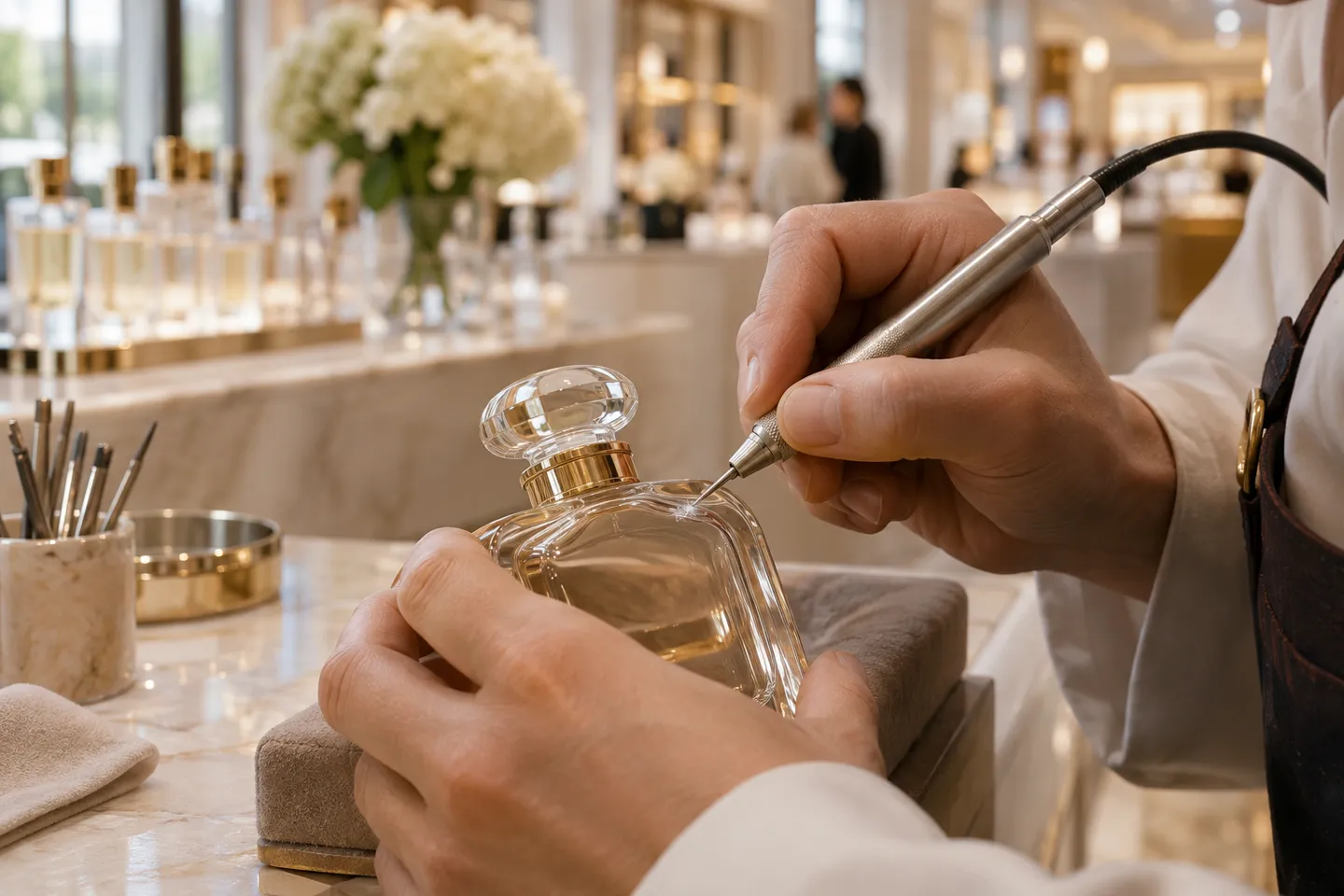
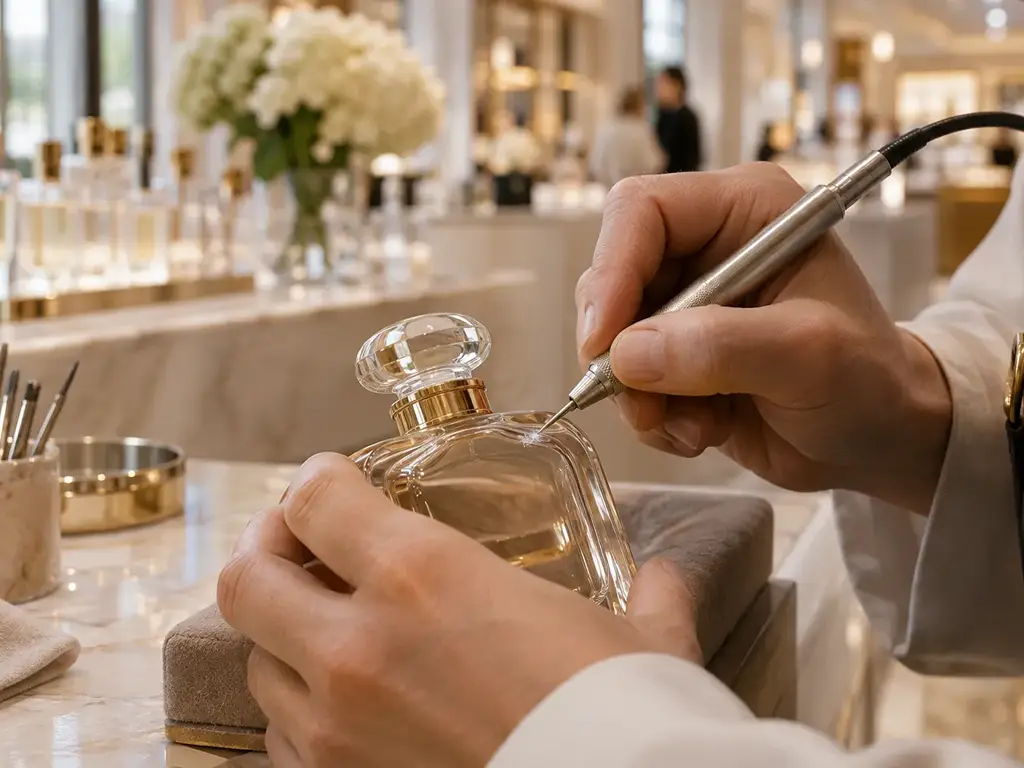
At the engraving counter, the specialist steadies a glass flacon against a rest, checks the spelling twice, and lowers a diamond-tipped pen onto the shoulder of the bottle. Two minutes later your mother’s name sits in the glass itself, catch-light and permanent. That is engraving on a perfume bottle: a mark made by removing or reshaping the surface of the glass, not by printing on top of it.
That distinction is the whole point. A label can peel, a print can scratch off, a sticker can yellow. Engraving cuts a fraction of a millimeter into the material, so the mark survives alcohol, sunlight, and years of being picked up. The bottle is the packaging, and the message lives inside the packaging.
Four routes can put that mark there. Hand engraving uses a diamond or steel tip guided by an artisan’s wrist, one bottle at a time. A rotary tool does the same work at home, with less control. A professional laser engraver ablates, or vaporizes, microns of glass along a programmed path. A mechanical engraving machine drags a diamond tip across the surface in a cold cut. And at industrial scale, acid etching frosts entire batches through a mask, and molds can even emboss a logo into the bottle as it forms.
The method decides everything downstream: how the mark feels under a thumb, how it handles an alcohol-based fragrance, whether it can follow a curved shoulder, and what it costs. The same three initials can carry a price tag of $5 at a beauty counter or $75 at a calligrapher’s studio, and a few tenths of a dollar on a factory line. The gap is not the machine. It is who holds it, and how many bottles share the setup.
Where Perfume Bottle Engraving Happens, and What It Costs
Four kinds of businesses engrave perfume bottles, and they serve four slightly different needs: fragrance houses, department and beauty retailers, independent engraving studios, and, increasingly, your own garage bench.
Fragrance houses treat engraving as part of the buying ritual. Parfums de Marly, Givenchy, and Viktor & Rolf all run engraving services that add names, initials, or short messages to bottles bought from them (Parfums de Marly, 2026; Givenchy Beauty, 2026). Beauty retail works the same way at scale. Macy’s maintains a dedicated perfume engraving program, with in-store events that bundle engraving free with a fragrance purchase (Macy’s, 2026). YSL Beauty charges nothing for loyalty members and $5 for everyone else (YSL Beauty, 2026).
Independent studios occupy the other end of the price ladder. A calligrapher who engraves by hand publishes rates starting at $75 per bottle, with illustration and painting adding $25 and up (A Handful of Letters, 2024). What you buy there is not convenience but artistry: flowing scripts, dates in flourishes, small drawings no machine template would attempt.
Where perfume engraving happens and what it costs
| Channel | Typical cost | Turnaround | Best for |
|---|---|---|---|
| Fragrance house counter | Often complimentary with purchase; about $5 for non-members at some houses | Minutes to days | Buying the fragrance anyway and wanting the official service |
| Department and beauty retail events | Free with select purchases during events | Same day, event dates only | Seasonal gifting on the spot |
| Independent studio or calligrapher | From $75 per bottle, plus $25 and up for artwork | 1 to 3 weeks plus shipping | Custom scripts, dates, and drawn artwork |
| DIY at home | Rotary tools and hobby lasers from roughly $100 to $500 one-time | Immediate, at your own risk | Practice pieces and non-pressurized empties |
Rules matter as much as price, and they are stricter than most buyers expect. Louis Vuitton caps bottle engraving at three letters, with or without dots between them, according to buyers discussing the service in r/fragrance (Reddit, r/fragrance, 2025). Character caps protect the layout: long text on a small glass panel turns illegible fast. Before you fall in love with a phrase, ask what the service can actually fit. Ask where on the bottle it can go, too, because flat panels engrave cleanly while tight curves test every method.
Should You Engrave? Where the “Ruins the Bottle” Worry Comes From
Hand a perfume lover an engraving offer and you will get two opposite reactions. In one thread on r/fragrance, a buyer who had just paid a high price for a fragrance in Paris was offered engraving and asked whether he would really be defacing the bottle (Reddit, r/fragrance, 2024). Meanwhile, luxury houses sell the same service as a premium ritual. Both sides are right, because they are answering different questions: a mark that makes a bottle yours makes it someone else’s less.
On safety, the professional answer is straightforward. Laser and mechanical engraving remove a sliver of the outer surface, measured in microns. They do not pierce the wall, and they do not touch the liquid inside. If a bottle leaks, the failure almost always sits at the pump crimp or the cap seal, not at a surface etch. Concerns raised by fragrance fans about engraving weakening bottles apply with real force to one case only: improvised DIY work, where uneven heating can stress the glass.
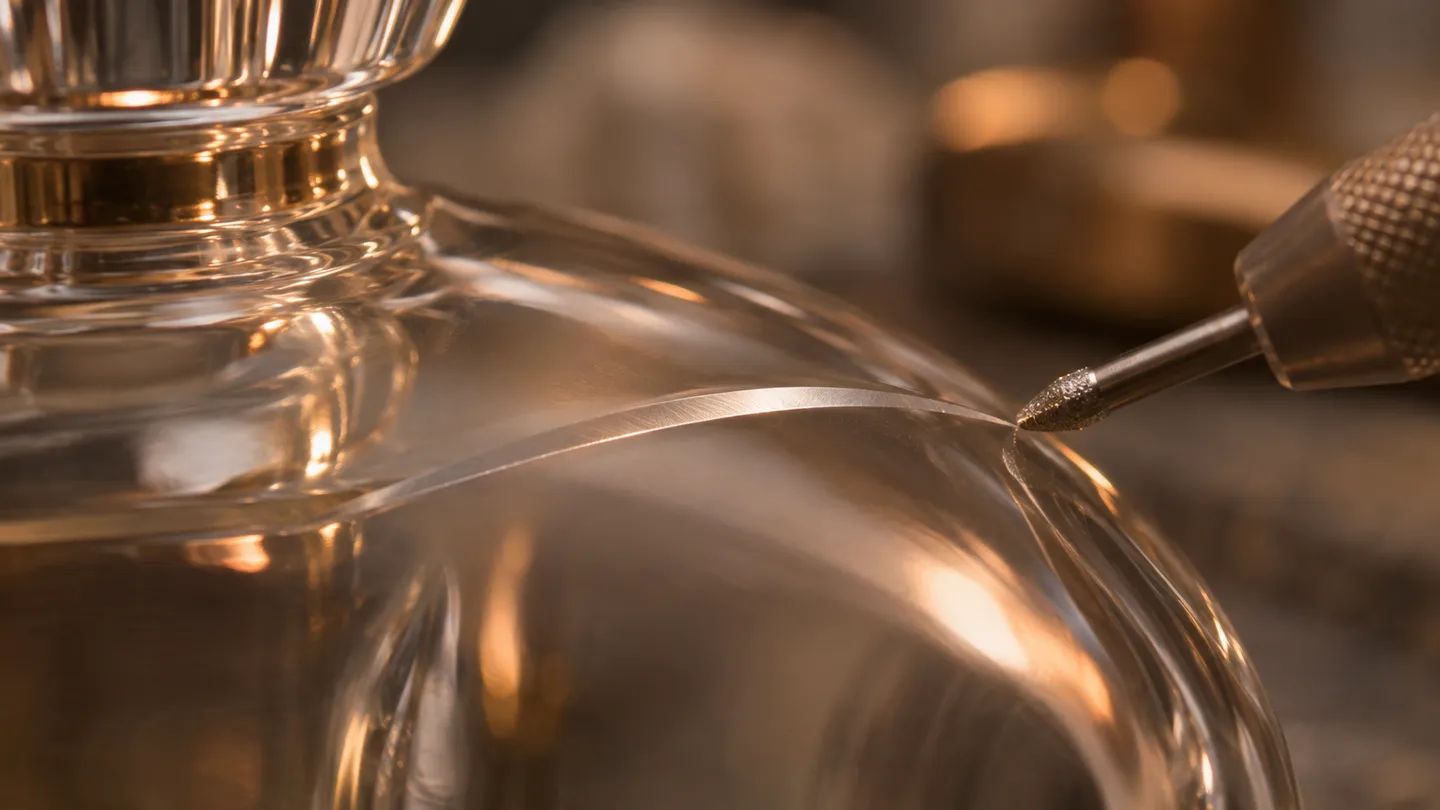
The line between professional work and improvised work is narrow, and it is worth seeing before anything breaks.
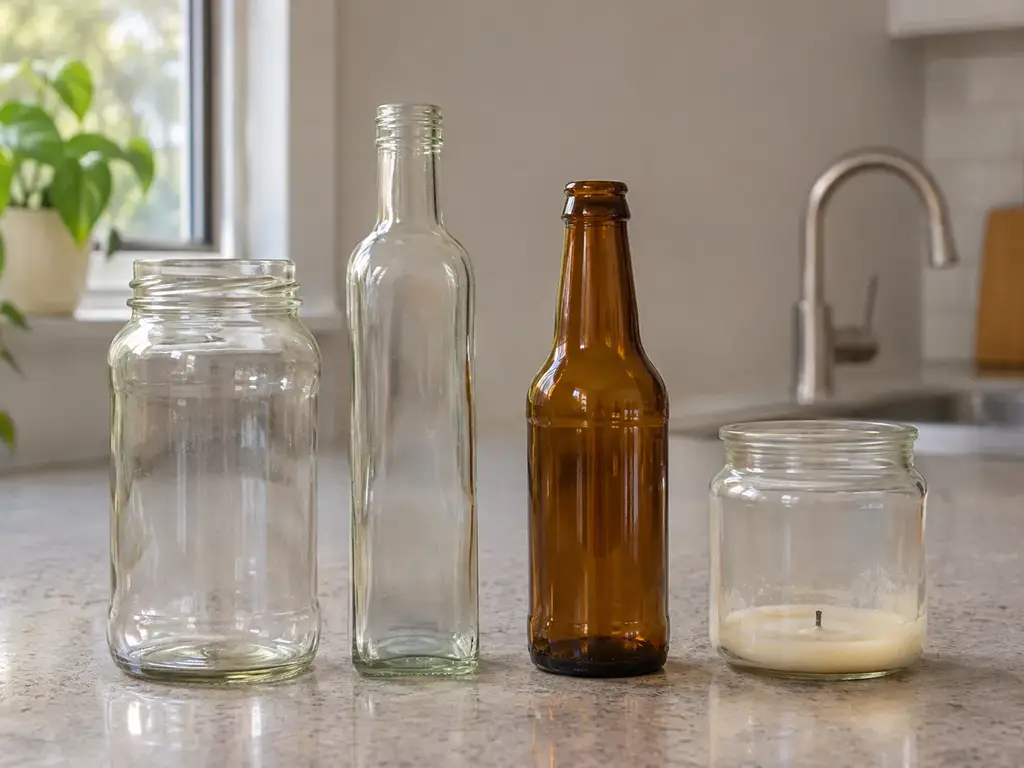
Do not learn engraving on a bottle you mean to keep or give. A handheld rotary tool or hobby laser heats glass unevenly and can leave micro-cracks you cannot see until the bottle is handled. Pressurized crimp-neck spray bottles are less forgiving than wide-mouth jars. Practice on an empty food jar first, and never test a technique for the first time on a filled perfume bottle.
Resale is the honest trade-off. Personalized glass is hard to resell, because no one else wants your initials. Collectors who flip rare releases lose value when the flacon carries a name. If a bottle is for you, or for someone who will actually finish it, engraving deepens the object’s meaning at zero functional cost. If it is an investment, leave the glass blank.
The worry is also fading on the supply side. The global personalized gifts market was valued around $30 billion in 2024 and is projected to more than double by the early 2030s (SkyQuest, 2024). Retail engraving events now anchor holiday calendars at major chains, which tells you where the service is heading: from occasional promotion to standing offer.
For a bottle brand, the same shift is a packaging decision: Daxin Glass engraves alongside six other in-house decoration processes on stock bottles from 1,000 pieces.
Get a Decoration QuoteLaser, Diamond-Tip or Acid Etch: How the Methods Really Compare
Choosing a professional method is a process decision, not a taste decision. The surface you engrave, the volume you need, and the budget you have will point at one method before aesthetics do.
What Laser Engraving Does to Glass and Coatings
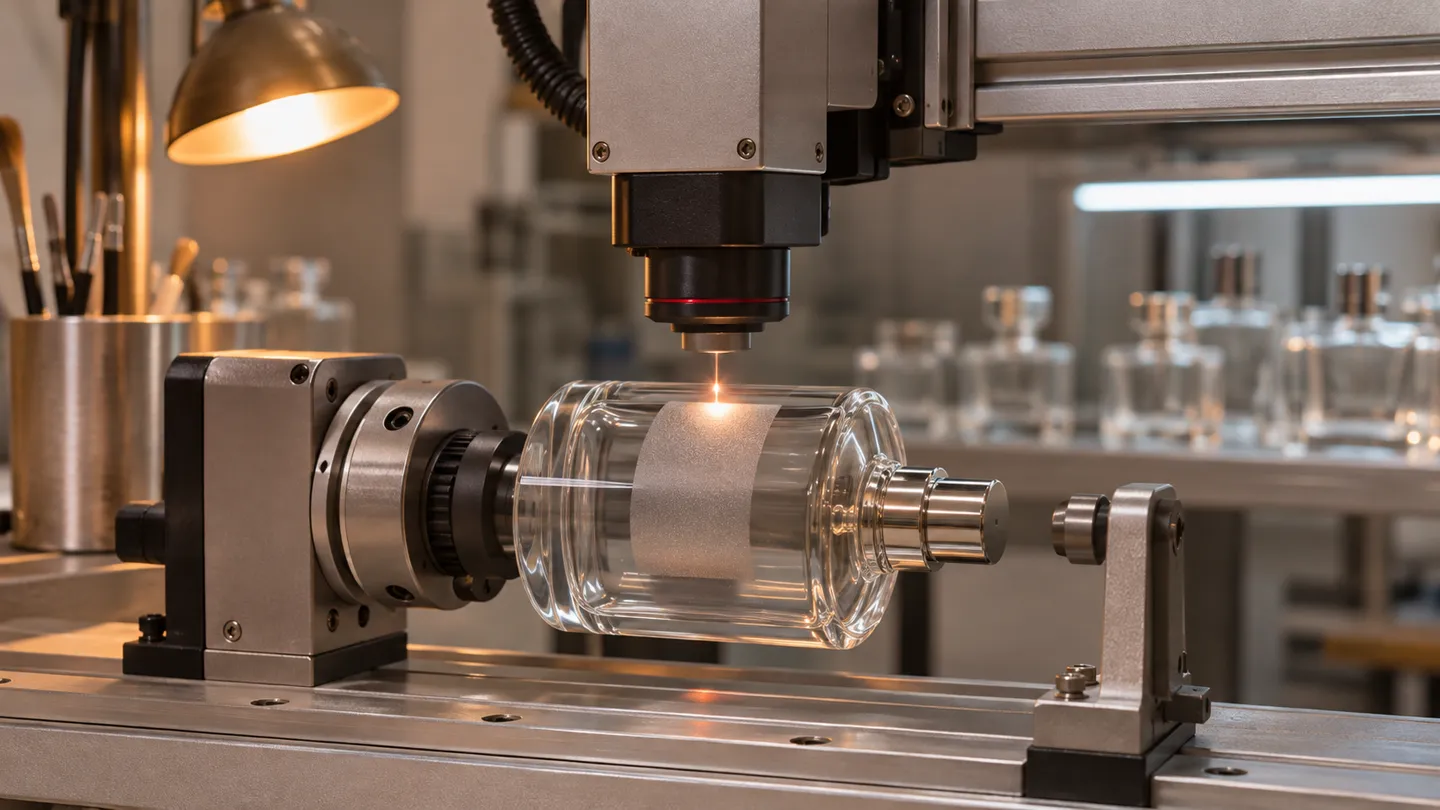
A laser head programs a beam to vaporize a controlled sliver of glass, micron by micron. The mark can sit at any depth the power allows, which makes laser work the default for fine text, serial numbers, and crisp logos. On colored or coated bottles, laser engraving delivers its best trick: it burns through the coating and exposes the glass underneath, producing sharp contrast between a gold or black finish and the clear glass inside the letterform.
Its constraint is geometry. The beam focuses at a fixed distance, so a deeply curved shoulder drifts out of focus and the mark goes uneven. Flat panels and gentle curves engrave beautifully; tight radii need test cuts.
What Diamond-Tip Engraving Does Differently
Mechanical engraving cuts cold. A diamond tip is dragged across the surface with controlled pressure, and the industry describes the result as a polished, tone-on-tone effect on perfume glass (Gravotech, 2026). Instead of a matte burn, you get a satin stroke that catches light the way cut crystal does, which reads as quieter and more artisanal.
There is no beam to focus, but there is a tip to steer, so complex double-curved surfaces still limit the reachable area. The upside for live events is practical: no fumes, no consumables, and a mark that appears the instant the tip passes.
Where Acid Etch Belongs, and Where It Fails
Acid etching frosts glass chemically through a protective mask. It produces the uniform, silky finish you see on mass-market frosted bottles, and it does so batch after batch with near-perfect consistency. What it cannot do is economics at low volume: masks, chemical handling, and line time only pay off across hundreds or thousands of units. For one personalized bottle it is the wrong tool entirely, which is why counters and studios never offer it. At production scale it moves back to center stage, and that is where the next section picks up.
Three professional methods plus two DIY routes
| Method | How it marks glass | Feel and look | Curved surfaces | Economics |
|---|---|---|---|---|
| Hand engraving | Diamond or steel tip guided by hand | Faceted, artisanal strokes | Good on small areas | From $75 per bottle |
| Laser engraving | Focused beam ablates microns of surface | Matte, precise, high contrast on coatings | Limited by focal depth on tight curves | Fast per unit once programmed |
| Mechanical diamond-tip | Cold polished cut | Tone-on-tone satin sheen | Moderate, tip must reach the spot | No consumables, steady output |
| Acid etch | Masked chemical frost | Uniform silky matte | Any shape, via masking | Uneconomic below batch volume |
| DIY rotary or hobby laser | Handheld cutting or low-power ablation | Inconsistent, skill-dependent | Poor to moderate | Cheap to start, risky on good bottles |
Two failures published by buyers show where process discipline actually lives. One luxury counter engraved initials with dots between them after the customer explicitly asked for none; the remedy discussion turned on redoing the bottle (Reddit, r/Louisvuitton, 2025). In another case, initials arrived visibly off center on a $320 bottle, and the buyer debated whether to care (Reddit, r/Colognes, 2024). Neither failure is about equipment. Both are about skipping a preview. Insist on a mockup that shows exact characters, spacing, and placement, and get it approved before anything touches glass.
Engraving at Production Scale: Glass or Coating, MOQ and Specs
On a production line the question changes shape. You are no longer personalizing one bottle; you are deciding whether a mark belongs on every bottle of a SKU, and what that mark must survive.
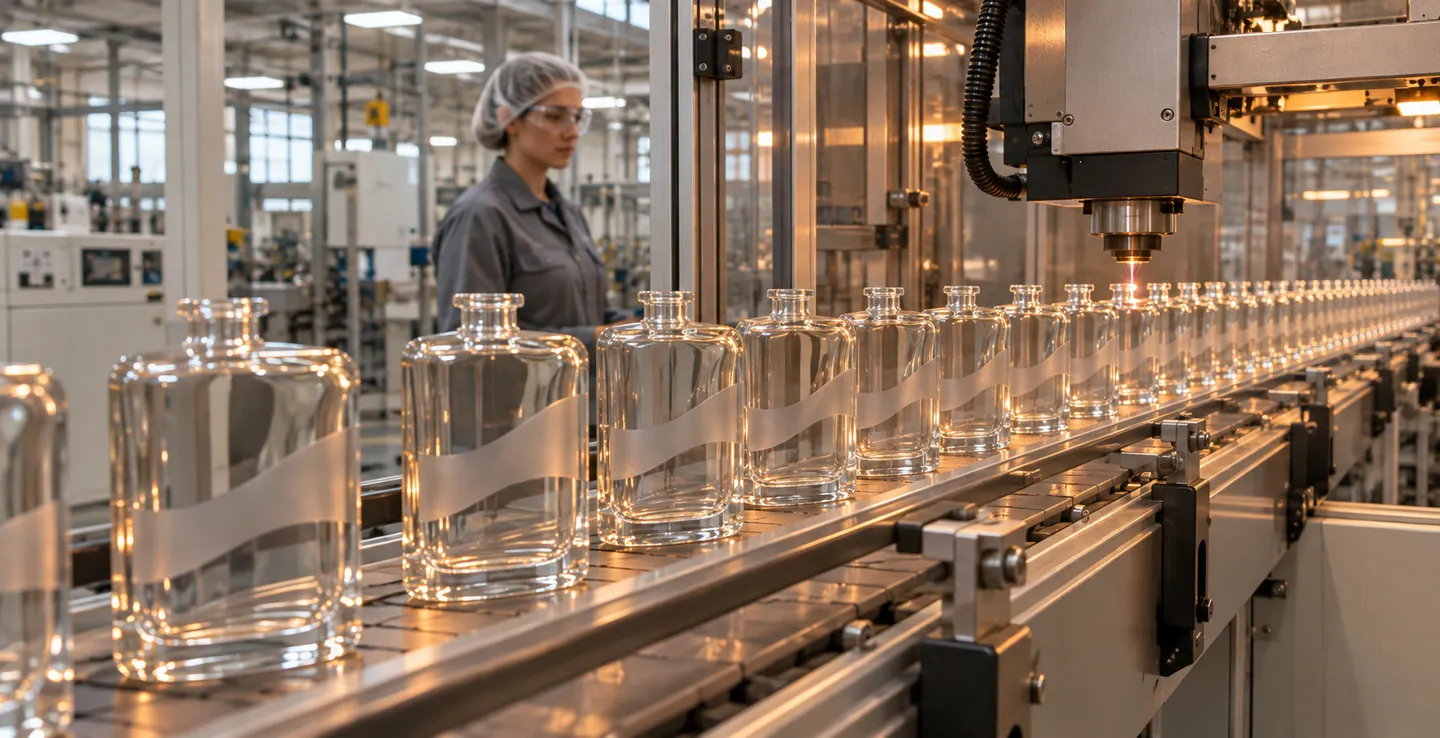
One number frames the whole decision. At a US studio, hand engraving starts around $75 per bottle. On a factory line, a complete decorated set, glass bottle plus sprayer plus cap, quotes between $0.27 and $1 per set FOB Shanghai depending on style and volume (Daxin Glass, published bottle specifications, 2026). Same three letters on the same glass, yet the price differs by two orders of magnitude. At retail, the setup cost rides on one bottle. On a line, it is spread across thousands of them. That spread is the single most useful number in the whole decision: it tells you engraving at retail price is a gift service, and engraving at production price is a packaging decision.
$75 at a retail counter. $0.27 to $1 per set on a production line. Same three initials, two orders of magnitude apart; the setup is shared across thousands of bottles.
Engraving the Glass or the Coating: A Durability Decision
The first spec to settle is what the laser actually hits. Bare glass engraves into permanence: there is no coating to lift, and the contrast comes from frosted texture against clear or tinted glass. Coated bottles work the other way: the engraving removes paint or plating and lets the glass show through, which gives you a bright mark on a dark bottle.
The risk lives in that second route. Perfume is an alcohol system, and alcohol attacks coatings whose adhesion is marginal. When adhesion is weak, the cut edges of an engraved mark are exactly where the coating lets go first. The checkable standard exists: cross-cut adhesion testing under ASTM D3359 rates how well a coating holds, with 4B or better the usual pass band for demanding work (ASTM International, 2023). Before committing to engrave a coated bottle, ask for the adhesion report and for alcohol-wipe survival on finished, decorated samples.
One more surface earns a line: the closure. Metal caps and collars engrave cleanly, and a mark on the cap can outlast scrutiny of the glass.
Where the mark lives: durability boundaries
| Engraved surface | Works best for | Durability with alcohol-based perfume | Failure boundary | Ask the supplier for |
|---|---|---|---|---|
| Bare glass | Clear or tinted bottles, minimal luxury look | Permanent, nothing to lift | Low contrast on clear glass unless frosted first | Depth spec and contrast method |
| Coated or plated glass | High-contrast marks on colored finishes | Depends on coating adhesion | Cut edges lift first when adhesion is weak, and alcohol speeds it up | ASTM D3359 cross-cut report at 4B or better, plus alcohol-wipe survival on decorated samples |
| Metal cap or collar | Logos on zamak, aluminium, or plaques | Very durable | Not part of the glass, so it reads as an accessory mark | Material grade and plating spec |
| In-mold embossing | Marks formed into the bottle as it takes shape | Permanent, part of the bottle itself | Glass color only, no fill contrast, and it requires tooling | Tooling quote and a first-article sample |
What Engraving Costs at Production Volume
Production pricing runs on two axes: the bottle program and the decoration program. Stock bottles from existing molds start at 1,000 pieces undecorated. The same manufacturer’s published terms list seven decoration processes available on a single bottle body, with up to four combinable on one bottle (Daxin Glass, published bottle specifications, 2026). Laser engraving sits on that menu alongside silk screening, hot stamping, electroplating, and frosting. That means the decision is rarely “engraving or nothing.” It is usually engraving plus two cheaper processes, tuned per face of the bottle.
Fully custom tooling raises the commitment by an order of magnitude, because a mold is a different financial object from a decoration run. Decoration itself adds process days rather than weeks: treated as a post-processing step, it is measured in single-digit days per batch once bottles exist. Sample programs, where the engraving is proven on a pre-production bottle before mass decoration, are the norm rather than the exception, and they are where your money is actually protected.
The Spec Sheet to Hand Your Supplier
Most engraving disappointments at production scale trace back to a spec sheet that stopped at “logo on bottle.” Hand over the following and the supplier can quote without guessing.
- Artwork as a vector file, with the exact character set and a licensed font.
- Placement and size in millimeters on a dimensioned drawing of the bottle.
- Surface decision: bare glass, coating, or metal closure, with the contrast you expect.
- Adhesion requirement for coated surfaces: ASTM D3359 cross-cut at 4B or better, documented.
- Alcohol-wipe survival confirmed on decorated pre-production samples.
- Acceptance sampling per AQL 1.0 under ANSI/ASQ Z1.4 for the decorated batch.
- Transit proof: packed sets tested to ISTA 1A, including an 80 cm drop.
- Named approval step: a signed-off engraved sample before the mass run.
Every line on that list is checkable, which is the point. A supplier who answers all of them has the process. One who waves at “high-quality engraving” is selling you the failure stories from the previous section.
Making Engraving Pay: Which Bottles in Your Line Deserve It
Run the numbers back through your catalog and the decision sorts itself. Engraving is a tool for specific bottles, not a default finish for the line.
Limited editions, gift sets, and collaborations justify it first. The $75-to-$0.30 spread only matters when you multiply it across units, and limited runs multiply nothing. A few thousand bottles carrying a collectible mark is exactly where a permanent, hard-to-copy surface feature earns its premium. Gift sets add a second reason, since engraving-friendly bottles photograph as objects rather than containers.
Your volume core should usually stay on screen printing and hot stamping. Those processes carry brand marks at the lowest unit cost, they combine with coatings freely, and nothing about a daily-use SKU needs a mark that survives a decade. Save the deep-cut drama for the SKUs that justify it.
If you are validating a new brand, the arithmetic flips in your favor: stock-mold bottles start at 1,000 pieces, and laser engraving turns a stock shape into something no competitor stocks, before you commit to any tooling at all. Tooling can wait for proof. The mark cannot.
A final check belongs at bottle selection, not at decoration. Small essential-oil formats and tight-curve diffuser bottles leave almost no flat real estate for a mark, so decide where the engraving goes while you are still choosing the shape, not after.
- Limited editions, gift sets, collaborations: engrave, the premium carries the cost.
- Volume core SKUs: screen print and hot stamp, keep unit cost down.
- New brand validation: stock mold plus laser engraving at 1,000 pieces, tooling waits for proof.
- Small or tight-curve formats: choose the engraving zone during bottle selection or skip the mark.
If you are weighing which of your own bottles should carry an engraved mark, our line is built around exactly this decision: seven in-house decoration processes, combinable up to four on a single bottle, with stock molds from 1,000 pieces, and our decoration and finishing options show how engraving pairs with the rest.
Put a Permanent Mark on Your Own Bottles
Send your bottle model, your mark, and your target volume, and we reply with the process choice, the MOQ, and a decorated pre-production sample plan.
Start Your ProjectReferences
- Parfums de Marly. “Luxury Perfume Bottle Engraving Service.” 2026. https://us.parfums-de-marly.com/collections/engraving
- Givenchy Beauty. “Engraving: Custom Engraved Perfume Bottles.” 2026. https://www.givenchybeauty.com/us/fragrance/engraving/
- YSL Beauty. “Personalized Engraving: Makeup & Fragrance.” 2026. https://www.yslbeautyus.com/personalized-engraving—fragrance-makeup—ysl-beauty/engraving.html
- Macy’s. “Perfume Engraving.” 2026. https://www.macys.com/shop/featured/perfume-engraving
- A Handful of Letters. “Perfume Engraving.” 2024. https://www.ahandfulofletters.com/blog/teb81ggqrxy42ad3snker10p8gpt2r
- Gravotech. “Perfume and Cosmetics Engraving Machines.” 2026. https://www.gravotech.us/applications/cosmetic-and-perfume-engraving
- SkyQuest. “Personalized Gifts Market Size, Share, Trends Report.” 2024. https://www.skyquestt.com/report/personalized-gifts-market
- Reddit, r/fragrance. “Custom Engraving on Fragrance Bottles…Yes or No?” 2024. https://www.reddit.com/r/fragrance/comments/18jczrw/custom_engraving_on_fragrance_bottlesyes_or_no/
- Reddit, r/Louisvuitton. “Perfume Engraving Messed Up.” 2025. https://www.reddit.com/r/Louisvuitton/comments/1h3dwuf/perfume_engraving_messed_up/
- Reddit, r/Colognes. “Should I Care?” 2024. https://www.reddit.com/r/Colognes/comments/1ap5che/should_i_care/
- Reddit, r/fragrance. “Buying LV and Considering Engraving.” 2025. https://www.reddit.com/r/fragrance/comments/1kgzed3/buying_lv_and_considering_engraving/
- ASTM International. “Standard Test Methods for Rating Adhesion by Tape Test (D3359).” 2023. https://store.astm.org/d3359-23.html
 English
 Spanish
 French
 German
 Arabic
 Italian
 Dutch
 Portuguese
 Russian
 Korean
 Japanese