
What Sustainable Perfume Packaging Actually Covers
A recycled-board carton usually collects the praise. It photographs well, it carries the FSC logo, and it gives a launch its eco story. Then the same brand fits a metal collar, a plastic pump and a coated glass bottle under that carton, and the claim quietly moves from the material doing the work to the one doing the decorating. The bottle, not the box, is where most sustainability promises in perfume packaging come undone.

A perfume package is a system of three layers, and each layer carries its own circularity. The bottle is the glass body. The fitting layer is the pump, the cap and the collar that seal it. The secondary layer is the carton, the inserts and the shipping protection. Mixed-material failure starts at the fitting layer more often than anywhere else, because that is where metal, plastic and glass meet in one inseparable unit.
Search results for sustainable perfume packaging lean heavily toward box ideas: kraft cartons, molded pulp trays, soy inks. Those matter, but a box solves perception while a bottle solves the promise. This guide follows the bottle and the system around it, because that is where engineering decisions, and sourcing decisions, actually get made.
The timing is not marketing pressure alone. McKinsey’s 2025 US survey found 77 percent of consumers rate recyclability as extremely or very important when they judge a package (McKinsey & Company, 2025). In the EU, Regulation 2025/40, the Packaging and Packaging Waste Regulation, entered into force in 2025 with obligations applying from August 2026, and it requires all packaging sold in the union to be designed for recyclability by 2030 (European Commission, 2026). Regulators and shoppers are converging on the same demand: claims that survive contact with a real recycling line.
Material Routes Compared: Glass, PCR Plastic, Pulp and Bio-Based
Material choice is not a menu of virtues. Each route carries a different recycling behavior, a different cost structure and a different way of failing. Four routes cover nearly every decision a fragrance brand will face.
Glass: the default for a reason
Glass melts back into new glass with no loss of quality, which makes it the only perfume bottle material that recycles into itself indefinitely. Melters work crushed cullet back into new batches at rates commonly between 30 and 60 percent, and every ton of cullet lowers the melt temperature and the fuel bill alongside the emissions. One manufacturer’s sustainability page publishes the number directly: 670 kg of CO2 saved per ton of recycled glass. The same page estimates a glass bottle stays in circulation for roughly 50 reuses. Clarity has its own hierarchy in glass: standard flint formulas carry 1.2 to 1.5 percent iron content, while low-iron crystal formulas run below 0.8 percent and reach about 99 percent light transmittance, which is why prestige colorless bottles specify the crystal grade.
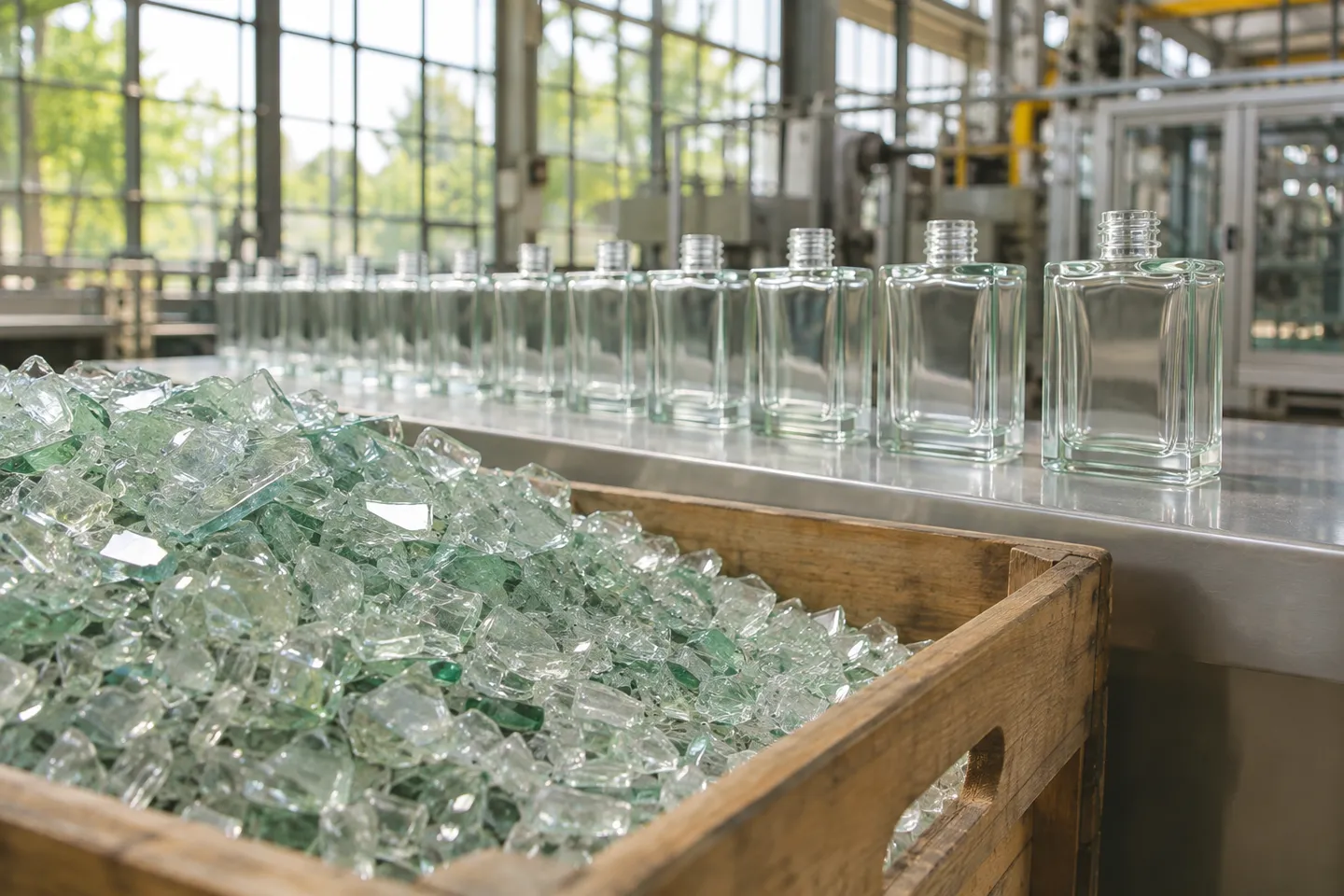
The boundary is weight and finish. Glass is dense, so freight costs rise with every gram, and a heavy coat of baked-on paint can turn a recyclable bottle into a sorting-line reject. Ask for the coating type and whether it strips in the recycling process before you write “recyclable” on the carton.
The glass route in numbers
670 kg
CO2 saved per ton of recycled glass
~50
reuses per bottle in circulation
~99%
light transmittance, low-iron crystal
PCR plastic and its limits
Post-consumer recycled (PCR) plastic cuts virgin resin use and answers the recycled-content targets now landing on plastic packaging in the EU. The limits show up in fragrance specifically: perfume carries alcohol, alcohol stresses many recycled resins, and PCR content can shift color and clarity in a category where both sell the product. Verify the PCR percentage and demand alcohol-compatibility testing on the actual formulation, not a generic resin datasheet.
Paper and pulp: the box side of the system
Molded pulp trays and recycled-board cartons are where paper routes belong in a perfume package. They are light, mono-material and easy to certify under schemes like FSC. Their boundary is structural: paper cannot protect a 200-gram glass bottle on its own, so it always travels with plastic-coated inserts or foam, and that combination needs a second look at separability before anyone calls the set recyclable.
Metal fittings and bio-based materials
Zamak caps carry weight and a premium finish, and metal recycles well when it can leave the bottle. Bio-based plastics appear in the ingredient lists of a few caps and inserts; treat them as a niche option for now, worth a line in your matrix but rarely the main route for a glass perfume system. The practical question for the fitting layer stays the same: can the cap leave the bottle without tools?
Established houses keep anchoring their refill programs in glass, which tells you where the industry’s default landed: Mugler has run its in-store refill fountain since 1992, built on the glass Angel bottle (Mugler, 2026).
| Material route | Best fit | Circularity property | Where it fails |
|---|---|---|---|
| Glass (low-iron for prestige) | Perfume bottles, refill systems | Recycles into itself indefinitely, cullet cuts melt CO2 | Freight weight, non-strippable coatings |
| PCR plastic | Caps, inserts, secondary fittings | Cuts virgin resin, meets recycled-content rules | Alcohol stress, clarity and color drift |
| Paper and pulp | Cartons, trays, shippers | Light, mono-material, FSC-certifiable | No structural strength for glass, wet-strength limits |
| Metal (zamak) | Caps and collars | Recyclable when separable | Bonded or glued fittings that stay on the bottle |
Choosing a Circularity Route: Recycle, Refill, Reuse or Lightweight
Material is the carrier. The route is the promise your brand can actually keep, and regulators now write that promise into law: Regulation 2025/40 expects every package sold in the EU to be recyclable by design from 2030, and it phases in minimum recycled content for plastic packaging from the same year (European Commission, 2026). Buyer patience is thinner than the law. The same McKinsey survey that ranked recyclability first also documents how quickly sustainability claims erode when a shopper cannot see the mechanism behind them. Four routes compete for that trust.
The recyclable route: what survives the sorting plant
Theoretically recyclable and actually recycled are different claims. In the United States, only 31.3 percent of glass containers got recycled in the most recent EPA accounting, and a perfume bottle fares worse than a pickle jar: recyclers reject bottles that mix glass with metal collars, plastic pumps and baked coatings, because the sorting line cannot separate them (US EPA, 2026). A bottle that leaves the factory as one inseparable unit has already spent its recyclability, whatever the carton says.
The three engineering fixes
- Separate without tools
- Coatings strippable, or none on the claim
- Components marked by material
The refill route: a supply chain commitment, not a cap option
Refill promises break in two places. They break at retail, where refill stock runs out or never ships, and they break at pricing. A 190-comment thread on r/ZeroWaste asked the obvious question: why does the refill cost more than the bottle it refills (Reddit r/ZeroWaste, 2021)?

The engineering side runs through the neck. FEA15, the 15 mm crimp neck, is the standard finish for small and medium fragrance bottles from 10 to 50 ml, and crimp pumps need a press tool to seat and to remove (Packamor, 2026). Crimp seals tamper-evident but blocks consumer refilling, so refill systems built on it work through inner bottles, store fountains or exchange programs. Screw necks reopen easily and trade some tamper evidence and some shelf polish for that ability. Pick the neck by deciding who performs the refill, the brand or the buyer.
A mid-2026 thread on r/fragrance drew 300-plus comments after buyers of Diptyque’s “forever” solid-perfume case discovered the matching refills had quietly stopped being available. The reusable shell survived; the product inside it did not. A refill claim is a commitment to keep making the second thing, and that commitment sits with your supply chain, not your packaging.
The route holds when three conditions line up: stable repurchase, a supply chain that commits to the refill SKU for years, and volume that spreads the second visit’s cost. Miss any of the three and the refill program becomes the next 300-comment thread.
Reuse and lightweight: the quiet routes
Reuse works where the vessel outlives the product, and fragrance has real examples: candle jars become storage and vases, diffuser bottles keep their reeds while only the oil leaves. It stays honest when the brand designs for the second life instead of just permitting it. Lightweighting is the quieter route with the sharper trade-off. Every gram cut from a glass bottle lowers freight emissions and per-unit cost, and it also lowers the perceived value and raises the breakage rate on a high-speed filling line. The trade has a floor, and the floor is found in drop-test data at the target weight, not in a lighter catalogue photo.
| Route | What it demands | Where it breaks |
|---|---|---|
| Recyclable | Mono-material design, separable fittings, strippable coatings | Sorting lines reject mixed-material bottles whole |
| Refillable | Stable repurchase, multi-year refill supply, volume economics | Refill stock dries up or refills cost more than originals |
| Reusable | A vessel with a genuine second life | “Reusable” as a label with no second-use design |
| Lightweight | Drop-test data at the target weight | Too light reads cheap and cracks on filling lines |
Turning the Route Into Specs and Supplier Verification
A route becomes real when it appears in a request for quotation. Four steps take it there.
Step 1 locks the structure. Write mono-material and separability into the drawing before the mold opens. Specify which fittings must separate without tools, and which coatings are allowed. A baked-on decorative coat needs a documented stripping behavior, or the recyclability claim dies at the sorting plant.
Step 2 fixes the neck and the pump. Choose crimp or screw deliberately. FEA15 crimp fits most 10 to 50 ml bottles and seals tamper-evident; screw reopens for refills. Confirm the pump-to-neck tolerance in writing, because that tolerance is what keeps a high-speed filling line from chewing your launch schedule.
Step 3 demands the proofs. Ask for the quality management certificate behind the factory floor, most fragrance packaging suppliers work under ISO 9001. Ask for third-party test reports from houses like SGS or Intertek on the claims you will print: alcohol resistance for coated bottles, compatibility with your juice, and drop tests at your target weight. Ask for recycled-content documentation if recycled glass or PCR is part of the pitch.

Step 4 sets the order parameters. MOQ and lead time decide whether the sustainable option is actually purchasable. The typical three-tier structure at glass packaging factories runs 1,000 units for in-stock shapes, 5,000 for custom decorating on stock glass, and 10,000 for a full custom mold. In-stock shapes ship in roughly 5 to 10 days after payment; out-of-stock production runs 25 to 40 days. Mold fees are one-time, and rebate thresholds at certain volumes are common enough to ask about.
Supplier verification checklist
- Separability: can cap, pump and collar leave the bottle without tools?
- Coating: documented stripping behavior or no coating on the recyclable claim.
- Recycled content: percentage documented, not implied.
- Tests: alcohol resistance, juice compatibility, drop test at target weight, from a third party.
- Certification: ISO 9001 or equivalent quality system.
- Neck: FEA15 crimp or screw, decided by who refills.
- Tolerance: pump-to-neck spec in writing for your filling line.
- MOQ and lead time: all three tiers quoted, in-stock and custom timelines separated.
Two boundaries keep this section honest. First, lightweighting: confirm wall thickness and drop-test results at the target gram weight before you approve a lighter bottle, because the savings vanish if the breakage rate climbs. Second, recyclability claims: confirm the coating situation before the claim goes to print, because a painted bottle and a bare bottle do not recycle the same way.
Reading the Market as a Packaging Buyer
The broken promises in this article share one root: the claim was written before the design was locked. The Diptyque refills died because the refill commitment was never engineered into the supply plan. The rejected bottles die because separability was never written into the drawing. Both are procurement failures before they are marketing failures.
So the working stance is simple: sustainability belongs in the structural spec, locked before the mold opens. Mono-material construction, separable fittings, a deliberate lightweighting target, documented recycled content. The carton story comes after those four exist, not instead of them.
Evaluation of a supplier then reduces to three checks. Can they document the recycled share in their glass? Can the cap and pump leave the bottle without tools? Can they quantify the weight of the bottle against drop-test data? A factory that answers those three in writing will survive the questions your customers ask later.
Cost closes the loop. The three-tier MOQ structure and one-time mold fees mean the sustainable route is usually a packaging decision, not a capital decision, and rebate thresholds make custom molds recoverable for brands that find volume. That is a decision worth making early: cheap to change now, expensive to unwind after launch.
Every Daxin RFQ answer lists all three MOQ tiers, so you can price the sustainable route against real numbers while the drawing is still on the table.
Start your perfume bottle RFQThis is also the standard this article’s own factory works to. Daxin runs its perfume bottle line the way this guide recommends. The low-iron crystal formulas reach about 99 percent light transmittance, and the sustainability page publishes the circularity figures openly: 670 kg of CO2 saved per ton of recycled glass, and roughly 50 reuses per bottle. We match caps and pumps in zamak, resin, acrylic or wood to the neck finish, so the finished bottle stays separable, and our MOQs follow the same three tiers described above: 1,000 units for in-stock shapes, 5,000 for custom decorating, 10,000 for full custom molds. The perfume bottle range shows both the stock and the custom side.
Run the checklist from the previous section against Daxin’s in-stock perfume bottle catalogue before your next RFQ: most stock shapes ship 5 to 10 days after payment, so the comparison costs you an afternoon, not a quarter.
A bottle spec that survives the sorting plant
Send Daxin your target weight, neck finish and decoration plan. Quotes cover in-stock shapes from 1,000 units and full custom molds from 10,000, with separable fittings and documented recycled content.
Request your perfume bottle quoteReferences
- European Commission. “Packaging Waste.” 2026. https://environment.ec.europa.eu/topics/waste-and-recycling/packaging-waste_en
- European Commission. “New EU Rules on Packaging Enter Into Application.” 2026. https://environment.ec.europa.eu/news/new-eu-rules-packaging-enter-application-2026-08-11_en
- U.S. Environmental Protection Agency. “Glass: Material-Specific Data.” 2026. https://www.epa.gov/facts-and-figures-about-materials-waste-and-recycling/glass-material-specific-data
- McKinsey & Company. “Do US Consumers Care About Sustainable Packaging in 2025?” 2025. https://www.mckinsey.com/industries/packaging-and-paper/our-insights/do-us-consumers-care-about-sustainable-packaging-in-2025
- Mugler. “Mugler Commitment to Sustainability.” 2026. https://inter.mugler.com/int/mugler-commitment-to-sustainability.html
- Reddit, r/ZeroWaste. “Why Are the Refills More Expensive Than the Standard…?” 2021. https://www.reddit.com/r/ZeroWaste/comments/qo1e4r/why_are_the_refills_more_expensive_than_the/
- Reddit, r/fragrance. “Diptyque Sold Me a ‘Forever’ Solid Perfume Case and Then…” 2026. https://www.reddit.com/r/fragrance/comments/1ujk1qm/diptyque_sold_me_a_forever_solid_perfume_case_and/

 English
 Spanish
 French
 German
 Arabic
 Italian
 Dutch
 Portuguese
 Russian
 Korean
 Japanese