
When developing a new fragrance line, brand founders and B2B procurement managers often fall into a common and costly trap: obsessing over the visual 3D renderings while completely ignoring the underlying manufacturing engineering. You might have a breathtaking concept for your perfume bottle packaging design, but if the pump leaks during international ocean freight, or the tooling costs for a custom zinc alloy cap spiral out of control before a single unit is sold, that beautiful design quickly becomes a commercial disaster.
In the high-stakes world of fragrance manufacturing, aesthetic appeal is merely the baseline. True luxury is defined by the weight of the glass, the precision of the micro-dosing pump, and the flawless chemical resistance of the surface finish. This ultimate B2B sourcing guide goes far beyond surface-level trends. We will dissect the uncompromising engineering rules, dimensional tolerances, and hidden cost structures that separate successful global fragrance launches from expensive manufacturing failures. Whether you are scaling up production or launching a flagship niche perfume, here is everything you need to know to bridge the gap between imagination and physical realization.
The Core Anatomy of Premium Perfume Packaging Design
Before diving into specific materials, it is crucial to understand that premium perfume packaging design is not merely graphic art; it is a precise battleground of chemistry, physics, and aesthetics. A perfume bottle is a functional containment system designed to hold highly volatile, corrosive liquids (high-concentration alcohol and essential oils) for years without degradation.
The architecture of this system relies on three interconnected physical lines of defense: the Primary Packaging (the glass vessel itself), the Dispensing System (the pump, collar, and cap), and the Secondary Packaging (the rigid outer box and inserts). In mass production, these three components are often manufactured by completely different specialized factories. If there is even a 0.1mm dimensional discrepancy between the glass neck finish and the aluminum pump collar, the results are catastrophic.

Consider a 50ml niche fragrance retailing at $150. If dimensional mismatch leads to microscopic evaporation or active leakage during transit, the resulting customer returns will destroy not just your packaging investment, but also the expensive fragrance oils inside and, most importantly, your brand’s hard-earned reputation. This is why top-tier manufacturers mandate rigorous Compatibility Testing long before mass production, ensuring that no essential oil compounds dissolve the plastic inserts, adhesive layers, or inner pump mechanisms.
Navigating Glass Bottle Engineering and Neck Finish Standards
When sourcing internationally, the most common point of failure is dimensional incompatibility. A beautiful glass bottle is useless if the global standard pumps do not seal perfectly onto its neck. Understanding standard industry measurements is your first step toward risk-free procurement.
Deciphering FEA Standards and Crimp-On Tolerances
The European Aerosol Federation (FEA) has established the gold standard for perfume bottle neck finishes. Choosing the right FEA standard ensures that your bottle will flawlessly accept universal crimp-on pumps and collars. Think of the bottle’s neck finish as the foundation of a house; if the foundation is misaligned by even a fraction of a millimeter, the roof (the cap) will inevitably leak.
| Standard Specification | Typical Capacity Match | Outer Crimp Diameter (mm) | Crucial Sealing Risk Factor |
|---|---|---|---|
| FEA 13 | 15ml – 30ml (Travel / Mini) | ~13.0mm | Prone to pump tilting if the crimping machine pressure is uneven. |
| FEA 15 | 50ml – 100ml (Industry Standard) | ~15.0mm | The absolute mainstream. Requires strict glass neck tolerance of ±0.2mm to prevent chronic evaporation. |
| FEA 18 / 20 | 100ml+ or Home Fragrance | ~18.0mm / ~20.0mm | Higher risk of collar buckling due to the larger metal surface area during sealing. |
For the vast majority of 50ml to 100ml commercial fragrances, FEA 15 is the undisputed choice. However, specifying FEA 15 is not enough. The critical engineering metric during the crimp-on process is the manufacturing tolerance. The outer diameter of the glass neck must be controlled strictly within ±0.2mm. If the factory’s glass parison molds are worn, the neck might be slightly too narrow, causing the aluminum collar to wrinkle during crimping, which leads to slow, undetectable alcohol evaporation.
Glass Distribution Weight and Base Thickness Rules
What makes a Tom Ford or Chanel bottle feel inherently expensive the moment you pick it up? The secret lies in “Glass Weight Distribution”—specifically, the engineering of a Thick Bottom (Heel). High-end perfumes often utilize 15mm to 20mm of solid glass at the base. This low center of gravity provides a satisfying, heavy tactile experience that screams luxury.
However, producing a thick-bottomed glass parison presents a massive manufacturing challenge. The thicker the glass, the longer the required cooling time in the mold, which increases tooling costs and slows down production efficiency. Furthermore, a widespread pain point in the industry is that when inferior factories attempt thick-bottom designs, the accumulated impurities in standard glass cause the thick base to emit a cheap, dull greenish tint. Additionally, manual molten glass cutting often results in every bottle having a slightly different base thickness.
To completely eliminate the green tint and guarantee uniform thickness, top-tier manufacturers like Daxin Glass employ extreme control parameters. They utilize a premium Crystal White glass formula with an iron content strictly controlled at <0.8%, paired with high-purity cerium oxide clarifying agents. This achieves a diamond-like, flawless light transmittance. More importantly, in the critical molten glass cutting phase, Daxin abandons traditional cam mechanisms in favor of servo motor precision cutting, keeping the weight variance of each glass gob within a microscopic ±0.5g to 1g. This level of precision not only delivers a breathtaking visual impact but ensures that high-speed automated filling lines will never face downtime due to inconsistent internal bottle volumes.
Cap and Pump Systems Engineering for Leak-Proof Delivery
The most devastating customer complaints do not stem from the color of the box; they come from leaking bottles and caps that fall off when lifted. Dissecting the mechanical and chemical interplay within the closure system is non-negotiable.
Cap Material Science and Weight Dynamics
Choosing the right cap material requires balancing weight, chemical resistance, and mold costs. Here is the hardcore engineering matrix you need to consult:
| Material | Weight & Tactile Feel | Chemical Resistance | Tooling Cost |
|---|---|---|---|
| Zamac (Zinc Alloy) | Extremely heavy, cold to the touch. Ultimate luxury. | Poor on its own. Requires a plastic inner sleeve. | $1,800 – $3,000 |
| Surlyn (Resin) | Lightweight, glass-like transparency. | Excellent alcohol and perfume oil resistance. | $1,000 – $1,800 |
| ABS / PP | Lightweight, feels like standard plastic. | Good, but often needs electroplating for better aesthetics. | $600 – $1,200 |
| Acrylic | Heavier than PP, high clarity. | Prone to cracking over time if exposed to pure perfume oils. | $1,200 – $2,000 |
A Severe Engineering Warning: If you choose Zamac to achieve that premium heavy feel, you must pay close attention to the inner sleeve. Zinc alloy directly interacting with the pump collar will scratch it. Therefore, a high-elasticity, alcohol-resistant PP or POM inner sleeve must be injected inside the metal cap. This inner sleeve governs the Pull-Force. Industry veteran Jean-Luc Moreau strongly advises that the pull-force must be calibrated between 1.5kg and 2.5kg. If it is too tight, the consumer will rip the crimped pump entirely off the bottle. If it is too loose, a customer lifting the fragrance by the heavy Zamac cap will experience a disaster as the heavy glass bottle slips out, crashing onto the bathroom floor.
Pump Mechanisms and Micro-Dosing Precision
The dispensing pump is the heart of the user experience. A cheap pump shoots a harsh, concentrated squirt of liquid like a water gun. A premium pump, however, features a highly engineered internal spring and gasket system that delivers a “cloud-like mist” with an optimized spray angle.
For luxury fragrances, specify Micro-dosing pumps. These regulate the exact volume of liquid dispensed per press—typically strictly controlled between 0.08ml and 0.12ml. Furthermore, modern high-end perfume packaging design practically mandates the use of an Invisible Dip Tube. Made from special fluoropolymers, these tubes have the exact same refractive index as the perfume liquid, making them literally disappear once submerged, preserving the pristine visual purity of your glass design.
Mastering Secondary Rigid Box Structures and Inserts
Transitioning from the primary vessel to the outer packaging, we encounter a new set of engineering challenges. A frequently searched pain point among procurement managers is ensuring structural integrity against impact while maintaining a luxurious unboxing experience. To achieve both, you must design for International Safe Transit Association (ISTA) drop test compliance without compromising aesthetics.
Rigid Cardboard Construction and V-Groove Techniques
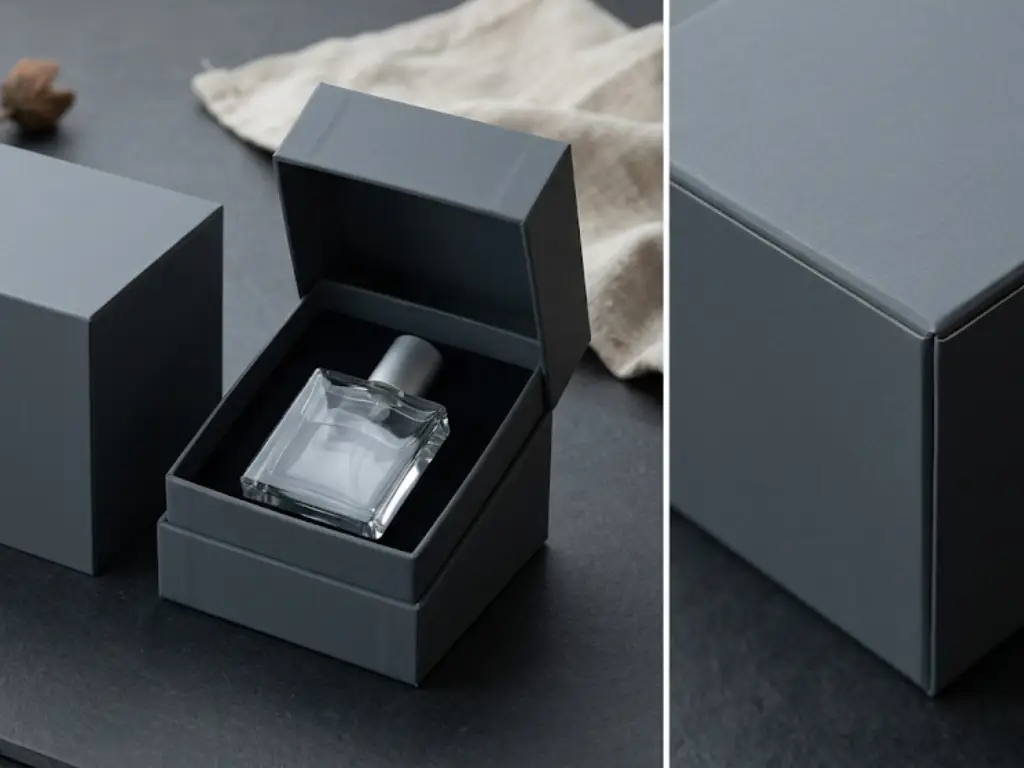
For high-end perfumery, standard folding cartons are unacceptable. The industry standard relies on Rigid Setup Boxes—specifically Top-and-Bottom (Telescope) boxes or Magnetic Closure designs. However, the secret to a true luxury box lies not just in the structure, but in the corner finishing.
Premium boxes utilize a technique called V-Grooving. Instead of using a standard half-cut crease which leaves a rounded, slightly bulky edge, a V-shaped blade removes a precise strip of the 1200gsm to 1500gsm heavy greyboard. When folded, this creates razor-sharp, flawless 90-degree corners. If you examine the packaging of a flagship smartphone or a designer watch, that crisp, mathematical edge is the result of V-groove machinery. Inferior boxes with rounded, blunt edges instantly signal a lower price point to the consumer before the box is even opened.
High-Density Inserts for ISTA Drop Test Compliance
The internal insert is your final line of defense against shattered glass. When a pallet of perfume is dropped during transit, the rigid box transfers the kinetic energy directly to the insert. If the insert lacks calculated buffering space, the glass will break. This must be validated using the ISTA 1A Drop Test standard (10 free-fall drops from specific heights and angles).
While EVA foam, standard sponge, and molded pulp are common, a severe warning must be issued regarding standard EVA: its abrasive microscopic surface can act like sandpaper during prolonged ocean freight vibrations, completely scratching off your bottle’s custom plating or silk-screen logos. If using basic EVA, it must be lined with a premium flocking layer.
To eliminate these risks entirely, industry leaders like Daxin integrate advanced, patented EPE (Expanded Polyethylene) buffer packaging as the inner tray. EPE offers vastly superior structural resilience, is waterproof, highly shock-absorbent, and completely dust-free. This innovative material solves the dreaded “glass tilting and shattering” issue, ensuring a 99.9% intact delivery rate and safeguarding your delicate surface finishes throughout the harshest global logistics chains.
Surface Finishing Resiliency and Visual Embellishments
While surface finishing fulfills the primary aesthetic desire of most brand founders, an engineering mindset must still dictate the execution. The goal is not just to make the design look beautiful on day one, but to ensure the color and metallization do not peel off on day one hundred after repeated exposure to human sweat and highly concentrated alcohol.
There are two primary methods for coloring glass: Vacuum Metallization (Electroplating) for a high-gloss metallic sheen, and Color Spraying for matte, glossy, or gradient finishes. The absolute truth in verifying the durability of these finishes is the 3M Cross-Cut Tape Test (ASTM D3359). If a factory’s hot-stamped logo or sprayed color easily flakes off when the adhesive tape is pulled, it will certainly degrade in the consumer’s hands, severely damaging brand equity.
A massive pain point in the modern B2B landscape is the intersection of environmental compliance and chemical resistance. Many manufacturers switch to basic eco-friendly water-based paints to pass EU VOC emission standards, only to discover these paints immediately dissolve when exposed to perfume alcohol. To combat this, elite manufacturers utilize a specialized alcohol-resistant water-based polyurethane emulsion combined with an isocyanate curing agent. This creates a highly cross-linked, dense protective film that easily passes strict EU environmental regulations while flawlessly surviving over 500 direct alcohol rub tests.
Bridging the Gap from 3D Renderings to Physical Tooling
One of the most expensive mistakes a brand can make is finalizing a beautiful 3D concept design without consulting a tooling engineer. The gap between a digital rendering and a physical steel mold is filled with strict physical constraints. Navigating this gap requires three critical milestones: 3D modeling, rapid prototyping (3D printing), and finally, steel mold cutting.
Designers frequently create bottles with perfectly vertical, 90-degree internal walls. However, in the reality of glass molding and plastic injection, a product with 90-degree walls cannot be extracted from the mold once it cools and hardens. Engineers must introduce a Draft Angle—usually between 1.5 to 3 degrees—allowing the hardened piece to slide out easily, much like greasing a baking pan to release a cake. Additionally, material Shrinkage Rates must be precisely calculated; glass and plastic shrink at different percentages as they cool. Skipping the 3D resin prototyping phase and rushing straight to steel tooling can result in tens of thousands of dollars wasted on a mold that produces defective, un-assemblable parts.

Decoding B2B Cost Structures and Minimum Order Quantities
Ultimately, every technical specification must align with your commercial reality. The fragrance packaging industry is notoriously opaque regarding pricing and Minimum Order Quantities (MOQ). Understanding the cost tier model allows you to allocate your capital efficiently, avoiding the trap of over-investing in custom tooling before your brand has achieved market validation.
Developing a completely custom “Private Mold” glass bottle typically requires an MOQ of 10,000 to 20,000 units. Furthermore, the tooling cost varies wildly depending on the material: while a glass bottle mold might cost around $1,000 to $1,500, a complex custom Zamac cap mold with multiple cavities can easily exceed $2,000. For mid-sized brands or startups, locking up massive amounts of cash in tooling and high MOQs is incredibly risky.
To balance product uniqueness with healthy cash flow, the smartest procurement strategy is to partner with a physical manufacturer that offers both a massive existing inventory and a transparent refund mechanism for custom work. Daxin Glass engineers strategic breakthroughs for brands in two distinct ways:
- The Agile Market Entry: Utilize Daxin’s extensive library of over 2,000+ ready-to-ship stock molds. By applying deep customization (like high-end silk screening or custom V-groove boxes) to a premium stock bottle, you can launch with a highly disruptive MOQ of just 1,000 units, with rapid global dispatch in just 7 to 10 days.
- The Risk-Free Custom Vision: For brands demanding a 100% exclusive silhouette, Daxin offers an incredibly transparent private tooling cost (typically only $1,000 – $1,200 for glass). More importantly, Daxin guarantees a full refund of the mold fee once cumulative orders reach 100,000 units, effectively reducing your long-term scaling and trial-and-error costs to zero.
Ready to bridge the gap between your design concept and flawless manufacturing?
Contact our engineering team today for a free 3D prototype review, or browse our 5,000+ stock catalog to launch your next bestseller.


 English
  Spanish
  French
  German
  Arabic
  Italian
  Dutch
Dutch  Portuguese
  Russian
  Korean
  Japanese