
Discovering that your expensive, signature fragrance is leaking is a moment of pure panic. Whether you are a fragrance collector watching a $300 bottle of niche perfume evaporate into thin air, or a brand owner facing a disastrous wave of customer returns due to supply chain packaging failures, a leaking perfume bottle is a crisis that demands immediate attention. Perfume is not just scented water; it is a volatile mixture of high-concentration ethanol and delicate essential oils. When the structural integrity of the bottle is compromised, every second counts.
This comprehensive guide is designed to bridge the gap between consumer emergency triage and professional industrial packaging engineering. We will start by helping you diagnose the exact source of your leak and provide highly specific, damage-free methods to salvage your remaining fragrance. Then, we will peel back the curtain on the fragrance manufacturing industry, revealing the hidden B2B supply chain blind spots—from microscopic glass tolerances to elastomer degradation—that cause these catastrophic leaks in the first place. Whether you need a temporary DIY fix or are searching for an uncompromising, leak-proof packaging supplier for your brand, here is the ultimate diagnostic and prevention protocol.
Crisis Assessment: Is Your Perfume Actually Leaking?
Before you attempt any invasive rescue procedures, you must first confirm that your bottle has suffered a genuine mechanical failure. Fragrances are highly sensitive to environmental factors, and what appears to be a leak might simply be a temporary physical reaction to temperature shifts.
- The Condensation Illusion: If your perfume was recently exposed to rapid temperature changes (such as being delivered on a freezing winter day and brought into a heated room), condensation can form on the glass and metal collar. Wipe the bottle completely dry with a microfiber cloth and let it sit at room temperature for 24 hours. If no further liquid appears, your seal is intact.
- The Ethanol Evaporation Test: Because perfume contains a high percentage of alcohol, it evaporates incredibly fast. A true leak rarely leaves a massive puddle; instead, it leaves a sticky, oily residue (the concentrated essential oils) around the neck or base of the pump. If your bottle feels constantly sticky to the touch and the room smells overwhelmingly of the fragrance even when not sprayed, you have a breached seal.
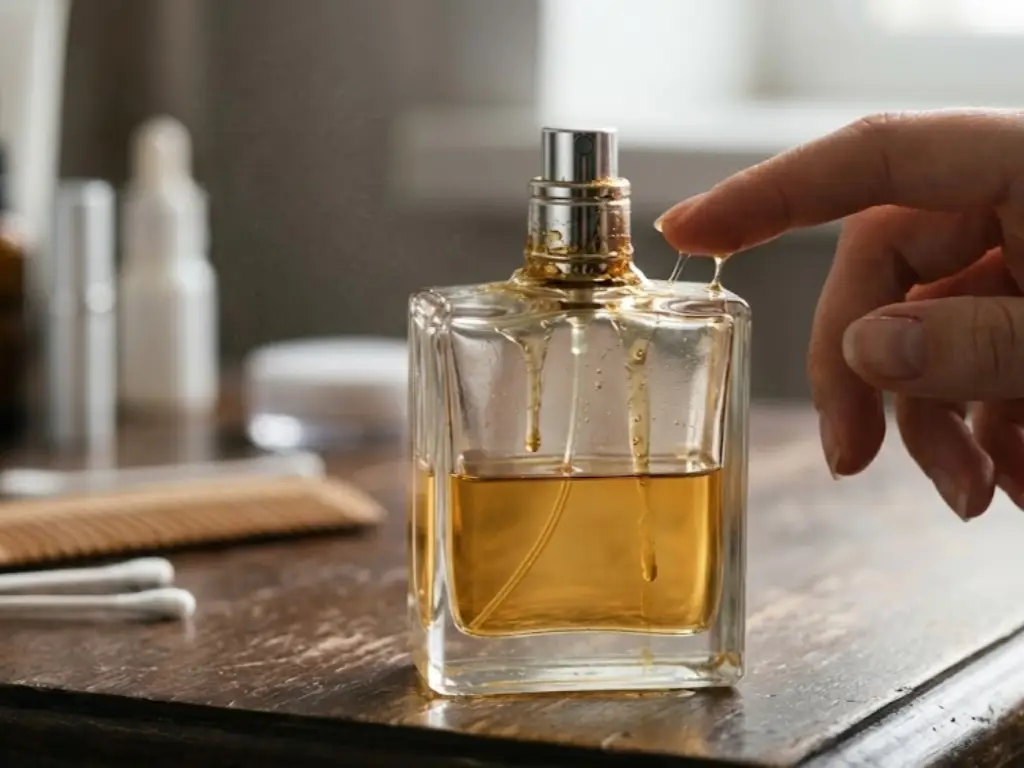
If you have confirmed a genuine leak, do not panic and do not aggressively shake the bottle. Move immediately to the diagnostic matrix below to locate the exact point of failure.
Visual Diagnostic Matrix: Locating the Exact Leak Source
Treating a leaking perfume bottle requires precision. Applying the wrong fix to the wrong part of the bottle will not only fail to stop the leak but can permanently destroy your fragrance. Let’s isolate the exact point of failure.
Nozzle and Actuator Dripping (Top Leak)
If the liquid is bubbling out from the very top of the spray head (the actuator) immediately after you press it, or if your fine mist has suddenly turned into a concentrated liquid stream that runs down the side of the bottle, you are experiencing a top leak. This is often a “false leak” regarding the bottle’s main seal.
The core issue here is usually a blockage in the actuator insert. The microscopic pathway inside the nozzle can become clogged with dried perfume oils or microscopic dust. When you press down, the liquid cannot escape through the intended micro-holes, causing back-pressure that forces the liquid to pool around the base of the spray button. To fix this, pull the plastic actuator cap straight off and soak it in warm water or high-proof rubbing alcohol to dissolve the hardened oils. Dry it completely before snapping it back on.
Neck and Crimp Collar Seepage (Base Leak)
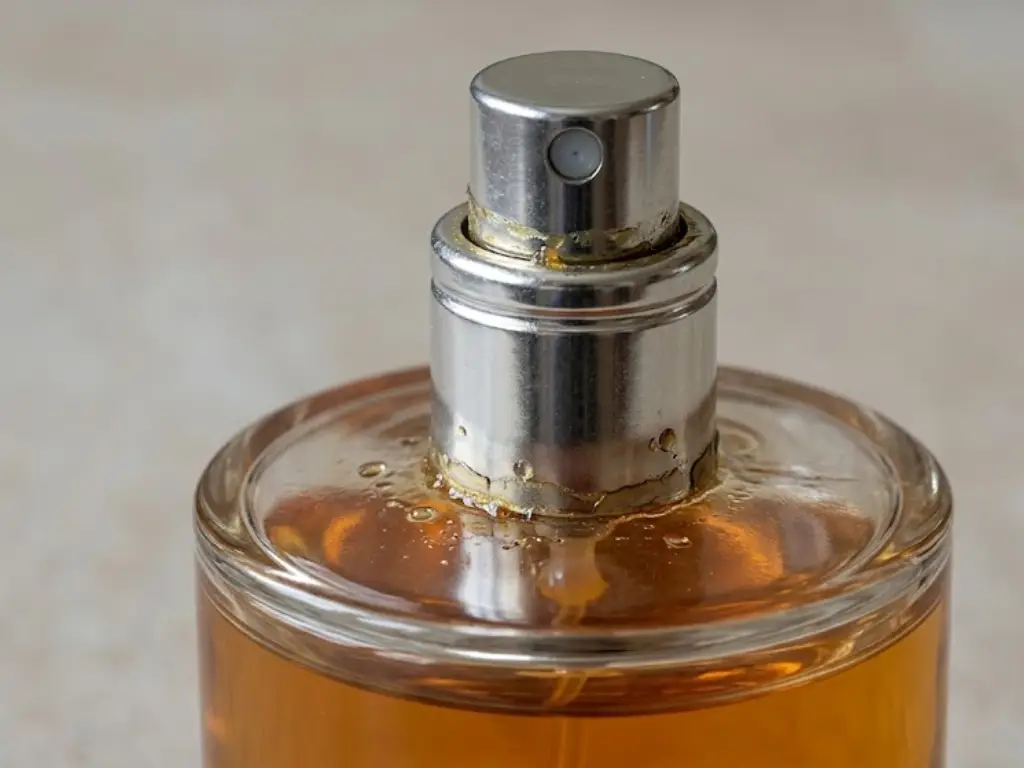
If the liquid is seeping from underneath the metal band that wraps around the glass neck of the bottle, you are facing a base leak. This is the most critical and fatal type of leak, indicating a failure of the primary sealing gasket or the mechanical attachment itself.
Your salvage strategy depends entirely on the type of neck your bottle uses. Here is how they differ:
| Feature | Screw-On Neck (Threaded) | Crimped Neck (Irreversible) |
|---|---|---|
| Mechanism | Twists onto glass threads, similar to a standard water bottle cap. | Aluminum collar is mechanically crushed (crimped) around the glass rim. |
| Common Usage | Niche perfumes, indie brands, travel atomizers, and sample vials. | 95% of commercial designer and luxury fragrances (FEA 15mm standard). |
| Fixability | Highly fixable. Can be unscrewed and resealed. | Unfixable. Once the crimp is compromised, the structure is destroyed. |
The Screw-Top Protocol: Temporary Fixes for Minor Leaks
If you are lucky enough to have a leaking perfume bottle with a screw-on threaded neck, you have the opportunity to rescue the bottle without transferring the liquid. However, standard household fixes will not withstand the highly corrosive nature of perfume alcohol.
The PTFE Tape Precision Wrap
The ultimate fix for a leaking screw-thread is industrial Polytetrafluoroethylene (PTFE) tape, commonly known as plumber’s tape. PTFE is completely chemically inert, meaning it will not dissolve in alcohol or contaminate your fragrance notes.
However, you cannot use it straight off the roll. Perfume threads are incredibly narrow, and wrapping a wide tape will jam the pump mechanism. Here is the precision protocol:
- Unscrew the pump entirely and wipe the glass threads clean with a dry tissue.
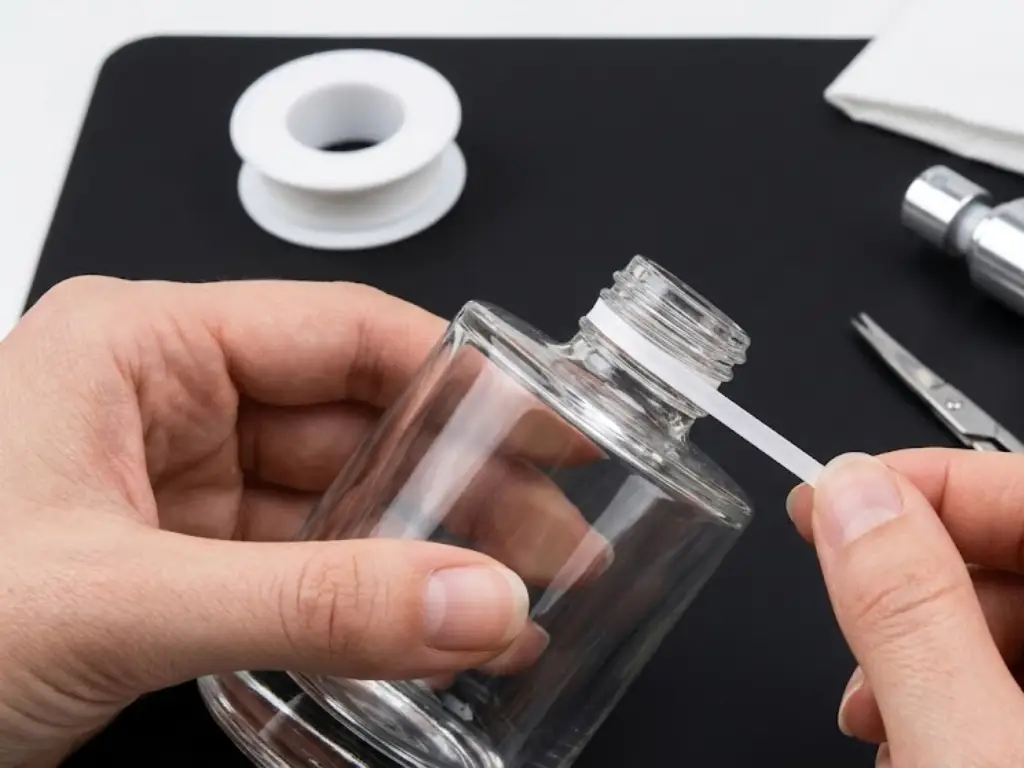
- Take your PTFE tape and use scissors to cut it longitudinally into a very narrow strip, exactly 3 to 5 millimeters wide.
- Holding the bottle firmly, wrap this micro-strip around the glass threads in a clockwise direction. Wrap it exactly two times—no more, no less. Over-wrapping will cause the plastic cap to crack under pressure.
- Carefully screw the pump back on. The tape will compress, filling in the microscopic manufacturing tolerances that caused the leak.
The Danger of Superglue and Sealants
A common and disastrous piece of internet advice is to use cyanoacrylate (superglue) or silicone sealants around a leaking collar. Do not ever do this. Chemical glues contain volatile organic compounds (VOCs) and solvents that will immediately react with the ethanol and delicate floral absolutes in your perfume. Even if the glue does not physically drip into the bottle, the chemical fumes will penetrate the seal, turning your luxury fragrance into a toxic, foul-smelling liquid. Furthermore, as the glue hardens, it loses elasticity, and the next time the bottle experiences a temperature shift, the seal will crack completely.
The Crimp-Pump Protocol: Decanting Without Oxidation
If your leaking bottle utilizes an aluminum crimped neck (as most designer fragrances do), you must accept a hard truth: you cannot fix the bottle. Trying to squeeze the metal collar with pliers will only warp the aluminum further and generate microscopic aluminum shavings that will fall into your fragrance and oxidize the essential oils. Your only goal now is safe, sanitary extraction.
Syringe Extraction & The Vacuum Lock Trap
The most professional way to save your fragrance is using a blunt-tip medical syringe. However, many people fail at this method because they do not understand the physics of a crimped bottle. The interior of a perfume bottle is a completely sealed system. If you attach a syringe to the plastic dip tube and simply pull the plunger, you will fight against a Vacuum Lock. The liquid will not budge because no air is entering to replace the volume of the extracted liquid.
To bypass the vacuum lock, you must use a specialized Extraction Adapter (a small plastic tip with side grooves that fits onto the syringe). Remove the spray button. Press the syringe with the adapter down firmly onto the exposed plastic valve stem. You must depress the valve stem to open the liquid pathway. As you slowly pull the plunger, gently rock the syringe slightly to allow a micro-amount of air to enter the grooves, breaking the vacuum lock. This allows you to draw the liquid up into the syringe without exposing it to open-air oxidation.
Bottom-Fill Atomizer Transfer
If using a syringe is too complex, the safest alternative is purchasing a high-quality bottom-fill travel atomizer. Remove the spray button from your leaking bottle, exposing the vertical stem. Align the valve at the bottom of the travel atomizer directly over the stem and pump vigorously. This acts like an aerial refueling mechanism, transferring the liquid directly from the broken vessel into the secure travel container without a single drop being exposed to the degrading effects of oxygen.
The B2B Blind Spot: Unmasking Supply Chain Leakage
While consumers struggle with syringes and tape, the real tragedy happens on a macro scale. When an independent fragrance brand experiences a 3% or 5% leakage return rate, it is rarely the fault of the end-user. It is a catastrophic failure within the B2B packaging supply chain. Let’s unmask the deeply technical reasons why mass leakages occur.
Bottleneck Tolerance & Crimping Mismatch
It is a massive industry misconception that leaks are solely caused by poorly calibrated crimping machines. In reality, the silent killer of perfume packaging is Bottleneck Tolerance. Even if a factory perfectly calibrates its crimping machine’s torque, if the glass bottles supplied are inconsistent, disaster strikes.
If the glass neck is even half a millimeter too thick, the crimping pressure will cause micro-fractures in the glass, leading to slow leaks. If the glass neck is too thin, the aluminum collar will not grip tightly enough, allowing air and liquid to bypass the seal. The solution lies entirely in the glass manufacturing process.
Top-tier packaging suppliers, such as Daxin Glass Bottles, eliminate this variable by upgrading from outdated cam-linkage cutting to Servo Motor gob cutting. This ensures that every single drop of molten glass is measured with an astonishing accuracy of ≤±0.5-1g. Furthermore, for small-mouth perfume bottles (≤30mm), utilizing the highly precise Blow-and-Blow manufacturing method guarantees uniform wall thickness and absolute precision in the neck dimensions. When the glass tolerance is virtually zero, the crimp seals flawlessly every single time.
Elastomer Degradation & Spring Failure
Another major blind spot for brand owners is chemical compatibility. Fragrance is a harsh solvent. If a procurement manager tries to cut costs by ordering spray pumps fitted with standard silicone gaskets, they are planting a time bomb. High-concentration ethanol and essential oils will soak into basic silicone, causing the elastomer to swell, warp, and eventually lose its elasticity. This creates the dreaded “delayed leak,” where the bottles pass initial factory inspection but begin leaking months later in a sweltering overseas warehouse.
Professional packaging requires highly inert elastomer selections, specifically Butyl Rubber or Viton (fluoropolymer elastomer), which aggressively resist chemical degradation. Furthermore, cheap pumps suffer from metal spring fatigue. If the internal spring weakens, the tiny glass ball valve inside the pump will fail to drop back into place rapidly after a spray, leaving a microscopic gap for liquid to slowly seep out under internal vapor pressure.
Industrial Prevention: The Anatomy of a Truly Leak-Proof Perfume Bottle
Whether you are launching a luxury fragrance line or looking to upgrade your existing packaging to stop bleeding revenue through customer returns, understanding the anatomy of a truly leak-proof vessel is non-negotiable. Building a brand takes years; losing a customer due to a soggy, ruined perfume box takes seconds.
Here is the ultimate industrial checklist that separates premium, failure-proof packaging from risky, low-end alternatives:
- Chemical Inertness & Thermal Stability: To ensure zero chemical reaction with delicate fragrance notes and absolute resistance to temperature-induced cracking, the glass formulation matters. Elite vessels demand Crystal White Glass with iron content strictly controlled to <0.8% for pure, diamond-like clarity. Crucially, the glass must be processed through a continuous annealing furnace with a precise gradient holding zone of 520°C~560°C for 1.5 to 2 hours. This entirely eliminates internal stress, preventing spontaneous thermal shock breakages.
- The Vacuum Quality Control Standard: A bottle should not be deemed ready for market unless it can survive the pressure shifts of a 30,000-foot cargo flight. Premium suppliers mandate strict pneumatic validation, subjecting finished assemblies to a rigorous -0.06 MPa vacuum pressure test for 3 minutes to guarantee zero micro-leaks.
- Zero-Waste Global Delivery Systems: A perfectly sealed bottle is useless if it micro-fractures during a turbulent sea freight journey. Standard 3-ply cardboard is insufficient. The gold standard for transit security involves 5-layer double-corrugated export cartons combined with patented, high-resilience EPE (Expanded Polyethylene) pearl cotton inner trays. This custom-slotted architecture absorbs severe kinetic impacts, preventing the glass-on-glass collisions that compromise structural integrity before the bottle even reaches the filling line.
A 3% leakage return rate does not just represent the double loss of expensive international shipping and ruined product value—it actively destroys the luxury brand reputation you have painstakingly built within your consumer community. Do not let compromised, low-tolerance packaging destroy your high-investment fragrance formulas.
If you are a brand owner or distributor looking for a supply chain partner capable of delivering packaging that passes the uncompromising -0.06 MPa vacuum test right out of the box, Daxin Glass Bottles is your solution. With a library of over 2,000 ready-to-ship mold designs, support for 30+ advanced decoration techniques (including eco-friendly low-VOC coatings), and an exceptionally accessible Minimum Order Quantity (MOQ) of just 1,000 units, you can elevate your product to world-class, leak-proof standards without the burden of excessive capital risk or custom tooling fees.
 English
  Spanish
  French
  German
  Arabic
  Italian
  Dutch
Dutch  Portuguese
  Russian
  Korean
  Japanese