
A candle maker pours soy wax into a jar stamped 8 oz and watches it stop more than an inch below the rim. Nothing leaked. The jar simply never held 8 oz of wax. The number on the bottom measures the space inside, not the weight of what you pour into it. That gap between the stamped number and the real fill is why jar sizing trips up buyers at every scale. It catches the first canning batch and the full product line alike.
This guide follows the decisions in order: what the numbers mean, what a jar really holds, and which sizes earn a place in a product line. The last section is the spec list to settle with a supplier before money moves. One note on scope: everything here covers wide-mouth glass jars. Narrow-neck bottles follow a different logic built around neck finishes and pumps, so the numbers below do not transfer.
What Glass Jar Sizes Actually Mean
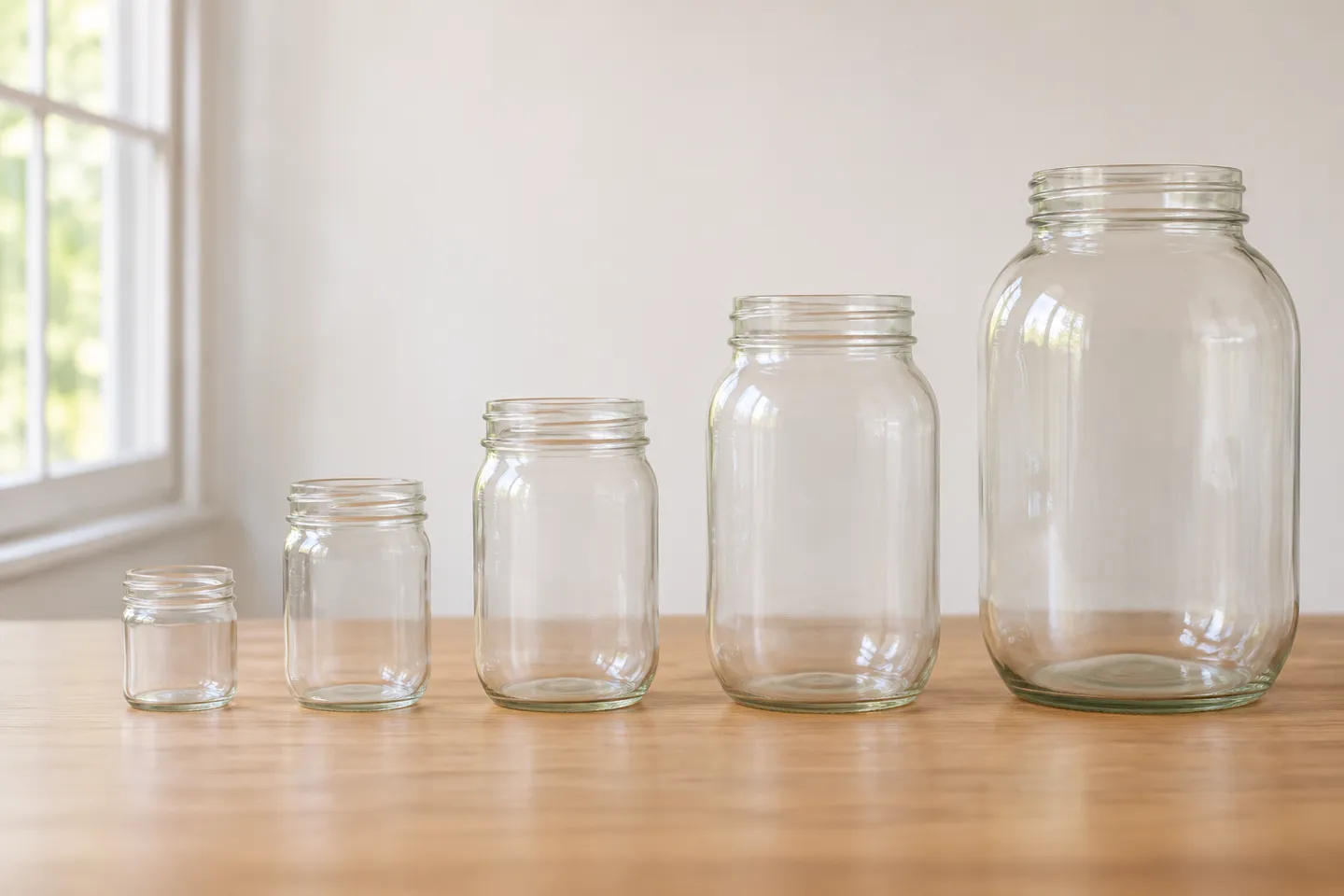
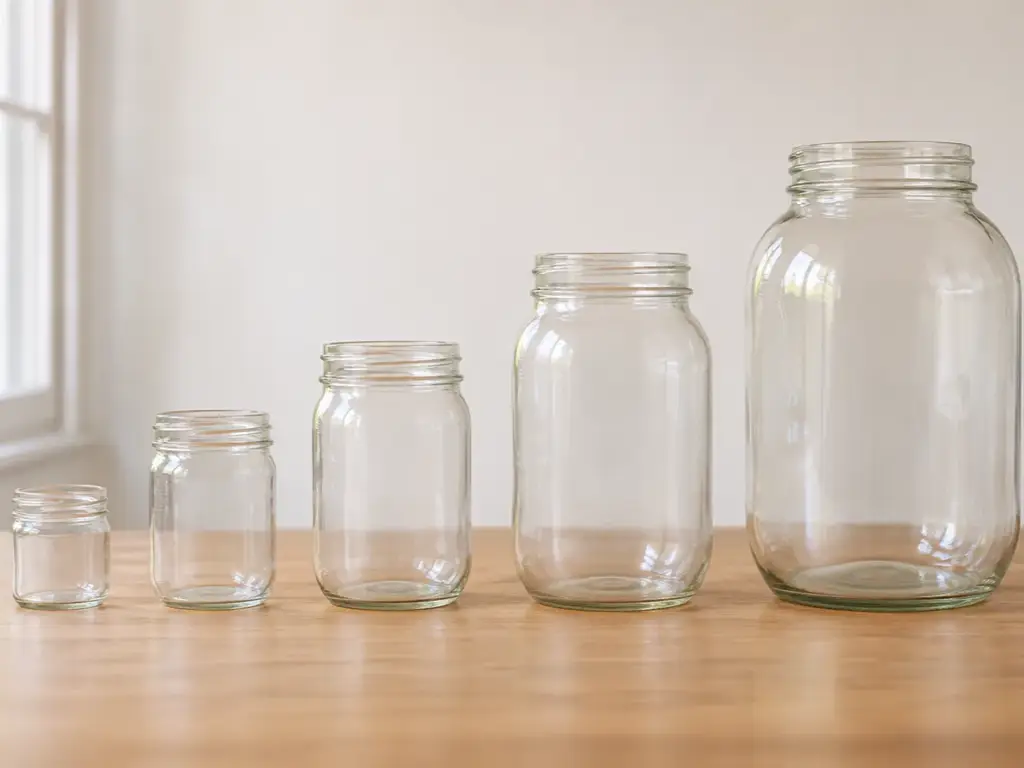
The ounce numbers on jars measure fluid volume, the same system used on beverage labels. The standard line-up runs 4, 8, 12, 16, 24, 32, and 64 oz TricorBraun. In milliliters that is roughly 118, 237, 355, 473, 710, 946, and 1,890 ml. Along that ladder sit the kitchen names: 8 oz is a half pint, 16 oz is a pint, 32 oz is a quart. Packaging catalogs list the same jars with neck finish codes such as 58-400, which is the threading standard that decides which lids fit.
Two things on the shelf use different naming systems, and mixing them causes most sizing confusion. Food and storage jars speak in ounces and milliliters. Cosmetic jars speak in grams, because the contents are dense creams rather than liquids. The ladder runs 5 g sample pots, then 15, 30, 50, 60, and up to 200 g for body products. The 30 g and 50 g sizes are the most common face-cream jars. A “50 g jar” and a “50 ml jar” are different objects with different diameters and closures.
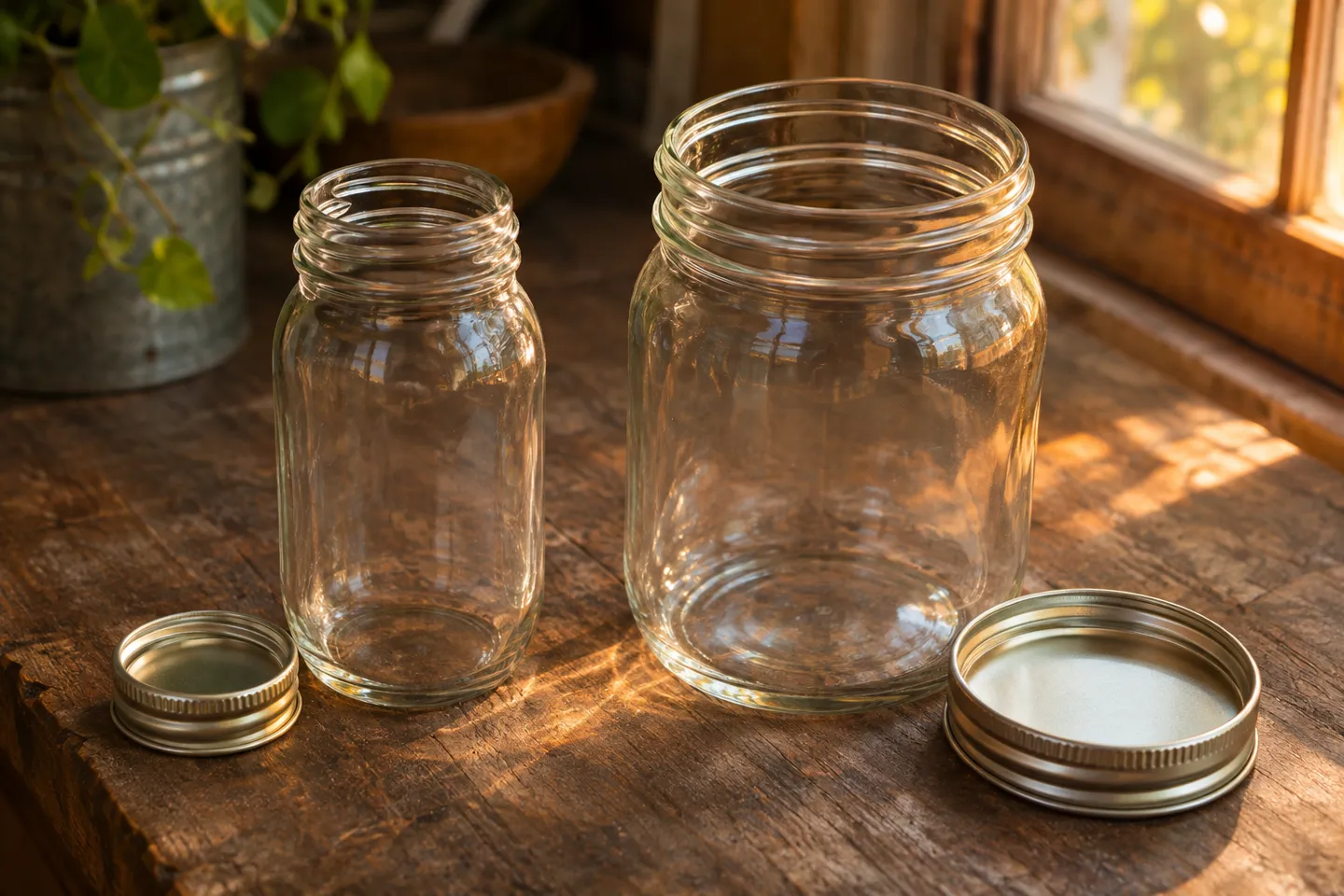
Mason jars add one more coordinate: mouth diameter. Regular mouth measures about 70 mm (2.75 inches) and wide mouth about 86 mm (3.38 inches) Daxin, mason jar specifications. That number matters more than it looks, because every lid, straw lid, and pour cap is built for one mouth family or the other. Buy jars in both families and your closure inventory doubles.
The three coordinates of a jar size
| Track | Typical sizes | Used for | Naming unit |
|---|---|---|---|
| Food and storage | 4/8/12/16/24/32/64 oz | Canning, honey, jam, pantry | Fluid oz (volume) |
| Cosmetic | 5/10/15/30/50/60/100/200 g | Creams, balms, scrubs | Grams (net weight) |
| Mouth families | Regular 70 mm, wide 86 mm | Closure matching | Millimeters |
Nominal Oz vs. Actual Fill: The Number on the Jar Is Not What You Pour
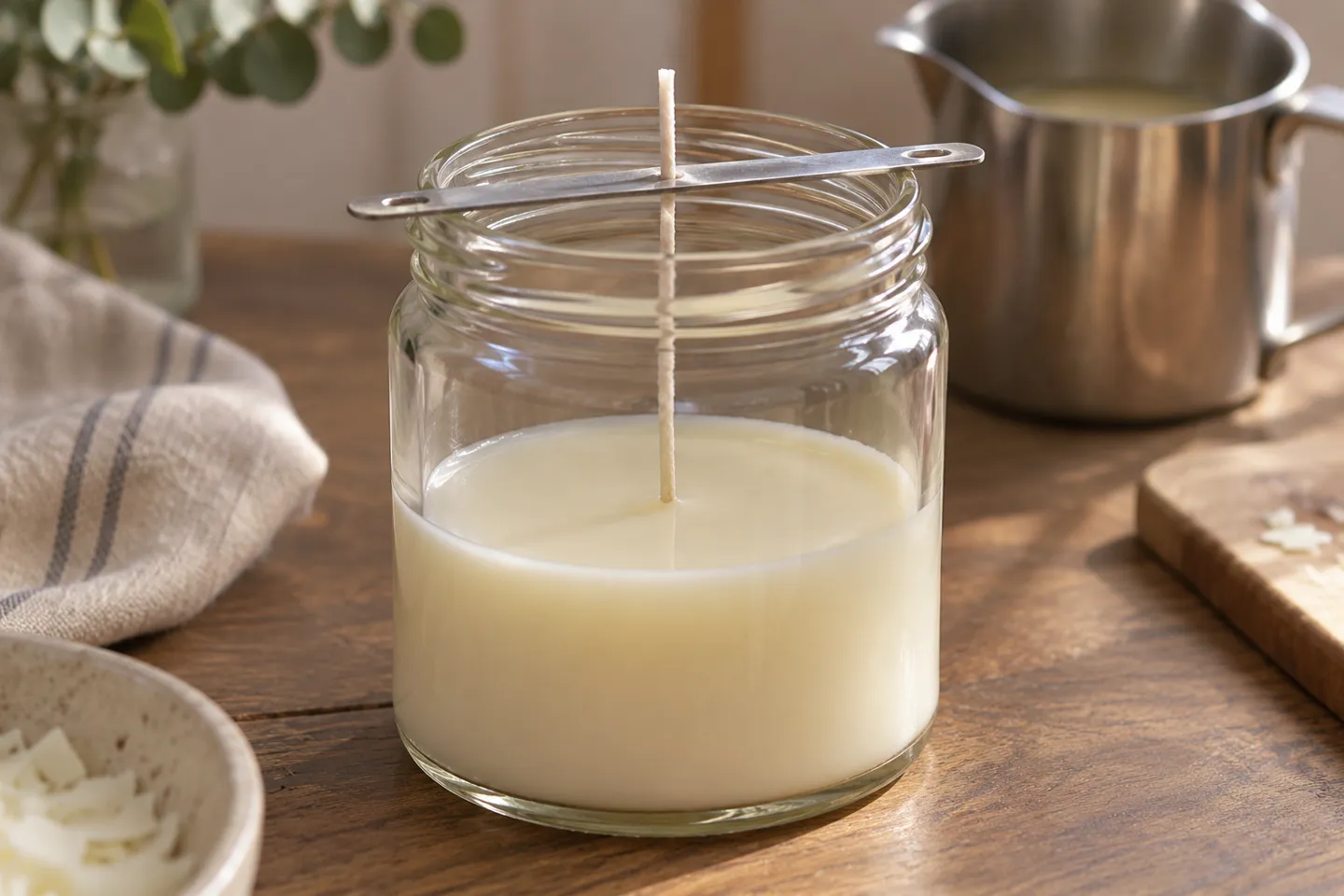
The stamped ounce is the geometric volume of the cavity, filled to the brim. Real production never fills to the brim. Wax leaves room for the wick tab and shrinks as it sets. Honey and jam leave headspace so the lid seals. Creams sit below the shoulder so the jar closes cleanly. Every one of those gaps comes out of the stamped number.
Why the Stamped Ounce Overstates Your Fill
Candle supply houses teach a working rule: multiply the jar’s fluid ounce volume by about 0.8 to get the wax weight it will actually hold. An 8 fl oz jar takes roughly 6.4 oz of wax by weight, and a 16 oz pint mason takes about 12.8 oz The Flaming Candle. The gap is physics, not sloppy pouring. Wax is lighter than water, and cure shrinkage eats another slice.
Tins widen the gap further. On the r/candlemaking forum, sellers report that “8 oz” tins sold for candle pouring hold only about 4 oz of real wax. The label there refers to overflow capacity r/candlemaking. Same stamped number, half the product.
The Label Law You Can Trip Over
If you sell the filled jar retail, the number that matters legally is the net quantity of contents. The Fair Packaging and Labeling Act requires that declaration, stated separately and accurately on the principal display panel eCFR, 16 CFR Part 500. The jar’s stamped volume never appears in that declaration. A candle in a nominal 8 oz jar is sold as a 6.4 oz candle; a honey jar sells by the net weight of honey inside. Sellers who print the container number on the label are declaring a quantity their product does not contain.
Label-law trip-wire: the label declares the net weight of the contents, never the jar’s stamped volume. An 8 oz candle jar ships as a 6.4 oz candle.
The workable habit costs one kitchen scale session: fill one jar the way production will, weigh the contents, and put that number on the label. Do it once per jar type, again whenever the jar or the recipe changes.
How to Spec a Jar by Fill, Not by Name
Flip the workflow and sizing stops being guesswork. Start from the net weight you intend to declare, add headspace for the closure, then pick the cavity volume that fits both. The Flaming Candle’s fill table makes the correspondence concrete The Flaming Candle. A 4 oz vessel holds about 3.2 oz of wax, an 8 oz jar about 6.4 oz, a 12 oz jar about 9.6 oz.
Same stamped size, different real fill
| Stamped size | Wax by weight (approx.) | Honey or jam (approx.) | Cream (approx.) |
|---|---|---|---|
| 4 oz / 120 ml | 3.2 oz wax | 3.7 oz by weight | n/a (cosmetic track uses grams) |
| 8 oz / 237 ml | 6.4 oz wax | 7.4 oz by weight | n/a |
| 12 oz / 355 ml | 9.6 oz wax | 11.1 oz by weight | n/a |
| 16 oz / 473 ml | 12.8 oz wax | 14.8 oz by weight | n/a |
| 30 g cosmetic jar | n/a | n/a | 30 g cream |
| 50 g cosmetic jar | n/a | n/a | 50 g cream |
Honey and jam figures assume density close to water with standard headspace; candle figures apply the 0.8 rule above. The column that matters is the one your product lives in, and the takeaway is uniform: the stamped number is a starting coordinate, never the spec.
The single fact worth remembering: a jar stamped 8 oz holds roughly 6.4 oz of wax by weight, and an “8 oz” tin can hold as little as 4 oz.
Diameter, Depth, Shape: The Geometry a Capacity Chart Won’t Tell You
Two jars with identical volume can behave completely differently in production, because capacity says nothing about the opening. Geometry decides whether a candle burns clean, whether a customer can reach the last of the cream, and how many units fit in a shipping carton.
Diameter is the loudest of the three. Wick makers rate wicks by the melt pool a flame must sustain. So a wide jar needs a bigger wick, or more of them, even when its volume is modest. The same supply-house guide gives the practical breakpoints The Flaming Candle. Jars of 4 to 6 oz run single small wicks, and 8 to 9 oz jars fit most single-wick recipes. At 12 to 16 oz, jars need double wicks plus a longer cure. A 16 oz wide-mouth mason at 3.9 inches of diameter is a two-wick vessel, full stop. Order it for a candle line without checking diameter and every pour becomes a tunneling complaint.
Depth does its damage quietly. A deep, narrow jar looks generous on a shelf and then earns one-star reviews because a brush or finger cannot reach the bottom third. The complaint shows up verbatim in retail threads: jars that are impossible to open, spatulas that never touch the product r/Sephora. For creams and balms, shallow and wide beats deep and slim at the same gram weight.
Shape decides logistics. Square and hexagon bodies pack tighter in a carton than round ones, which lowers freight per unit, but their flat panels shrink usable label area and embossing space. Hexagon honey jars in the 45 to 180 ml range trade exactly on this axis.
Geometry boundaries: where each shape fails
| Geometry | Works for | Fails when | Check before ordering |
|---|---|---|---|
| Narrow diameter single wick | 4 to 8 oz candles and samples | Diameter above ~3 in: melt pool never reaches the glass | Test burn one unit and confirm wick series against diameter |
| Wide diameter vessel | 12 to 16 oz candles with centerpiece looks | Single wick tunnels down the center | Spec double wick from the start and budget the longer cure |
| Deep narrow jar | Slim shelf footprint and tall silhouettes | Spatula or fingers cannot reach the bottom third | Ask for full height and inner mouth diameter and sample with product inside |
| Square or hexagon body | Dense carton packing and freight savings | Label and embossing area shrink | Request panel dimensions and a label mockup before tooling |
Building a Product Line: Which Sizes Are Worth Stocking
A product line is not a shelf of every available size. Sellers who do well converge on a small ladder: a small size that recruits buyers cheaply, a mid size that carries volume, and a large size that carries margin. The skill is picking the rungs with the unit economics visible, because size is a cost decision as much as a design one.
The Three-Size Line-Up Most Brands Land On
Festival and market sellers report the same pattern across seasons: the 4 oz and 8 oz candles move the most units r/candlemaking. Buyers lean small at markets and mid sizes for gifting. Small sizes lower the entry price and invite trial; the mid size is the reorder; the large size exists for margin and gift seasons. Three rungs cover it. More rungs split the reorder demand and bloat the closure and carton inventory.
Send your shortlist of sizes to Daxin and get MOQ tiers and quotes against in-stock molds.
Request Size QuotesCandle Line: 4 / 8 / 12 to 14 oz
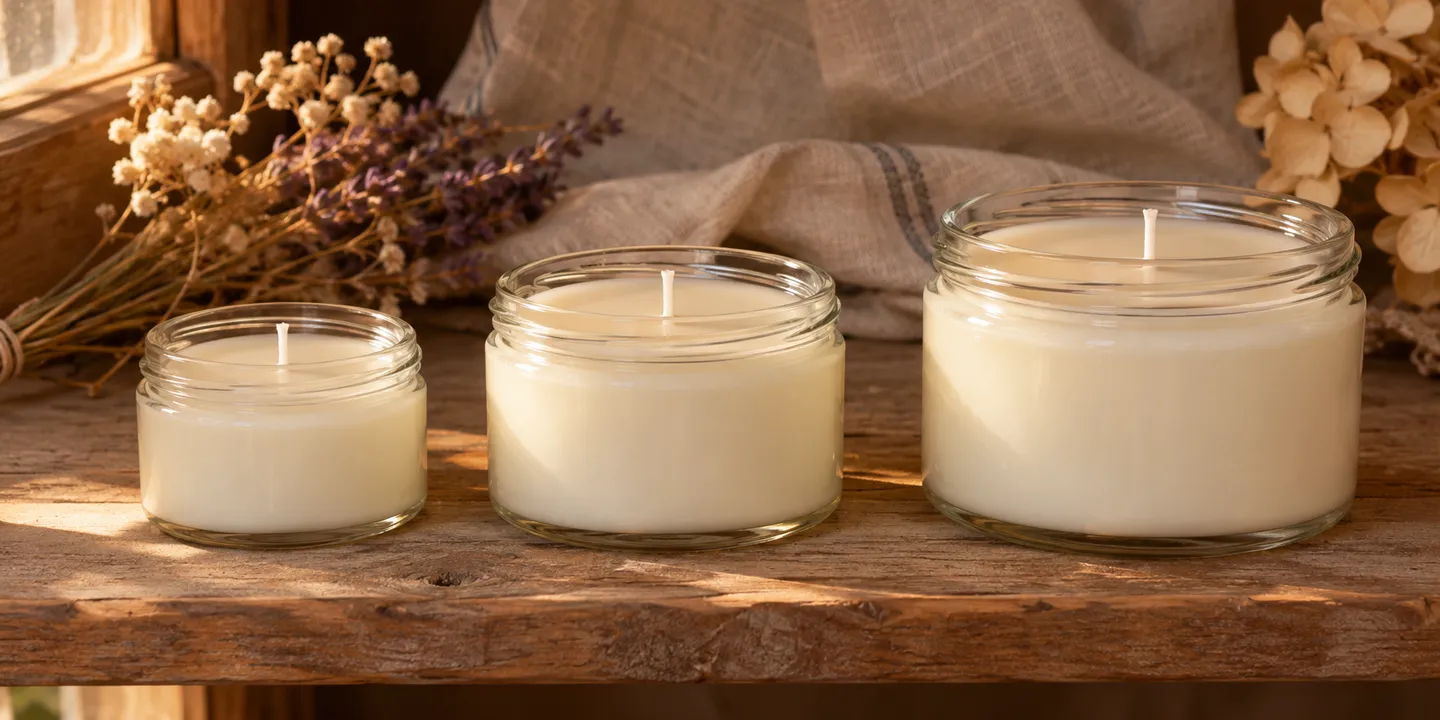
The ladder maps cleanly onto the wick economics from the last section. A 4 oz jar (about 3.2 oz of wax) is the trial size, single small wick, cheapest to ship. The 8 oz jar at roughly 6.4 oz of wax is the volume carrier, still single wick. Step up to a 12 to 14 oz jar and the geometry changes: wider diameter, double wick, longer cure. The labor per unit rises exactly when the price needs to justify it. That is why the large candle must be priced as a gift product, not a bigger version of the mid size.
Food and Honey Line: Start at 12 oz, Not Below
Beekeepers who sell by weight run the bluntest numbers on this. Packaging cost per ounce of honey climbs as jars shrink. The working advice from sellers is blunt: skip anything smaller than a 12 oz jar. Smaller packaging means a worse packaging-cost-to-honey ratio and more filling labor r/Beekeeping. The exception is a genuine gift product where the customer pays for presentation, an 8 oz hexagon at a gift price. Without that premium, small food jars lose money quietly, one unit at a time.
Cosmetic Jar Line: 30 g and 50 g Carry It
Cream brands work on a shorter ladder: 30 g as the standard face-cream size, 50 g as the value or body size. The 5 to 15 g pots are reserved for true samples and travel retail. The g track makes the net-content declaration trivial, which is why the cosmetic side never adopted ounces. A two-size core keeps closure and carton tooling cheap. Sample pots are a marketing expense, so they justify themselves only when they recruit repeat buyers of the 30 g.
The Unit-Economics Check
Three numbers decide whether a size earns its place in the line. First, packaging cost as a share of retail. A food-product jar above roughly 15 to 20 percent of shelf price turns the size into a gift item pretending to be a volume item. Second, minimum order quantity against cash flow. Custom tooling only pays back on big runs. Sellers describe the constraint plainly: custom jars make sense when you need a big run r/Entrepreneur. Stock molds with low MOQs are how brands test a size before committing to a mold. Third, the carton math. Amazon inbound cartons top out at 50 lb, about 22.7 kg, with maximum dimensions of 36 x 25 x 25 inches Amazon Seller Central. A heavy glass size that packs 24 per carton can fail the weight limit before the pallet is full. Run all three numbers per size before adding a rung.
Product-line size ladder by category
| Line | Entry size | Volume size | Margin size | Note |
|---|---|---|---|---|
| Candle | 4 oz (3.2 oz wax) | 8 oz (6.4 oz wax) | 12 to 14 oz double wick | Large size priced as gift |
| Honey and food | 12 oz minimum for volume | 16 oz pint | 8 oz hexagon only at gift pricing | Below 12 oz the packaging ratio fails |
| Cosmetic | 5 to 15 g samples | 30 g standard | 50 g value size | G track simplifies labeling |
The Spec Checklist to Settle Before You Commit
By this point the decisions have names and numbers, and they belong in the inquiry itself. Suppliers can only quote against what you actually specify, so the checklist below is the difference between a comparable quote and a guess. Confirm the items in order, because each one constrains the next.
First, mouth specification. State the family and the diameter in millimeters: regular 70 mm or wide 86 mm for mason formats. Request the matched closure list in the same line. A mouth off by 2 mm retires every lid you bought with it.
Second, nominal capacity with real tolerance. Ask for measured brimful and fill capacities, not just the stamped number, and lock the deviation you will accept. Third, geometry on paper. Outer diameter, total height, wall thickness, and label panel dimensions belong on a drawing, so labels and cartons get designed against measurements rather than photographs. Fourth, material and certification matched to contents. Food-contact glass should arrive with FDA or LFGB documentation, and candle vessels need a stated heat-safe rating. Fifth, the pack. Units per carton, carton dimensions, and gross weight: freight and channel limits live in those three numbers.
- Mouth and closure: diameter in mm plus the matched lid list, a 2 mm mismatch retires every lid
- Capacity tolerance: measured brimful and fill capacity plus the deviation you accept, skipping it puts labels off-spec across the batch
- Geometry drawing: outer diameter, total height, wall thickness, label panel size, so cartons and labels are designed against drawings
- Material and certs: FDA or LFGB documents for food contact, a stated heat-safe rating for candle vessels
- Carton and pack: units per carton, carton dimensions, gross weight, where freight and channel limits live
When you put an inquiry together against a real supplier’s range, this reads differently. Our own glass jar range is organized exactly this way, with in-stock molds listed alongside the MOQ and lead time tiers that apply to them in-stock jar MOQ and lead times. A checklist like the one above can be verified line by line before any deposit moves. Daxin runs roughly 2,000 in-stock jar and bottle designs our glass jar range. On those, the stock-tier minimum starts at 1,000 pieces, surface-finishing customization at 5,000, and full custom tooling at 10,000. The ladder maps directly onto the test-then-commit order of the product-line section above.
Sizing as a Buying Strategy
For distributors and wholesalers, the sizing logic above compounds into an inventory thesis. The same concentration that holds for a single brand holds across a resale assortment. Buyers reach for 4 oz and 8 oz candle vessels. They reach for 12 to 16 oz mason jars in both mouth families, and for 30 g and 50 g cream jars. Those are the rungs where shelf turns happen. A range built around the two mouth families, 70 mm and 86 mm, covers both closure worlds without doubling the closure inventory. That mouth-family logic, not category logic, is what should drive what sits in the warehouse.
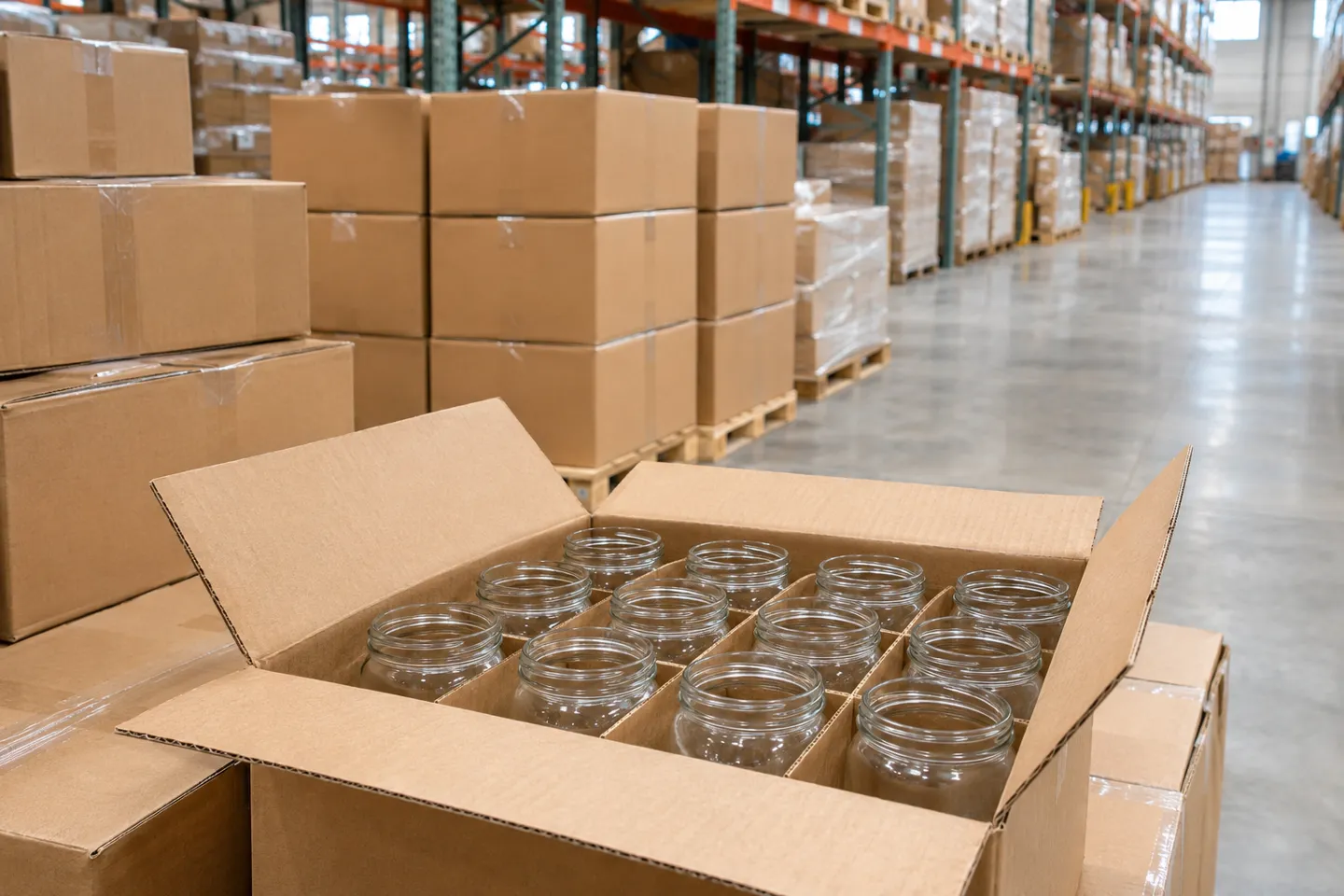
The MOQ ladder turns sizing into capital allocation. Stock-tier minimums around 1,000 pieces exist to test a rung cheaply. The 5,000-piece finishing tier is where a proven size gets a brand-specific color or coating. Full custom tooling at 10,000 and up is reserved for a size that has already sold through at least once. Treating the tiers in that order keeps the assortment experimental at the edges and boring in the middle, which is where the money is. The tier to resist is the small food jar below 12 oz. As a volume item its packaging ratio fails. As a price segment it attracts exactly the competition a wholesaler does not need.
Get a Size-True Quote Before You Order
Attach the spec checklist above (mouth, capacity tolerance, geometry, certifications, carton) and Daxin will quote against 2,000+ in-stock molds, from 1,000-piece stock tiers to full custom tooling.
Start Your Spec InquiryReferences
- eCFR. “16 CFR Part 500, Regulations Under Section 4 of the Fair Packaging and Labeling Act.” Current edition. https://www.ecfr.gov/current/title-16/chapter-I/subchapter-E/part-500
- Amazon Seller Central. “Shipping and Routing Requirements.” Accessed 2026. https://sellercentral.amazon.com/help/hub/reference/external/200141510
- r/candlemaking. “Marketing Candle Size Based on Wax Weight or Container.” 2023. https://www.reddit.com/r/candlemaking/comments/1857q2h/marketing_candle_size_based_on_wax_weight_or/
- r/candlemaking. “Sales and Candle Sizes.” 2022. https://www.reddit.com/r/candlemaking/comments/vuqemm/sales_and_candle_sizes/
- r/Beekeeping. “Most Profitable Size Bottle/Packaging and Pricing for Honey.” 2025. https://www.reddit.com/r/Beekeeping/comments/1ljhenm/most_profitable_size_bottlepackaging_and_pricing/
- r/Entrepreneur. “Seeking Advice on Cosmetics Packaging.” 2019. https://www.reddit.com/r/Entrepreneur/comments/b8p7l6/seeking_advice_on_cosmetics_packaging/
- r/Sephora. “Why Do So Few Companies Make Usable Packaging.” 2023. https://www.reddit.com/r/Sephora/comments/16nj36h/why_in_the_year_of_our_lord_2023_do_so_few/
 English
 Spanish
 French
 German
 Arabic
 Italian
 Dutch
 Portuguese
 Russian
 Korean
 Japanese