
The 8 oz straight-sided jar a candle brand fills in the morning and the hexagon jar a honey farm seals in the afternoon are both glass jars. In a factory, they are two different conversations: different molds, different mouths, and different glass batches. That gap is what this page sorts out.
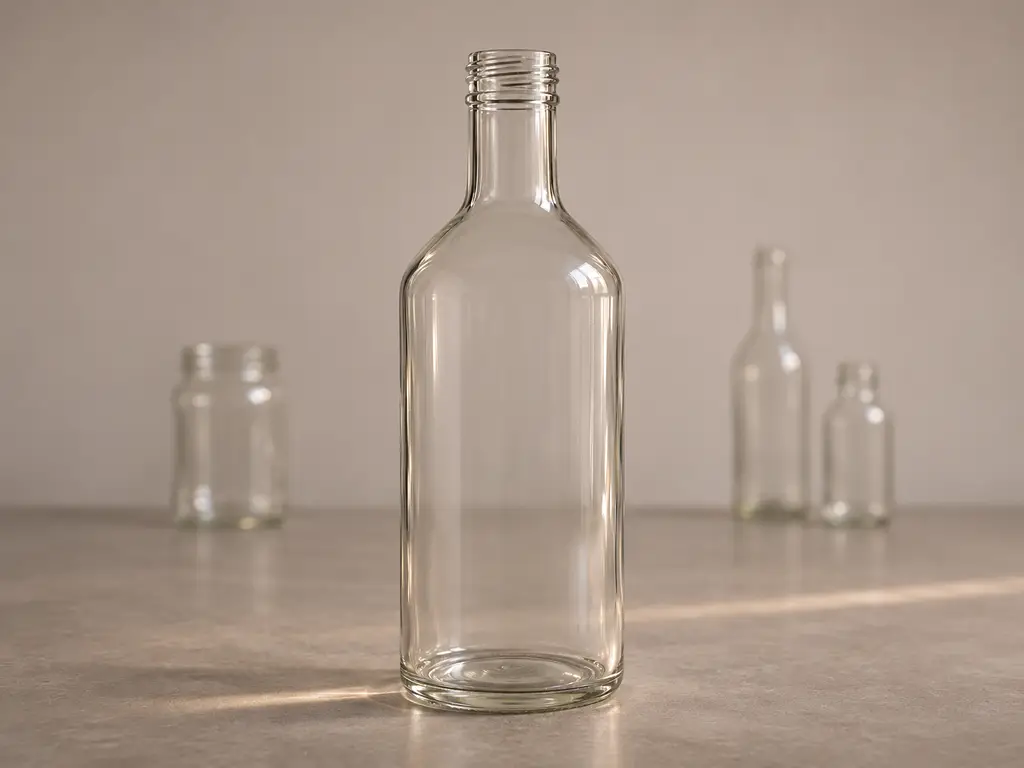
The line between a jar and a bottle comes down to the mouth. When the opening is nearly as wide as the body, you are holding a jar. When a narrow neck rises from the shoulder, it is a bottle, and it belongs to a different buying conversation. A wide-mouth beverage bottle blurs the edge slightly, but for sourcing purposes the mouth-to-body ratio is the test that matters.
Every jar is defined by three structural elements. First, the shape: the silhouette that decides how the jar sits on a shelf and how it fills. Second, the mouth and closure: the opening diameter and the lid system that either fits it or doesn’t. Third, the glass itself: the batch chemistry that decides how it handles heat and how clear it looks.
Those three elements do different jobs. Shape is a merchandising decision. The mouth is a compatibility decision. The glass type is a safety and clarity decision. Buyers who treat all three as one checkbox end up paying for the mistake twice: once in returned goods, once in replacements.
Keep the framework in mind as you read the families below. The same jar body with a different lid or a different glass batch is, for procurement purposes, a different product.
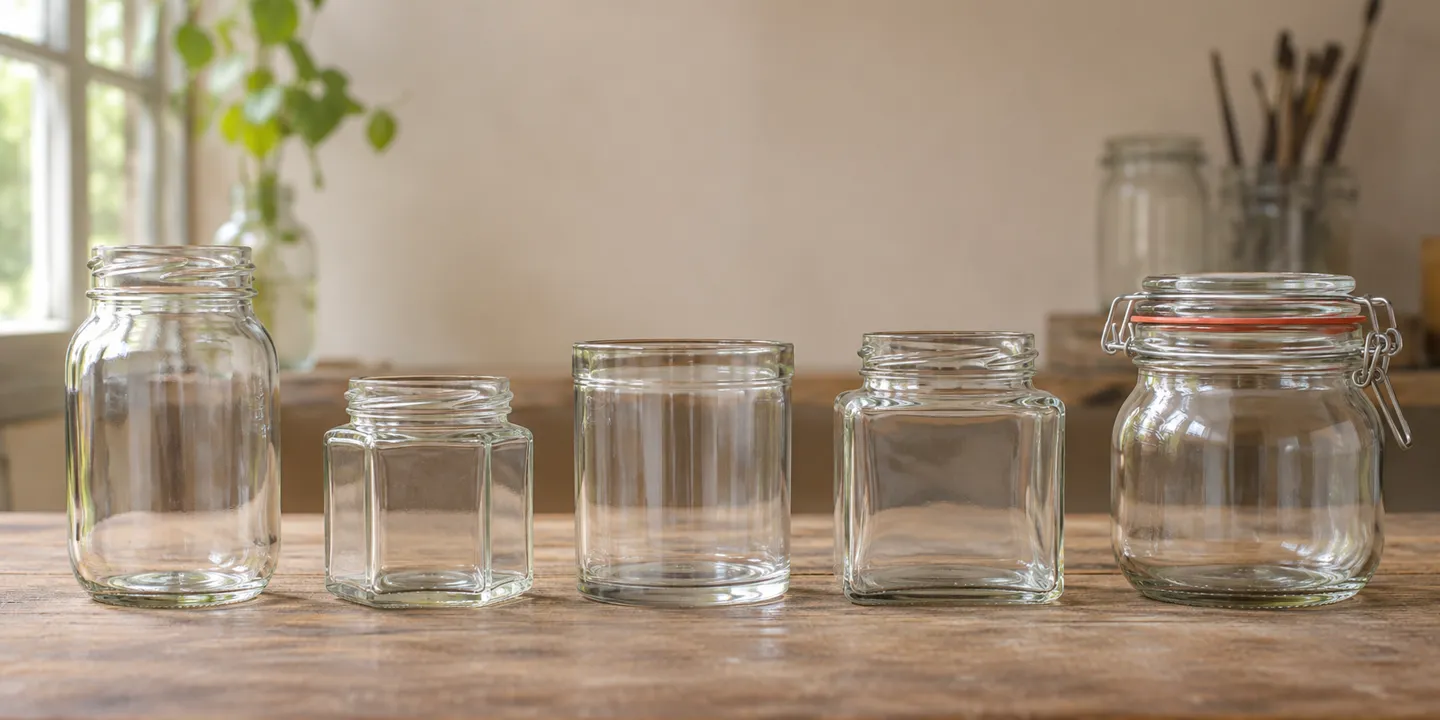
The Jar Shape Families You’ll Actually Meet
The names below are shared vocabulary. Distributors, brands, and factories use them daily, so knowing the families lets you read a catalog line and know what will arrive.
Jar Shape Families at a Glance
| Family | Structure in one line | Typical duty | Common capacity range |
|---|---|---|---|
| Mason (most common) | threaded mouth, visible screw rings, regular or wide opening | Canning, storage, rustic food lines | 4 oz to 32 oz |
| Straight-sided | cylindrical wall, flat shoulder, clean label panel | Candle vessels, creams, sauces | 4 oz to 16 oz |
| Paragon | tapered body, footed base, taller profile | Jams, sauces, premium food gifts | 8 oz to 16 oz |
| Hexagon | six flat panels, short and squat | Honey, jams, spice packs | 45 ml to 180 ml |
| Weck | glass lid, rubber gasket, steel clamps | Preserving, presentation storage | 50 ml to 1 L |
| Bail / Fido | hinged wire bail with gasket seal | Dry storage, fermenting | 500 ml to 2 L |
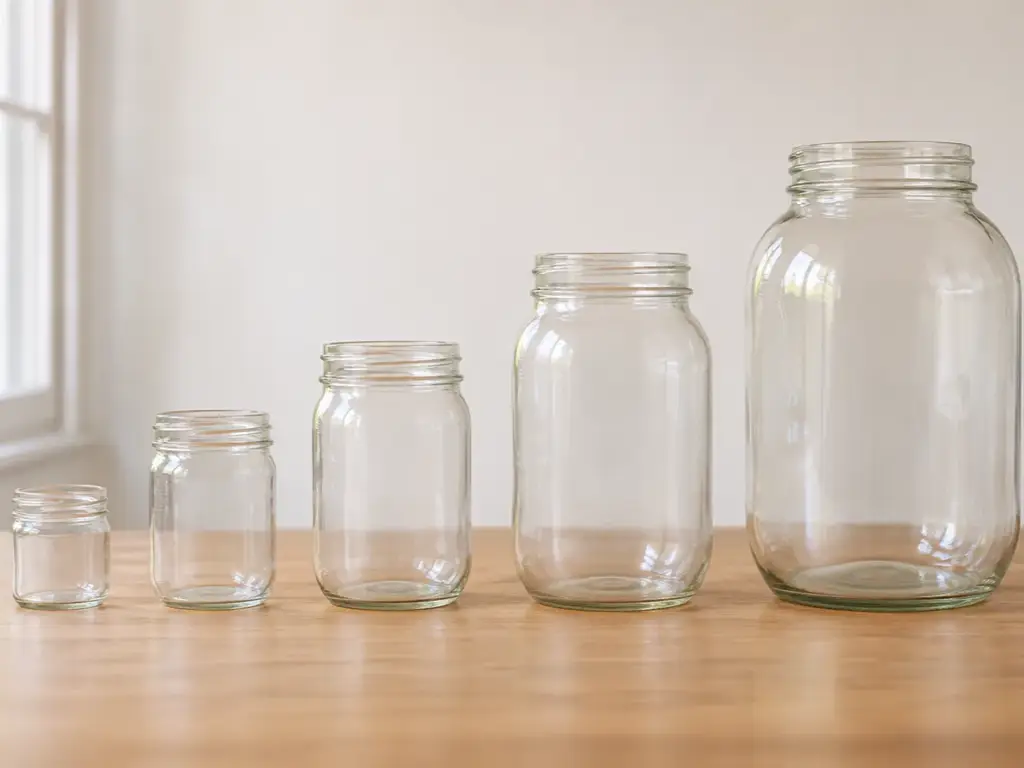
Mason jars are the most common family for one simple reason: the mouth became standard. Two openings dominate, and nearly every lid maker builds around them. That standardization is why a mason jar from one supplier can accept a lid from another, most of the time.
Hexagon jars are the bulk classic of the small-capacity world. The flat panels pack tightly in a carton, the shape reads “honey” to shoppers instantly, and the small volumes suit high-turn products.
Weck and bail jars solve sealing differently from everyone else. Instead of a threaded cap, a glass lid presses a rubber gasket down with steel clamps. The seal is excellent, the look is distinctive, and the gasket is a consumable part worth remembering.
A few names complete the map. Apothecary jars are tall display pieces with bulbous lids. Spice jars are small cylinders with shaker tops or narrow pours. French square jars have clean flat panels that label beautifully. Economy round jars are the plain, low-cost workhorses behind many private labels.
One caution before you order by name. Manufacturers disagree on the details behind shared names, especially paragon and straight-sided shoulders. The name starts the conversation; the drawing closes it.
Mouth Sizes and Closures: Why Lids Stop Fitting
A lid fails to fit for one boring reason: the mouth spec does not match. In the mason system, two openings dominate. Regular mouth runs about 70 mm (2.75 in), and wide mouth runs about 86 mm (3.38 in), which is how suppliers such as Daxin Glass publish their mason line. A lid built for one will sit loose or jam on the other.
Closure systems split into four common types. On top of the closure itself, retail food and cosmetic channels often want tamper-evident features, which change the lid specification again.
The four closure systems
Continuous thread
Screws down onto threads molded into the glass mouth.
Lug (twist-off)
Cap twists onto matching lug geometry; the classic food-canning close.
Bail clamp
Wire clamp pulls a lid onto a rubber gasket seal.
Snap-on
Plastic or metal cap presses over a sealing ring.
The mismatch failure is real and recurring. Candle makers importing canning jars have reported that Chinese-made jars run slightly off-size, so lids bought locally refuse to seat (r/candlemaking discussion, 2023). Nobody in that thread was careless. They ordered a “mason jar” and received a mason-shaped jar with a mouth a fraction off standard.
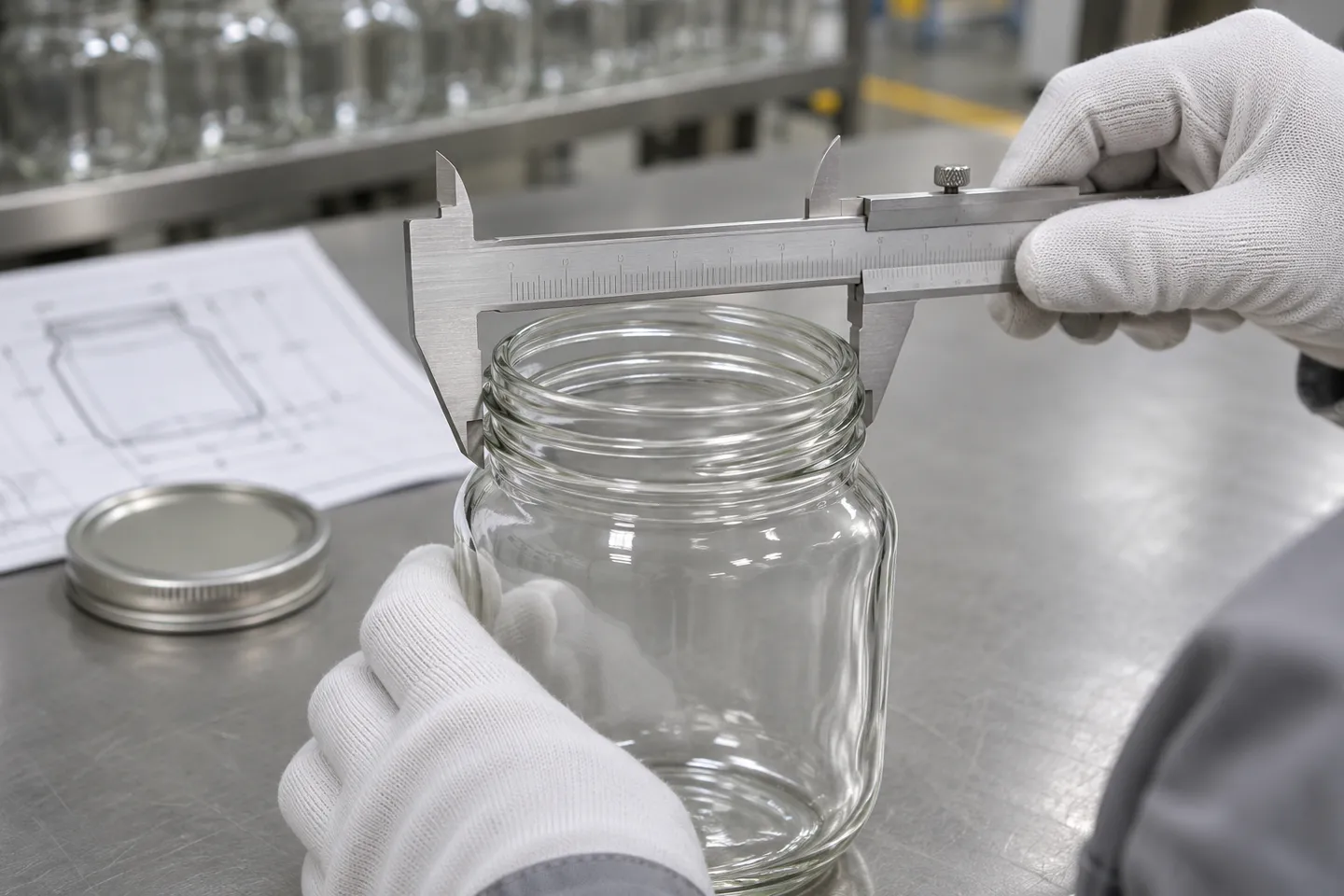
The fix costs nothing. Put three lines of spec on every jar purchase order: mouth diameter, closure type, and whether a gasket is included. Those three lines are the difference between a lid that seats on arrival and a pallet of jars that pairs with nothing.
Ordering “a mason jar” is not a spec. Write three lines on every jar PO: 1) mouth diameter (e.g., 70 mm regular or 86 mm wide), 2) closure type, 3) gasket included or not. Ask the supplier to confirm all three in writing against the drawing.
Glass Types, Annealing, and Thermal Shock
Shape and mouth decide whether a jar fits your product. The glass batch decides whether it survives it. Three answers cover almost every jar on the market.
Soda-Lime Glass: The Working Default
Most jars on store shelves are soda-lime glass. It forms efficiently, costs less, and its chemical stability handles normal food contact without trouble. Clarity within the family is a chemistry story: iron content tints glass green, so low-iron formulas produce the high-clarity “crystal white” look that premium jars use. The boundary is thermal. Soda-lime dislikes sudden temperature swings, and an unstressed jar tolerates far more than a stressed one.
Borosilicate: Where It Actually Earns Its Cost
Borosilicate expands less when heated, which is why laboratory glassware uses it. It shrugs off temperature deltas that would crack soda-lime, and it costs noticeably more. The honest boundary: commercial candle vessels are usually annealed soda-lime, not borosilicate. “Borosilicate means candle-safe” is marketing shorthand. What actually keeps a candle vessel intact is annealing quality and even wall thickness, which the next section covers.
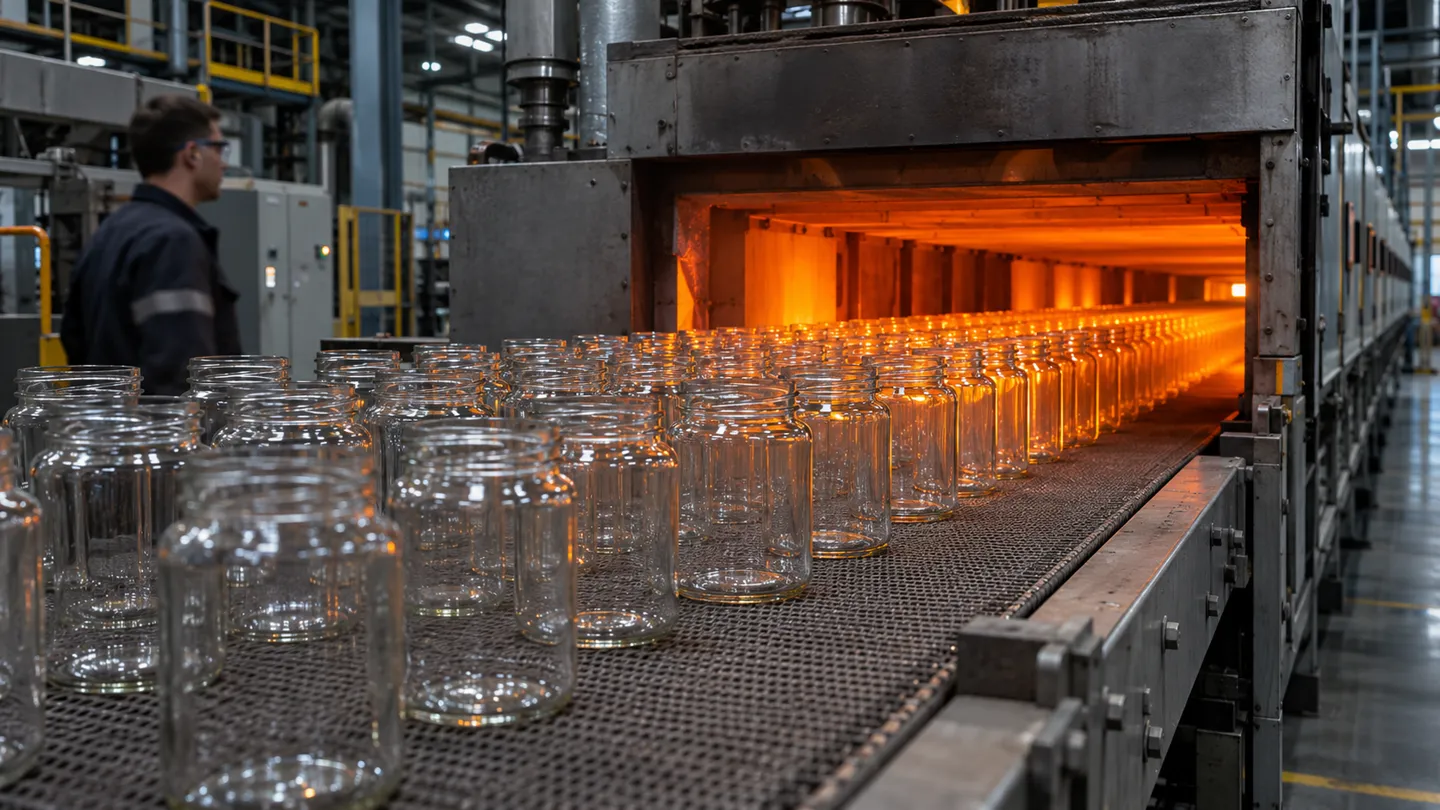
Annealing and Thermal Shock: What Happens When the Glass Cools Too Fast
Freshly formed glass comes out of the mold around 600 °C, full of locked-in stress. Annealing fixes that. The glass soaks near its annealing range, roughly 515-545 °C for soda-lime (Lehigh University glass processing lectures, 2015). Then it cools on a slow, stepped schedule over an hour or two.
The spec you cannot see
515-545 °C for 30-60 minutes
Glass holds that range long enough for internal stress to bleed out; a jar that never got the soak can crack the day you pour in boiling water.
The failure chain is short: residual stress plus a thermal gradient equals a crack. End users see it when a vessel cracks mid-burn, and makers trade prevention notes in maker forums (r/candlemaking on preventing jar breakage, 2025). The glass itself is rarely the villain; the stress left inside it is.
Thermal Boundary Matrix: What Each Glass Handles
| Glass / treatment | Fits | Fails | What to check before ordering |
|---|---|---|---|
| Annealed soda-lime | hot fill, candles, dishware-adjacent use | Boiling water, steady burning | Abrupt cold-to-hot shock, freezer-to-oven moves |
| Borosilicate | thermal cycling, premium storage | Repeated hot-cold cycles | Budgets that can’t absorb the cost premium |
| Low-iron soda-lime | display-first products, creams, gifting | Shelf clarity demands | Same thermal limits as standard soda-lime |
| Under-annealed glass (should be rejected) | nothing | Nothing, at any price | Thermal cracking in the field, returns, safety incidents |
Freezer storage follows the same physics with a simpler rule. Leave headspace for expansion, prefer wide mouths over narrow ones, and move jars between temperature zones slowly.
Acceptance actions before any thermal-use jar order: 1) ask how the annealing lehr is run (soak temperature, soak time, number of temperature zones), 2) request thermal shock test data, 3) run your own hot-water shock test on production samples, not just golden samples.
Matching Jars to Products: A Selection Map
The same six families sort into different duties once you put product inside them. Buyers match family to duty, not the other way around.
Candle Vessels
Straight-sided jars dominate the candle trade, with 4 oz to 15 oz as the working range. Suppliers such as Daxin Glass list live SKUs across exactly that spread, from single-wick 4 oz shooters to 15 oz three-wick formats. Whether a vessel is candle-grade comes down to annealing quality, wall thickness uniformity, and the mouth plus lid seal. The thermal acceptance actions from the previous section apply here in full, because a burning wick is a steady thermal load with local hot spots near the wick base.
Honey and Food Jars
Hexagon jars own the small-capacity honey trade, with live lines running 45 ml to 180 ml (Daxin Glass honey jar line). Wide-mouth rounds take the preserve and sauce duty at 8 oz and above. Food contact changes the requirement list: retail food packaging in the US and EU expects food-contact compliance such as FDA and LFGB certification. Mason lines advertise exactly those certifications for that reason (Daxin Glass mason line). Tamper-evident closures add a second layer of channel credibility once you sell through retail.
Locking specs for a honey or food line? Send Daxin Glass your capacities and closure needs, and get a quote with the matching food-contact certifications included.
Get a Food-Grade QuoteCream and Cosmetic Jars
Cosmetic creams run in small capacities, from 5 g sample jars to 200 g body sizes. Thick walls signal luxury, clarity sells the formula’s color story, and low-iron glass earns its cost here more than anywhere. Tamper-evident seals matter again, and small accessories such as metal spoons or spatulas often ship as part of the jar assembly.
Dry Storage Jars
Storage jars run from 16 oz to 32 oz and beyond. The closure does the heavy lifting: bail closures with gaskets for pantry display, screw lids with sealing rings for stackable kitchen use. The freezer boundary from the thermal section applies to anything headed for cold storage.
Selection Map by Application
| Application | Jar family | Capacity range | Specs to lock | Certification angle |
|---|---|---|---|---|
| Candles | Straight-sided, square | 4-15 oz | Annealing data, wall uniformity, mouth + lid seal | Market-dependent (candles are not food-contact) |
| Honey & food | Hexagon, wide-mouth round | 45-180 ml, 8 oz+ | Mouth spec, gasket, tamper-evident option | FDA / LFGB food contact |
| Creams & cosmetics | Thick-wall low-flint | 5-200 g | Clarity (iron content), seal, accessory fit | Cosmetic safety norms per market |
| Dry storage | Bail, screw + gasket | 16-32 oz+ | Closure type, gasket material, freezer headspace | Usually none (dry goods) |
One more decision sits inside every line on that table: how you buy. Stock purchases start around a 1,000-piece MOQ with roughly 5-10 day dispatch. Light customization (finishing and printing) runs around 5,000 pieces. Full custom molds start near 10,000 pieces. These tiers follow published supplier terms (Daxin Glass); confirm current figures with your supplier. Production runs typically quote 25-40 days, molds about 10 days, and 3D samples about 15 days. That structure, not the jar shape, decides your landed cost per unit.
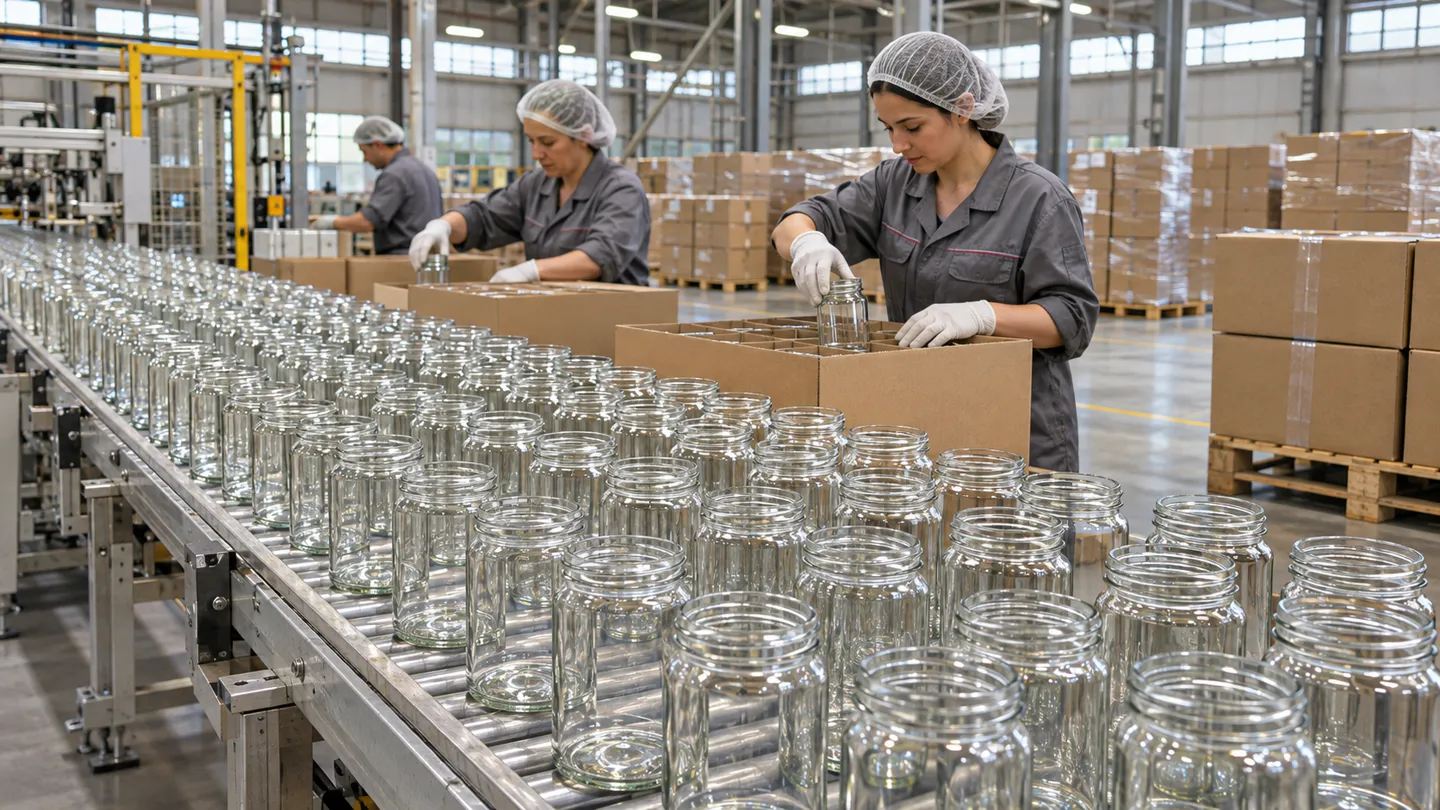
Building an Assortment That Holds Its Margin
Read the families above again as a channel buyer, and a pattern appears. Mason, hexagon, and economy round are public vocabulary with public catalogs, which means anyone can quote them and the price gap between quotes collapses.
What does not commoditize is the engineering wrapped around the jar. A locked mouth spec with a guaranteed lid fit, documented annealing data, food-contact certification, and custom decoration all require capability, not just a catalog. Those are the parts of a jar a price list cannot copy.
That split suggests how to structure the assortment. Volume lines use standard families to hold traffic and fight on price. Margin lines use differentiated jars: verified annealing for candle vessels, certified food contact for honey and sauces, low-iron clarity for cosmetics, custom finishes for brand identity. Tilt inventory toward the margin lines, because that is where the price gap survives.
Screening suppliers fits in three questions. How is the annealing lehr run? Can you produce certification documents? What is the sampling inspection rate on finished batches? A supplier who answers all three in specifics is worth a higher quote; one who answers none of them is competing on price alone, for a reason.
Price competition itself is not the mistake. Volume SKUs should fight on price, and loading every SKU with full compliance weight kills their job. The margin logic also has a boundary: in pure low-price, fast-turn categories, the engineering premium never recovers, so keep those SKUs standard.
The demand side makes the category worth structuring. Grand View Research values the global candle market at USD 14.8 billion in 2025 and projects USD 25.4 billion by 2033, a 7.3% CAGR (Grand View Research, 2026). Home fragrance keeps feeding the same vessels, and jars sit at the base of that demand. The assortment decision repeats with every season’s lineup.
Assortment Structure: Volume Line vs Margin Line
| Volume line | Margin line | |
|---|---|---|
| Role | traffic and price fight | Margin and differentiation |
| Jar choice | standard families (mason, hexagon, economy round) | Engineering-backed SKUs (verified annealing, certification, low-iron clarity, custom finishing) |
| You compete on | catalog price and availability | Specs, documents, and brand fit |
| Risk | margin erosion when quotes converge | Higher unit cost, slower turns if demand is thin |
Send Your Jar Spec Sheet for a Quote
Daxin Glass lists 2,000+ stock jar and bottle designs with a 1,000-piece in-stock MOQ and about a 10-day mold turnaround.
Request a QuoteReferences
- Grand View Research. “Candle Market Size, Share & Trends Report.” 2026. https://www.grandviewresearch.com/industry-analysis/candles-market
- M. Hubert / Lehigh University IMI-NFG. “Annealing and Tempering, Glass Processing Course Lecture 9.” 2015. https://www.lehigh.edu/imi/teched/GlassProcess/Lectures/Lecture09_Hubert_Annealing%20and%20Tempering.pdf
- r/candlemaking. “Where Do You Buy Your Vessels?” Reddit, 2023. https://www.reddit.com/r/candlemaking/comments/17elocn/where_do_you_buy_your_vessels/
- r/candlemaking. “How to Prevent Candle Jars from Breaking?” Reddit, 2025. https://www.reddit.com/r/candlemaking/comments/1p56jq0/how_to_prevent_candle_jars_from_breaking/

 English
 Spanish
 French
 German
 Arabic
 Italian
 Dutch
 Portuguese
 Russian
 Korean
 Japanese